
AI romance movie stills
A cinematic romance workflow for AI stills: intimate blocking, a soft motivated two-shot, negative space and six scene briefs that avoid the wedding-photo look.
What makes a romance still?
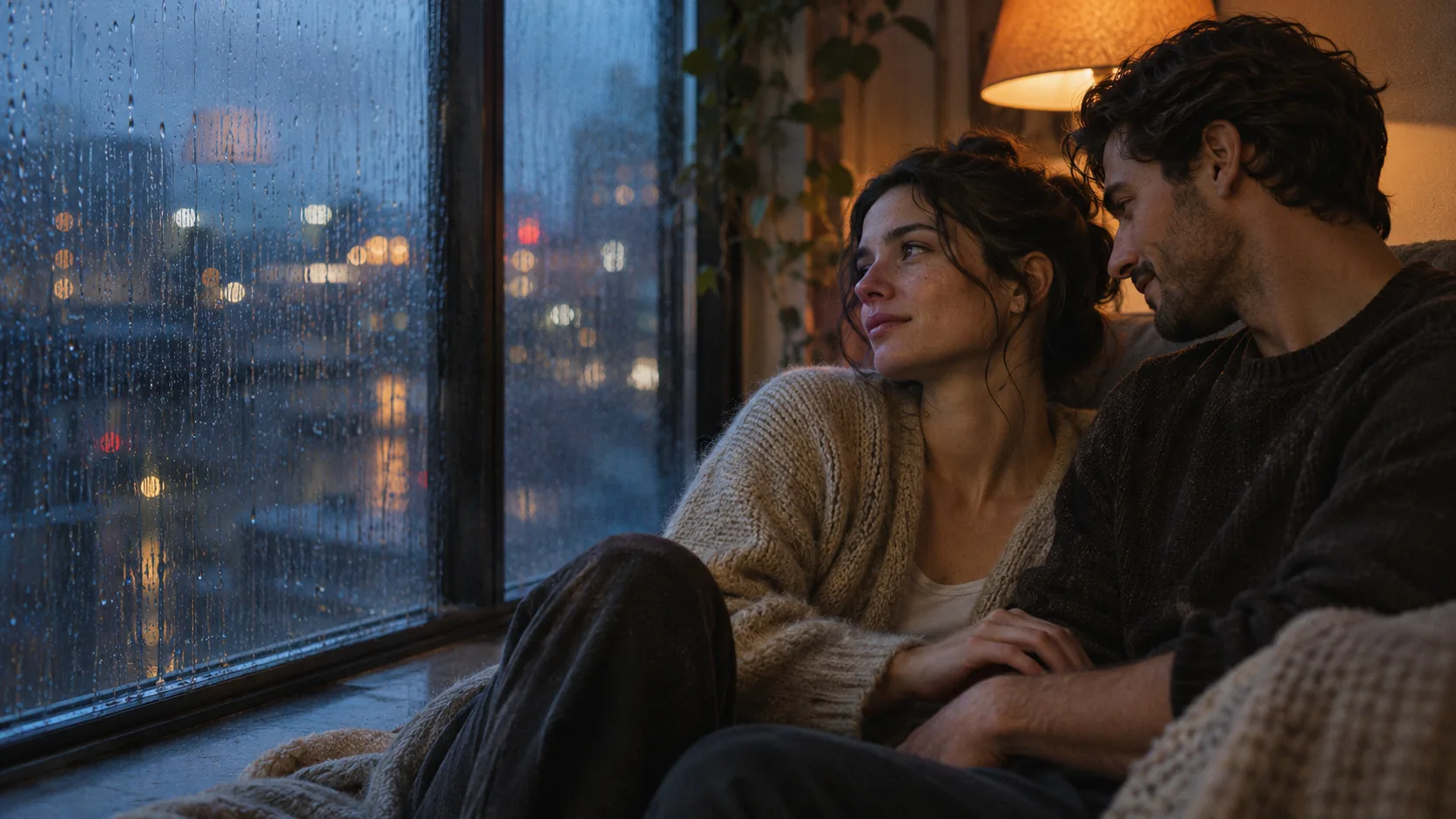
A romance still is about proximity, not decoration. The frame should feel like a moment between two people rather than a portrait of a couple. Hands, eyelines, the space between bodies and the light that falls between them matter more than a sunset or a bouquet.
The genre reads through intimacy: a two-shot, a shared object, an almost-touch, a look that is not for the camera. The composition guide covers negative space and eyeline; this page applies those controls to romantic tension.
Soul Cinema renders the still. The sequence — the same couple, wardrobe, palette and light — is what makes the frames feel like one story.
How do you stage intimacy without a posed portrait?
Give both people something to do. One pours coffee, one reads, one looks out the window while the other watches. Put them on different planes: one foreground, one background, one seated, one standing. The asymmetry makes the frame feel observed rather than arranged.
Avoid having both people look at the camera. Let one look away, or let both look at the same off-screen thing. The viewer should feel like they entered a moment already in progress, not like they were invited to a photo shoot.
The almost-touch is the genre’s most reliable gesture. Two hands on a table, a coat sleeve brushing a wrist, one person reaching for a cup while the other watches: the frame should end before the touch lands. That gap is what makes the next frame matter. If every frame is a kiss or an embrace, the sequence has no room to build.
- Give each person a small action.
- Put them on different depth planes.
- Let one look away or at the same off-screen thing.
- Use hands and shared objects to connect them.
- Keep the framing asymmetric.
- No direct address to camera.
How do you light a two-shot?
Use one soft motivated source: a window, a table lamp, a doorway, a screen. The light should fall between the two faces and keep both readable. A warm practical on one side and a cool window on the other gives the frame a relationship without a filter.
Keep the fill gentle. Romance does not need the hard contrast of noir or the deep shadow of horror; it needs softness with direction. The background can fall away, but the faces should not become plastic or evenly lit.
- One soft motivated source.
- Warm practical plus cool window for balance.
- Both faces readable, neither plastic.
- Gentle fill, not flat light.
- Background falls away softly.
- Shallow depth of field, but keep the gesture readable.
How do you use negative space and eyeline?
Put space where the look goes. If one person is looking at the other, leave space around the person being looked at; if both are looking out a window, leave space beyond the glass. Negative space is the room the relationship has to breathe.
Use the gap between bodies as a third character. An almost-touch is stronger than a kiss because the gap holds the tension. If the hands are about to meet, let the frame end before they do.
- Space in the direction of the gaze.
- A visible gap between bodies.
- An almost-touch instead of a full embrace.
- A shared off-screen object or view.
- One quiet area for the eye to rest.
- Do not center both faces symmetrically unless the symmetry is the point.
How do you avoid the wedding-photo look?
The wedding-photo look comes from perfect posing, even light, a white dress and a shallow blur with no story. Replace it with film-still logic: asymmetric blocking, a real location, a small action, motivated light and a frame that implies a before and after.
Avoid rings, bouquets, veils and formal portraits unless the story is actually a wedding. A couple in a kitchen at 2 a.m. is more cinematic than a couple on a cliff at sunset if the kitchen has a real moment in it.
- No formal posing or direct address.
- No white dress, veil or ring close-up by default.
- A real location with lived-in detail.
- A small action and an implied before/after.
- Motivated light, not a global soft-focus glow.
- A frame that tells a story, not a celebration.
Which six romance scenes should you brief?
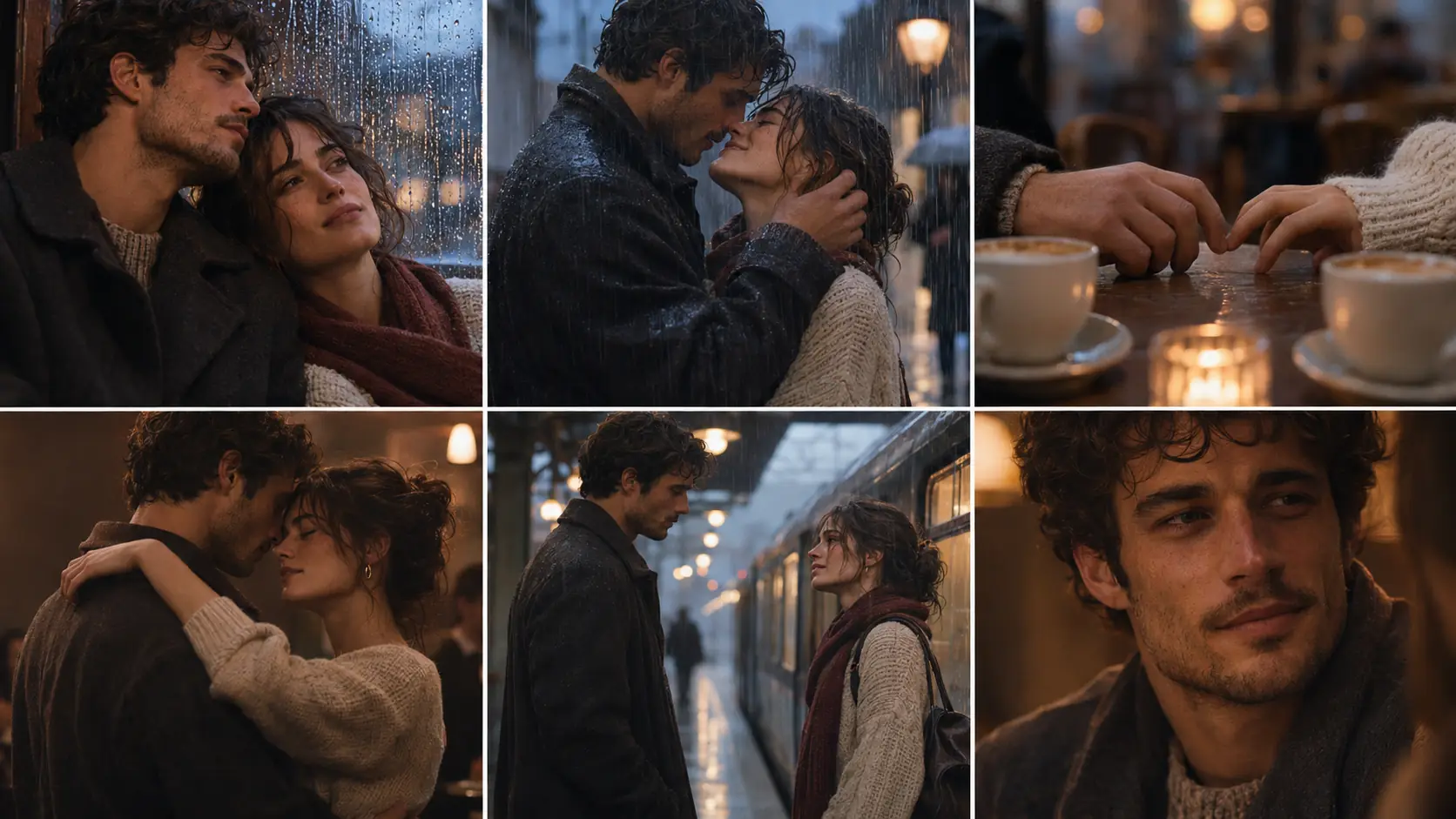
Six scenes cover the genre’s visual spine: the two-shot at a window, the rain embrace, the almost-touch hands, the dance, the goodbye platform and the close-up. Each scene isolates a different signal — proximity, weather, touch, movement, separation and the face.
| Scene | Light | Lens | Prompt anchor |
|---|---|---|---|
| Two-shot at a window | Soft lamp inside, cool blue window outside. | 50mm, medium. | Couple on the right third, rain on glass, city bokeh. |
| Rain embrace | Streetlamp and wet reflections. | 35mm, medium wide. | Embrace in light rain, coats dark, faces close. |
| Almost-touch hands | Warm table lamp, shallow focus. | 85mm, close. | Two hands on a cafe table, fingers not quite touching. |
| Dance | Warm practical, dim room, soft falloff. | 50mm, medium. | Slow dance, one face visible, the other turned away. |
| Goodbye platform | Cold fluorescent platform, warm train interior. | 35mm, wide. | Two figures separated by a train door, one hand raised. |
| Close-up | Soft warm key, cool rim. | 85mm, close-up. | One face, eyes off camera, restrained expression. |
How do you keep one look across a sequence?
Fix the couple, wardrobe, palette, lens and light logic, then change only the scene and the blocking. The second frame should feel like the same relationship on the same night. Keep the warm practical and the cool window on the same sides across the set.
Review the sequence as a contact sheet at thumbnail size. Use Soul ID for both characters and Palette Lock for the accent. The film treatment workflow is where the story and the visual rules should be decided.
A romance sequence also needs a rhythm. Alternate a wide two-shot with a detail frame, then return to the two-shot; the return is what makes the relationship feel like it is changing. If every frame is a close-up, the audience loses the space between the characters. If every frame is a wide, the intimacy never arrives. Keep the same warm practical and cool window visible in both the wide and the close-up, so the cut feels like the same room rather than a different set.
What are common romance AI mistakes?
The first mistake is a posed portrait with both people smiling at the camera. The second is a wedding-photo palette: white, gold and a generic sunset. The third is over-blurring the background until the location disappears. The fourth is a couple who changes face or wardrobe between frames.
The fifth is a frame with no story: beautiful light, attractive people, nothing happening. The sixth is too much touch. An almost-touch or a shared glance often carries more tension than an embrace.
- Both people posing for the camera.
- Wedding-photo white-and-gold palette.
- Background blurred into nothing.
- Couple changing face or wardrobe between frames.
- Beautiful light with no story.
- Too much touch; no tension or gap.
Frequently asked
How do I write a romance movie AI prompt?
Name the two people, their small actions, the distance between them and one soft motivated source. “Two-shot at a rain-streaked window, one seated and one standing, warm lamp inside and cool blue window outside, 50mm, shallow focus” gives the model a moment instead of a pose.
How do I make a romance AI image look cinematic?
Use asymmetric blocking, a real location, a small action and motivated light. Keep both faces readable, leave negative space in the direction of the gaze and imply a before and after. Avoid formal posing and wedding-photo props.
How do I light a romantic two-shot?
Use one soft motivated source, add a warm practical and a cool window for balance, and keep the fill gentle. Both faces should be readable without becoming plastic or evenly lit.
How do I avoid the wedding-photo look?
Skip the white dress, veil, ring close-up and formal pose. Use a lived-in location, a small action, asymmetric framing and a frame that tells a story. A kitchen at 2 a.m. can be more romantic than a sunset cliff.
How do I keep a romance sequence consistent?
Fix the couple, wardrobe, palette, lens and light logic, then change only scene and blocking. Review the set as a contact sheet at thumbnail size before rendering more frames.
Does Soul Cinema generate romance video?
No. Soul Cinema renders stills and keyframes. A romance sequence can be planned as a storyboard or treatment, but motion and editing happen in a separate video workflow.
Your first cinematic frame is one prompt away
Sign in with Google, pick a plan and keep every still at the resolution the model produced. Plans from $12/month, cancel at any time. No watermark, no re-encode.