
AI film noir stills
A practical noir workflow for AI stills: one hard source, a visible shadow pattern, a narrow palette and six scene briefs that hold as a sequence.
What makes a film noir still?
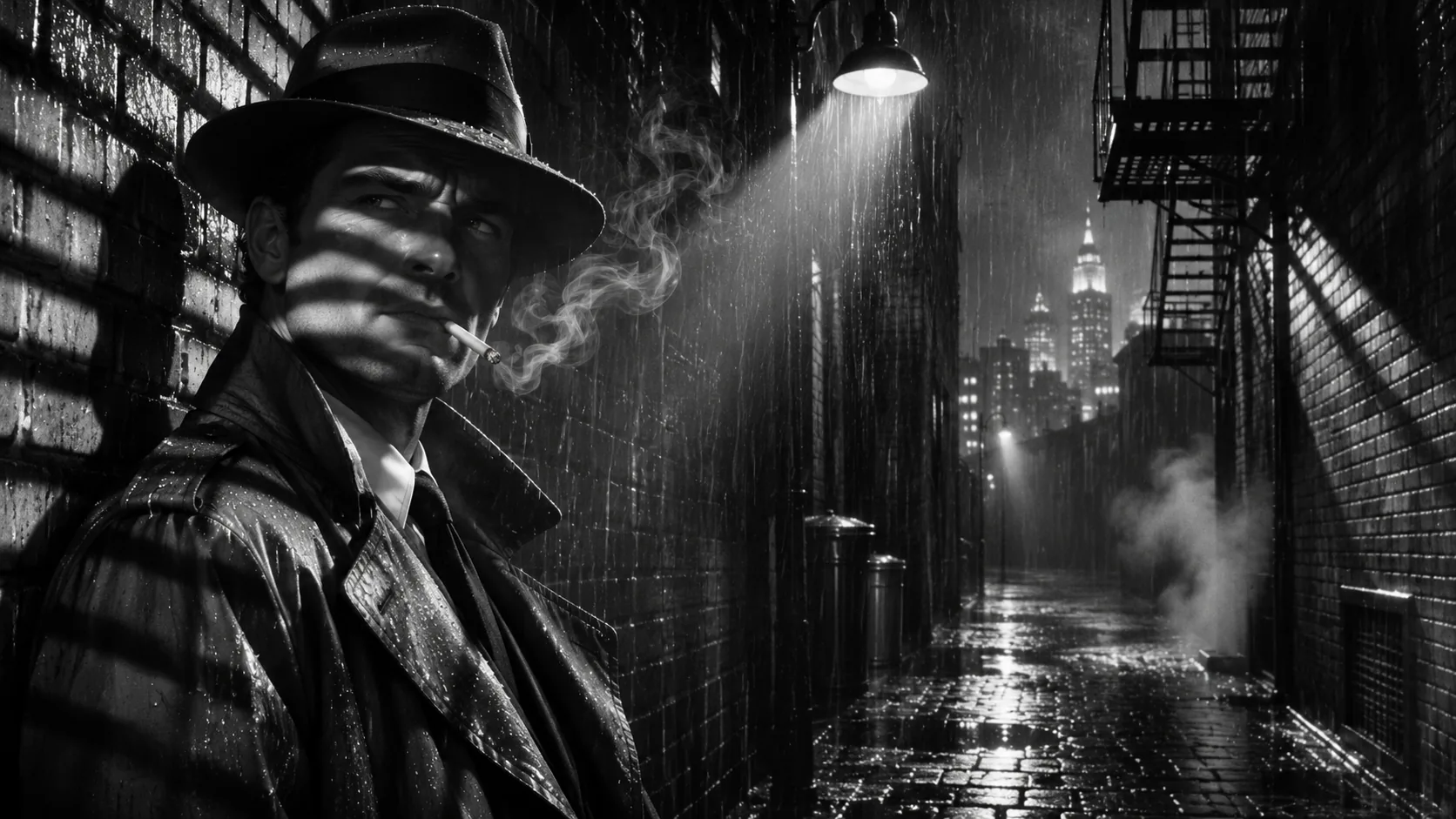
A film noir still is not simply a black-and-white photograph with a fedora in it. It is a frame built on moral tension: a hard light source that leaves part of the face unknowable, a shadow pattern that divides the space, a city that feels wet and hostile, and a character who looks like they have already lost something.
The visual grammar comes from 1940s and 1950s crime cinema, but the useful parts for AI are concrete: one dominant source, low fill, chiaroscuro, smoke or rain in the beam, and a palette that stays close to black, bone white and silver. The film noir tradition is broader than any single look; for prompting, narrow it to the lighting and shadow logic you can actually describe.
Soul Cinema renders the still. The sequence work — repeated shadows, the same detective, the same city — is where noir either holds or collapses.
Which light creates noir?
Start with one hard source and almost no fill. A streetlamp from camera left, a desk lamp low and close, a window with hard sun through blinds: the source should be visible in the logic of the frame even when the lamp itself is off-screen. The shadow side should stay dark but not become a featureless black hole.
Smoke and rain are not decoration; they make the light visible. A beam passing through cigarette smoke, a wet wall catching a hard highlight, a windshield turning a streetlamp into a smear — those are the cues that read as noir at thumbnail size.
- One hard key, low or no fill.
- A visible shadow pattern on a face or wall.
- A practical source inside the frame or just outside it.
- Smoke, rain or dust to make the beam visible.
- Deep blacks with one readable highlight.
- A palette of black, bone white and silver.
How do you prompt venetian-blind and diagonal shadows?
Describe the shadow as a physical object between the source and the surface. “Venetian-blind shadows fall diagonally across his face and the wet brick wall” is usable. “Film noir lighting” is not. Name the direction, the spacing and what the shadow lands on.
Diagonal shadows work because they cut the frame into unequal zones. A window frame, staircase railing, fire escape or half-open door can do the same job. If the shadow is the point of the shot, keep the rest of the frame quiet so the pattern reads.
- Name the object casting the shadow: blinds, railing, window frame, door.
- Name the surface receiving it: face, wall, floor, car hood.
- Give the direction: diagonal from upper left, horizontal across the eyes.
- Keep the background quiet so the pattern reads.
- Let part of the face stay in shadow.
- Avoid “noir lighting” without a source or shadow object.
Black-and-white or neo-noir color?
Classic noir is black and white, but the genre has a strong color branch: neo-noir uses sodium amber, crimson, teal or neon against deep shadow. Choose one mode before you write the prompt. A frame that asks for “black and white with neon red” is asking two different films to occupy the same shot.
For black and white, control contrast and grain: deep blacks, bone-white highlights, silver midtones, no color cast. For neo-noir, pick one accent and one dominant shadow color, then keep the palette narrow. The accent should come from a motivated source, not a global filter.
| Mode | Palette | Light behavior |
|---|---|---|
| Classic noir | Black, bone white, silver. | Hard key, deep shadows, smoke, 35mm grain. |
| Neo-noir | Charcoal plus one accent: crimson, sodium amber or teal. | Hard key with a colored practical or neon edge. |
| Crimson noir | Black, deep red, warm skin. | Low key, red practical, restrained fill. |
| Urban noir | Slate blue, gray, cold white. | Overcast night, wet streets, soft hard mix. |
Which lens and film stock should you name?
Use a 35mm or 50mm lens for the environmental noir frame, and an 85mm for the close-up where the shadow pattern crosses the face. Deep focus suits the alley and the office; shallow focus suits the femme fatale and the detective’s reaction. Name the aperture only when the falloff matters.
For black and white, name a grain structure rather than a color stock: “Ilford HP5-like grain” or “double-X-style black and white” is enough. For color noir, use the film stock prompt guide to pick one stock and keep it fixed across the sequence. The depth of field guide covers the lens and aperture side.
- 35mm: environmental noir, alley, office, car.
- 50mm: dialogue, medium two-shot, street corner.
- 85mm: close-up, shadow across the face, femme fatale.
- Deep focus: let the city stay readable.
- Shallow focus: isolate the face and the smoke.
- One stock line for the whole sequence.
Which six noir scenes should you brief?
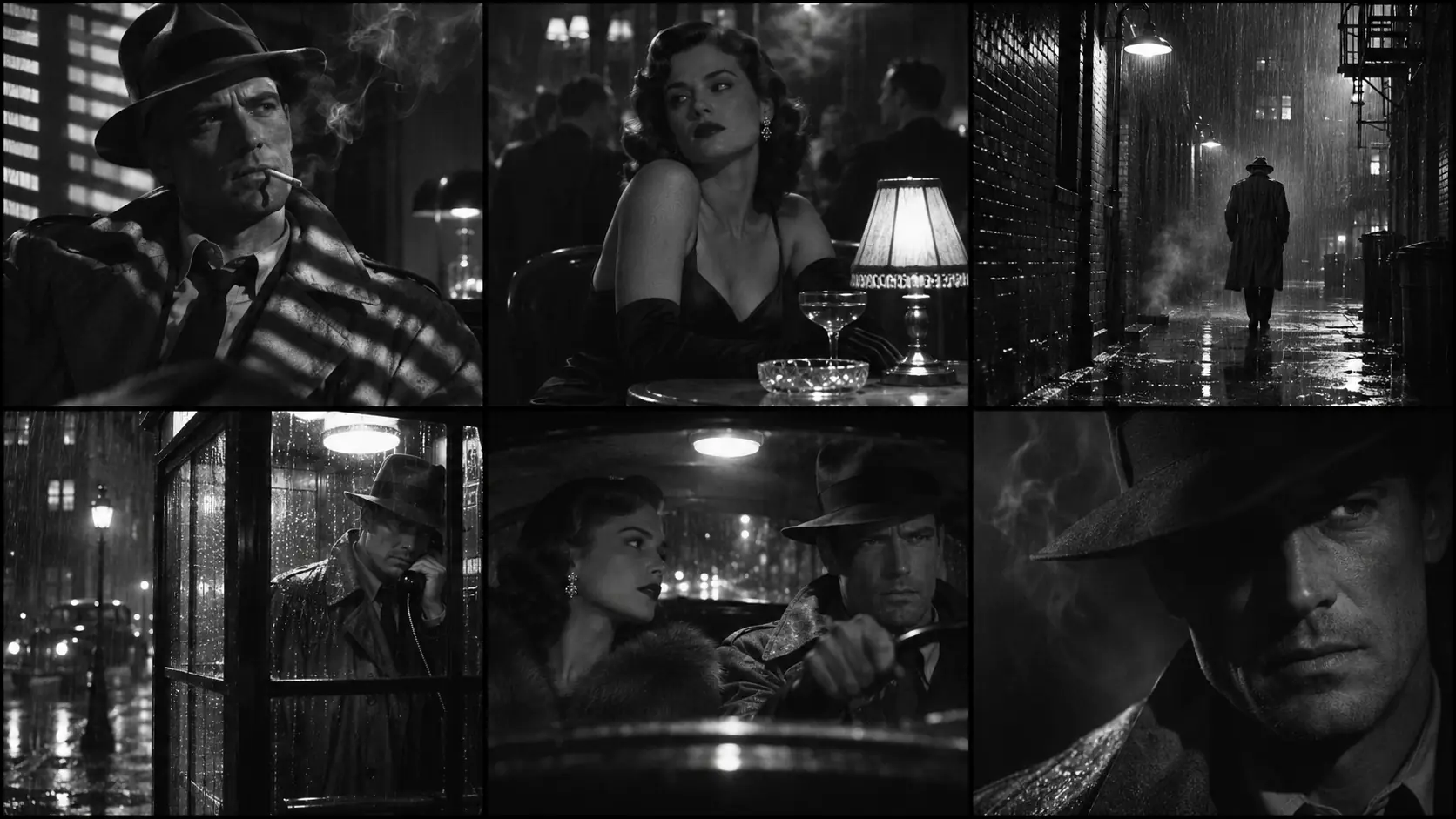
Six scenes cover the genre’s visual spine: the detective under blinds, the woman in the bar, the rain-soaked alley, the phone booth, the car interior and the close-up in shadow. Each one isolates a different noir signal — shadow, performance, city, communication, isolation and the face.
| Scene | Light | Lens | Prompt anchor |
|---|---|---|---|
| Detective under blinds | Hard streetlamp through venetian blinds. | 50mm, medium shot. | Diagonal shadow across the face and wet brick. |
| Woman in the bar | Single table lamp, low fill, smoke. | 85mm, medium close-up. | Warm lamp against deep shadow, guarded expression. |
| Rain-soaked alley | One streetlamp, wet cobblestones. | 35mm, wide. | Lone figure under the lamp, long shadow, rain streaks. |
| Phone booth | Cold interior light, city glow outside. | 50mm, medium. | Glass reflection, hand on the receiver, night street. |
| Car interior | Dashboard glow, streetlamp through the windshield. | 35mm, two-shot. | Driver in shadow, passenger half-lit, rain on glass. |
| Close-up in shadow | Hard side key, almost no fill. | 85mm, close-up. | Half the face in shadow, cigarette smoke, deep black. |
How do you keep one noir look across a sequence?
Fix the light logic, the shadow geometry, the lens and the stock line, then change only blocking, angle and expression. The second frame should contain evidence of the same city and the same contrast ratio as the first. If the shadow direction flips for no reason, the sequence reads as a folder of noir images rather than a film.
Review the set as a cinematic contact sheet at thumbnail size. Keep the character with Soul ID and the palette with Palette Lock. The film treatment workflow is the place to decide the rules before the first frame.
What are common noir AI mistakes?
The first mistake is asking for noir without a shadow source. The second is mixing black-and-white and neon color in the same frame. The third is modern objects — laptops, LED signs, contemporary cars — appearing in a 1940s scene. The fourth is over-styling the smoke until it becomes a graphic effect rather than atmosphere.
The fifth is a flat contrast curve: gray shadows, gray highlights and no true black. The sixth is inconsistent wardrobe or city geography between frames. Noir is a discipline of subtraction; if the frame has too many ideas, it stops feeling fatalistic.
- “Noir lighting” with no visible source or shadow object.
- Black-and-white plus neon color in the same frame.
- Modern props or signage in a period scene.
- Smoke used as decoration instead of atmosphere.
- Flat blacks and milky highlights.
- Different wardrobe, city or shadow direction between frames.
Frequently asked
How do I write a film noir AI prompt?
Name one hard light source, the shadow object and the surface it lands on, then add the lens, palette and grain. “Hard streetlamp through venetian blinds, diagonal shadow across the face, 50mm, deep blacks, 35mm grain” gives the model decisions instead of a genre label.
Should film noir AI images be black and white?
Classic noir is black and white, but neo-noir color is a valid branch. Choose one mode per sequence: black and white with controlled grain, or a narrow neo-noir palette with one motivated accent color.
How do I get venetian-blind shadows in an AI image?
Describe the blinds as an object between the source and the surface: “hard streetlamp through venetian blinds, diagonal bands of shadow across the face and wet brick wall.” Keep the rest of the frame quiet so the pattern reads.
Which lens is best for noir?
Use 35mm for environmental frames, 50mm for dialogue and medium shots, and 85mm for close-ups where the shadow crosses the face. The lens choice should follow the shot, not a single noir rule.
How do I keep a noir sequence consistent?
Fix the light direction, shadow geometry, lens, stock and wardrobe, then change only blocking and angle. Review the sequence as a contact sheet at thumbnail size before rendering more frames.
Does Soul Cinema generate a whole noir film?
No. Soul Cinema renders stills and keyframes. A sequence can be planned as a storyboard or treatment, but motion and editing happen in a separate video workflow.
Your first cinematic frame is one prompt away
Sign in with Google, pick a plan and keep every still at the resolution the model produced. Plans from $12/month, cancel at any time. No watermark, no re-encode.