
Cinematic AI image prompts
Four decisions make a frame look shot: where the light comes from, how far the contrast is pushed, what lens the framing implies, and what it is textured with.
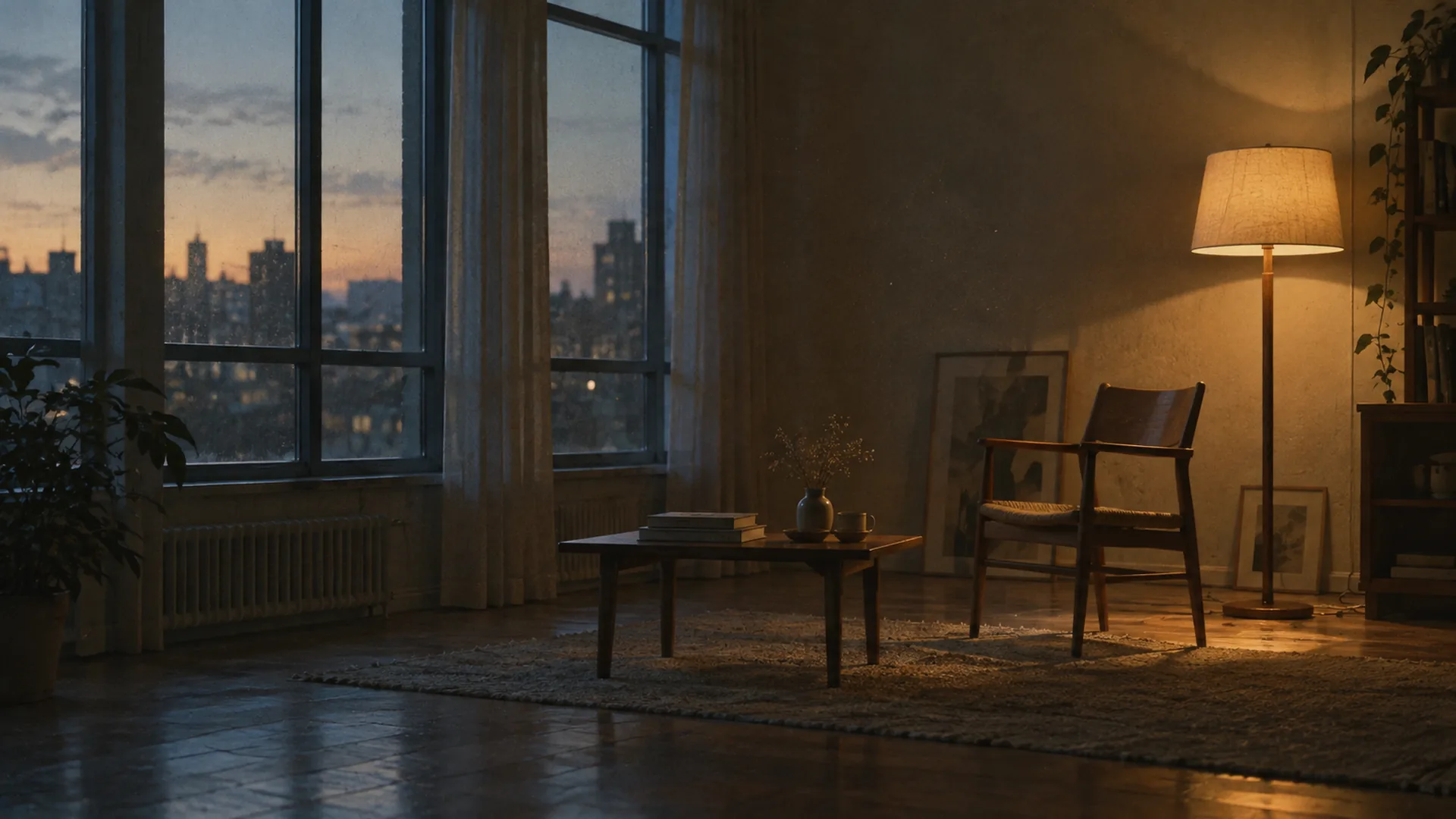
What makes an image read as cinematic?
Cinematic is not a filter. It is the visible result of four decisions: where the light comes from, how far apart the brightest and darkest parts of the frame sit, what lens the framing implies, and what the image is textured with. A frame with a motivated key, a controlled contrast ratio, a coherent focal length and honest grain reads as cinematic. A frame with none of those reads as a render, no matter how expensive the subject looks.
The fifth decision is negative space. Cinema frames are usually composed for a subject to sit inside a place, not to fill the rectangle. Leaving the top third of the frame to a wall, a ceiling or the sky is often what makes the difference between a portrait and a still.
How do you write light direction into a prompt?
Name the source and the side. “Single soft source from camera left, fill almost gone” is a complete instruction; “moody lighting” is not. Then name the quality — hard or soft — because a hard key draws an edge and a soft key wraps, and the two produce completely different faces. Finally, name the time of day or the practical that motivates the light, so the colour temperature has a reason to be what it is.
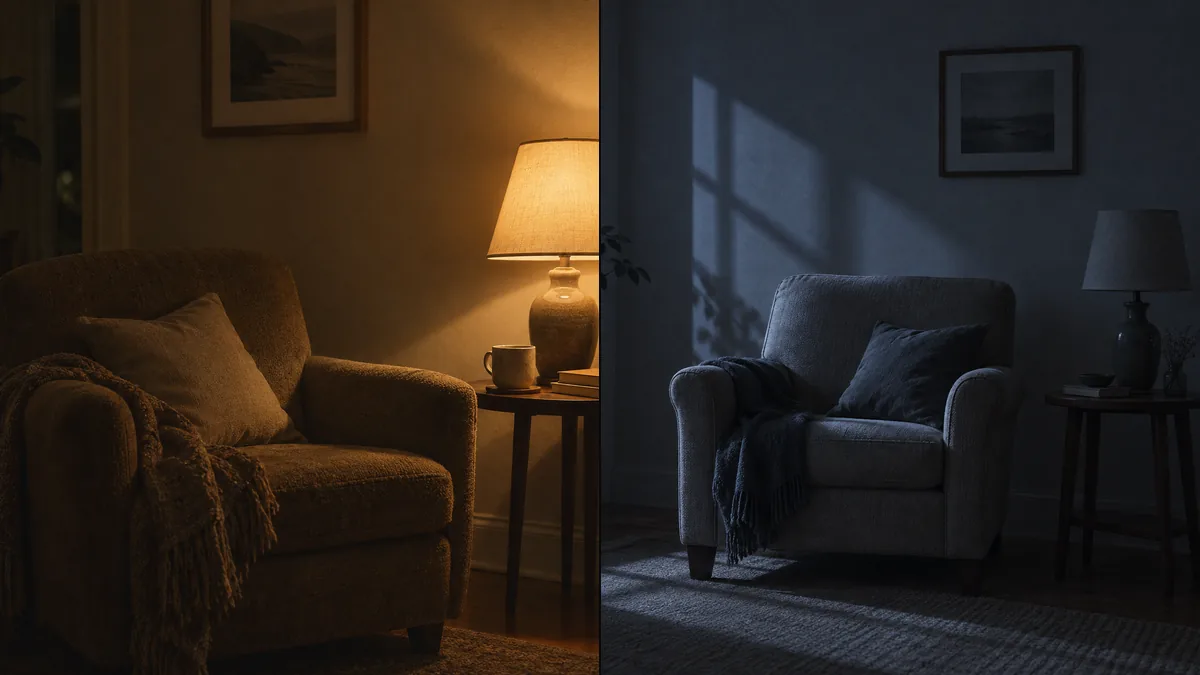
If you want two sources, say which one wins. A scene lit by cold window light with a warm lamp as an accent is a different frame from the same room lit by the lamp with the window as an accent, and a prompt that lists both without ranking them usually produces neither.
Which lens and stock words change the frame?
Focal length changes how the space feels before it changes anything else. A 24mm makes a room wide and a face angular; a 35mm is the reportage default; a 50mm sits close to how an eye reads a conversation; an 85mm compresses background into soft shapes and flatters a face; a 135mm flattens depth further and isolates the subject entirely. Naming the lens is often more useful than naming the framing, because it tells the model how much perspective distortion to draw.
Stock language covers texture and colour response. Kodak publishes its Vision3 500T as a tungsten-balanced stock and its 250D as daylight-balanced, which is a useful shorthand in a prompt: asking for a 500T look pulls the frame toward warm practicals and forgiving shadows, while a daylight stock reads cooler and cleaner. Add grain size last — fine grain for a modern negative, coarse for something older — and say no digital sharpening.
- 24mm — wide rooms, angular faces, strong perspective.
- 35mm — reportage, environmental portraits, room for context.
- 50mm — neutral, conversational, close to a human read.
- 85mm — compressed background, flattering faces, shallow focus.
- 105–135mm — isolation, flat depth, subject-only frames.
How do you keep one look across a set?
Write the light and stock lines once and treat them as constants. In Soul Cinema you can go further and pin the palette: palette lock holds a requested hex value across re-renders, so the accent colour you chose in the first frame is the same colour in the sixth. The cast is held the same way, through Soul ID, for up to six frames.
The practical habit that follows: save the brief, and change one line per test. If a frame is not working, you want to know whether it was the lens or the light, and you only learn that by moving one variable at a time.
What flattens a cinematic frame?
The most common cause is a prompt built from conclusions instead of instructions. Words like cinematic, filmic, moody, epic and 8K describe an outcome the model cannot act on, and they tend to pull the result toward the bright, evenly lit default that general models are tuned for.
After that: mixed times of day in one sentence, which averages into flat neutral light; full frontal fill that leaves no shadow side; and over-sharpening, which makes skin read as plastic. If a frame looks like a poster rather than a still, the fix is usually to remove light sources from the prompt rather than add them.
How do you test a look without burning credits?
Soul Cinema charges by output size: 2K costs 1 credit, 4K costs 2 and 8K costs 4, and failed frames are refunded automatically. That makes 2K the natural test size — four look tests cost the same as one 8K delivery — and 8K the last step, once the light, the lens and the palette have stopped moving.
A workable loop: one 2K test, change a single line, one more 2K test. When the frame looks right at 2K, re-render that setup at 4K or 8K against the same reference and the same pinned palette.
Frequently asked
What is the single most useful word in a cinematic prompt?
The direction of the light. Naming where the key comes from — camera left, backlit, overhead, from a practical inside the frame — changes the render more than any style adjective.
How do I get film grain without making the image noisy?
Specify the stock and the grain size separately from the contrast, then ask for no digital sharpening. Fine grain with a gentle highlight roll-off reads as 35mm; heavy grain with sharpened edges reads as noise.
Does resolution change the look of a frame?
Not the light or the palette, but it changes how much texture survives. Render the look at 2K, then re-render the chosen setup at 4K or 8K with the same pinned palette so the colour does not drift between sizes.
Can I use the same prompt for a whole set of images?
Yes, and you should: keep the light line, the stock line and the cast line identical, and vary only framing, angle and expression. That is what makes a set read as one shoot rather than one afternoon of experiments.
What does a look test cost on Soul Cinema?
One credit at 2K, two at 4K and four at 8K per frame. Basic is $12 a month for 120 credits and stills up to 4K; Pro is $29 for 600 credits and 8K.
Your first cinematic frame is one prompt away
Sign in with Google, pick a plan and keep every still at the resolution the model produced. Plans from $12/month, cancel at any time. No watermark, no re-encode.