
AI western movie stills
A practical western workflow for AI stills: hard sun, dust haze, wide horizons, a staged standoff and six scene briefs built around land and distance.
What makes a western still?
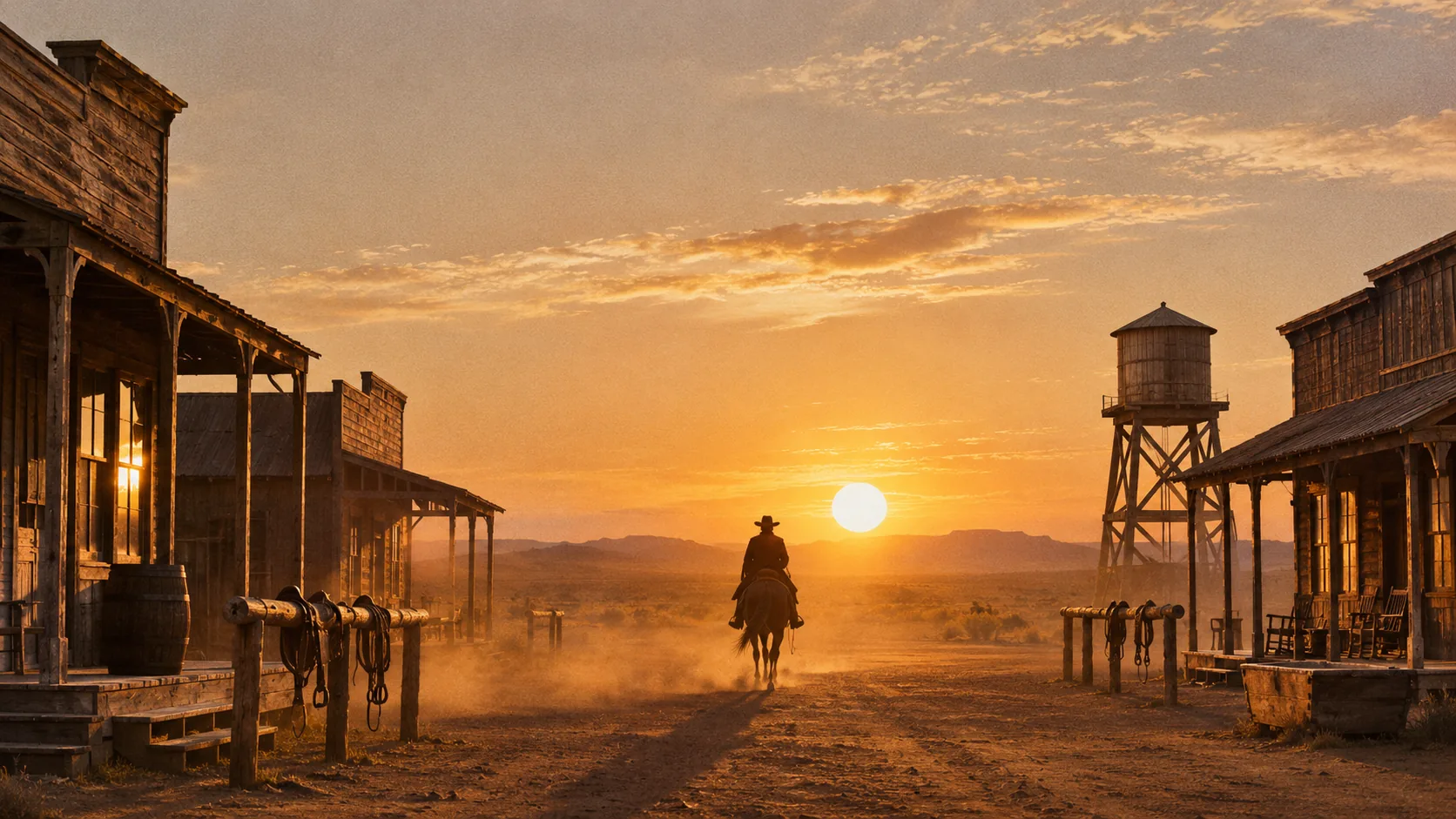
A western still is built on land, distance and light. The landscape is not a backdrop; it is the pressure on the character. A tiny rider against a huge horizon, a main street with a hard sun and long shadows, a figure waiting under a hat brim: the genre reads through scale and restraint.
The useful controls are concrete: a low or high horizon, a hard sun, dust in the air, an earth palette and a silhouette that reads at thumbnail size. The cinematic locations guide covers the setting; this page covers the western-specific grammar.
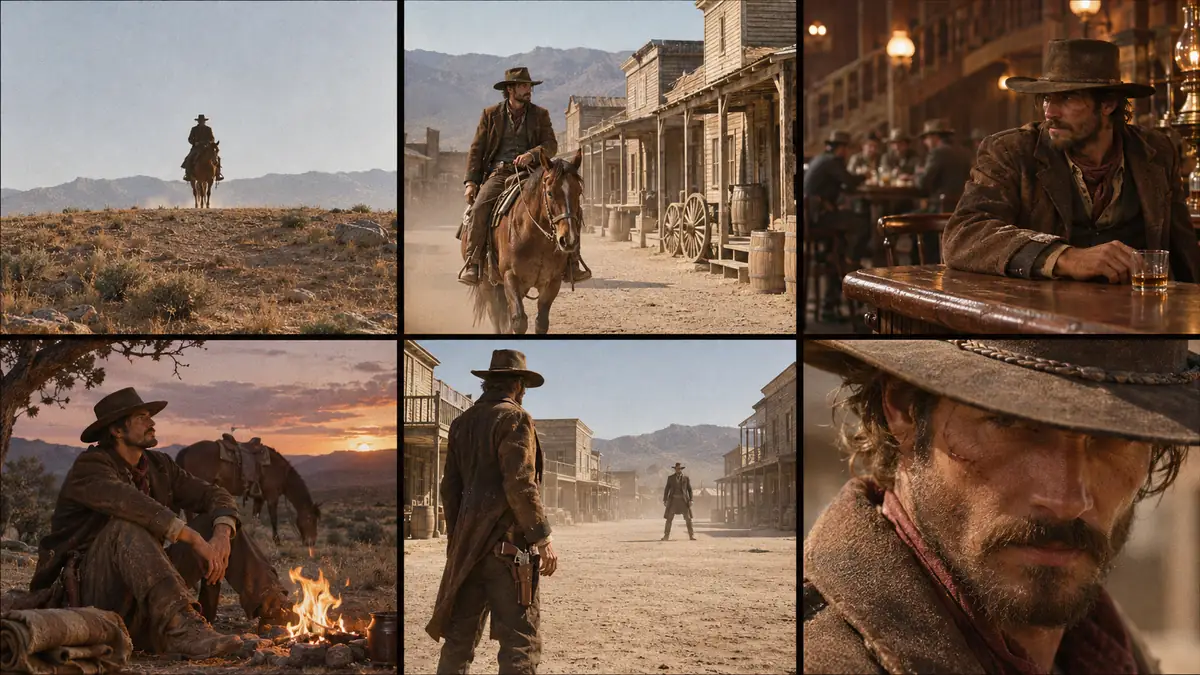
Soul Cinema renders the still. The sequence — the same rider, horse, town and sun direction — is what makes the frames feel like one film.
The genre also needs silence. A western frame often works because nothing is happening yet: the street is empty, the rider is still, the town is waiting. Resist filling the frame with action; the threat of movement is usually stronger than movement itself.
How do you light dust and hard sun?
Use a low sun and put it behind or beside the subject. Backlight turns dust into a visible atmosphere and gives the figure a rim. A hard side key makes the face and the wooden storefronts read as carved. Long shadows across the street tell the viewer the time of day without a clock.
Do not soften the sun. Western light is hard, dry and directional; a soft overcast frame loses the genre. Keep the shadows deep but readable, and let the dust haze separate the foreground from the horizon.
- Low sun, backlight or hard side key.
- Dust in the air to make the light visible.
- Long shadows across the street.
- Deep but readable shadows.
- Warm earth palette, pale sky.
- No soft overcast light.
How do you compose a wide horizon?
Choose a low horizon with a large sky, or a high horizon with a small human figure. Both work; the choice tells the story. A low horizon makes the land vast and the character exposed. A high horizon makes the figure small against the place.
Use a wide lens and keep one foreground texture: dust, a fence post, a horse’s neck, a wagon wheel. The foreground gives the eye a way into the depth. A clean horizon with no foreground reads as a landscape photo, not a film still.
- Low horizon with a large sky, or high horizon with a small figure.
- A wide lens for the landscape.
- One foreground texture: dust, fence, horse, wheel.
- A visible path or road into the distance.
- Silhouette that reads at thumbnail size.
- No centered postcard composition unless it is the point.
How do you stage a standoff?
A standoff is a composition of distance and eyeline. Put two figures far apart, give them space between, and let the negative space carry the tension. Hands near holsters, bodies still, faces shadowed by hats. The frame should feel like the moment before movement, not the movement itself.
Use a wide shot for the geography, then a close-up for the eyes or the hand. If both figures are in the same frame, keep the horizon low so the sky presses down on them. The standoff is a geometry problem before it is an action scene.
Sound is invisible in a still, so the frame has to imply it. Dust hanging in the air, a hand hovering over a holster, a horse shifting its weight, a curtain moving in the wind: these are the visual equivalents of a held breath. Cut to the close-up only after the wide has established the distance; the close-up is the release, not the setup.
- Two figures, wide apart, in the same frame.
- Negative space between them.
- Hands near holsters, bodies still.
- Faces shadowed by hat brims.
- Low horizon to compress the figures.
- A close-up of eyes or hand as the second beat.
How do you avoid costume and prop clichés?
The generic western is a costume shop: a clean hat, a shiny buckle, a cartoon cactus. Specificity fixes it. Use worn leather, patched wool, dust on the boots, a real wooden storefront, a horse with tack that looks used. Pick one period detail and let the rest stay restrained.
Avoid modern objects and anachronistic signage. If the town has a water tower, a hitching post and a general store, you do not need twenty props. The same rule applies to color: a global orange-teal grade reads as a filter, not a place.
- Worn leather, patched wool, dusty boots.
- One period detail, not a costume shop.
- A real wooden storefront and hitching post.
- Horse tack that looks used.
- No modern objects or signage.
- Earth palette, not a global orange filter.
Which six western scenes should you brief?
Six scenes cover the genre’s visual spine: the rider on the horizon, the dusty main street, the saloon interior, the campfire, the standoff and the close-up under the hat brim. Each scene isolates a different signal — scale, town, interior, night, tension and the face.
| Scene | Light | Lens | Prompt anchor |
|---|---|---|---|
| Rider on the horizon | Low golden-hour backlight, dust haze. | 35mm, wide. | Small rider, huge sky, long shadow, earth palette. |
| Dusty main street | Hard side sun, storefront shadows. | 35mm, wide. | Wooden buildings, hitching posts, dust in the air. |
| Saloon interior | Warm lamps, deep shadow, smoke. | 50mm, medium. | Bar, mirror, worn wood, one figure at the counter. |
| Campfire | Warm fire key, cold night ambient. | 50mm, medium. | Rider seated, hat low, horse in the background. |
| Standoff | Hard sun, low horizon, long shadows. | 35mm, wide. | Two figures far apart, negative space, hands near holsters. |
| Hat-brim close-up | Hard side key, shadow across the eyes. | 85mm, close-up. | Eyes in shadow, dust on the skin, no full face. |
How do you keep one look across a sequence?
Fix the rider, horse, wardrobe, town, sun direction and lens, then change only the scene and the blocking. The second frame should feel like the same day in the same town. If the sun jumps from camera left to camera right, the sequence loses its geography.
Review the set as a contact sheet at thumbnail size. Use Soul ID for the rider and Palette Lock for the earth accent. The film treatment workflow is where the town and the visual rules should be decided.
What are common western AI mistakes?
The first mistake is a generic desert with no town, road or human scale. The second is a costume-shop cowboy with clean clothes and a shiny buckle. The third is a global orange-teal grade that flattens the earth palette. The fourth is a soft, overcast light that removes the genre’s hardness.
The fifth is an inconsistent town or sun direction between frames. The sixth is too many props: a wagon, a cactus, a sign, a barrel and a horse in every shot. The western frame is strongest when it subtracts.
- Generic desert with no human scale.
- Clean costume-shop cowboy.
- Global orange-teal filter.
- Soft overcast light.
- Inconsistent town or sun direction.
- Too many props competing for attention.
Frequently asked
How do I write a western movie AI prompt?
Name the land, the human scale, the sun direction and the lens. “Lone rider on a dusty main street at golden hour, hard backlight, long shadows, 35mm, earth palette, 35mm grain” gives the model a place and a time of day instead of a costume.
How do I get dust and hard sun in an AI image?
Put a low sun behind or beside the subject, add dust in the air and keep the shadows deep but readable. Backlight makes the dust visible; a hard side key carves the face and the storefronts.
How do I compose a western landscape?
Choose a low horizon with a large sky or a high horizon with a small figure, use a wide lens and keep one foreground texture such as dust, a fence post or a horse. The foreground gives the eye a way into the depth.
How do I stage a western standoff?
Put two figures far apart in the same frame, leave negative space between them, keep the bodies still and the hands near the holsters. Use a low horizon and a close-up of the eyes or hand as the second beat.
How do I keep a western sequence consistent?
Fix the rider, horse, wardrobe, town, sun direction and lens, then change only scene and blocking. Review the set as a contact sheet at thumbnail size before rendering more frames.
Does Soul Cinema generate western video?
No. Soul Cinema renders stills and keyframes. A western sequence can be planned as a storyboard or treatment, but motion and editing happen in a separate video workflow.
Your first cinematic frame is one prompt away
Sign in with Google, pick a plan and keep every still at the resolution the model produced. Plans from $12/month, cancel at any time. No watermark, no re-encode.