
AI horror movie stills
A restrained horror workflow for AI stills: negative space, one practical light, a partial reveal and six scene briefs that build dread without gore.
What makes a horror still scary?
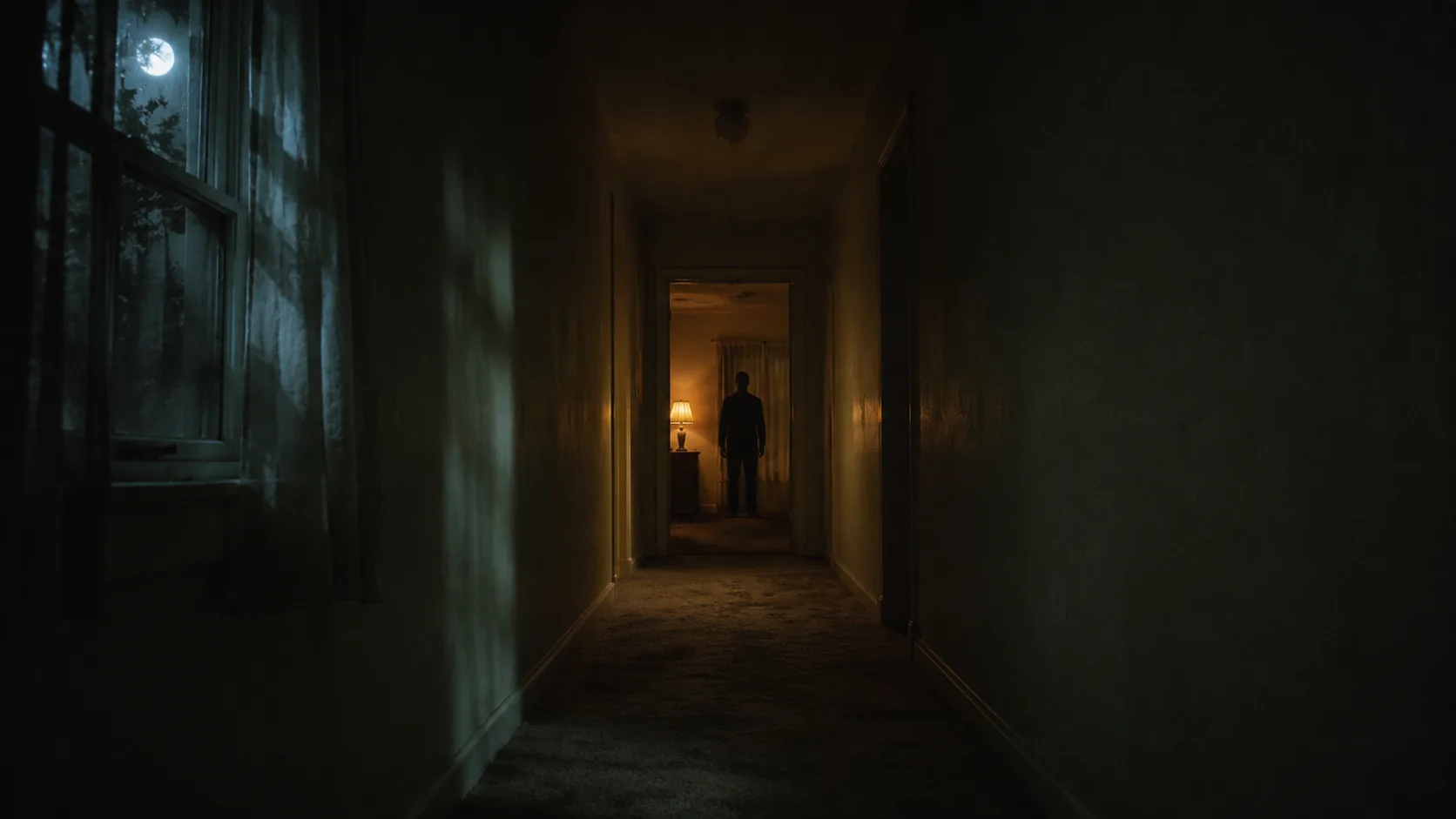
A horror still is not a monster portrait. It is a frame that makes the viewer search the dark for something that should not be there. The threat can be small, distant or partly hidden; the fear comes from the space around it and from the sense that the frame knows more than the viewer does.
That is why negative space matters more than gore. A hallway with one warm lamp and a figure at the far end is scarier than a close-up of a creature, because the viewer has to close the distance themselves. The composition guide covers the negative-space mechanics; this page applies them to dread.
Soul Cinema renders the still. The scare sequence — the same house, the same character, the slow reveal — is built across frames.
How do you build dread with negative space?
Put the threat in the smallest part of the frame and let the rest of the frame do the work. The empty space should feel like a place the character has to walk through, not a graphic backdrop. Doorways, hallways, stairwells and windows are natural thresholds because they promise an off-screen space.
Keep the threat partially occluded. A silhouette in a doorway, a reflection that is slightly late, a shape at the edge of the frame: the viewer fills in the rest. If the whole creature is visible and evenly lit, the image becomes a costume photo.
- Threat small in frame, not centered.
- A threshold: doorway, hallway, stair, window.
- One area of the frame that is darker than the rest.
- A partial occlusion: door edge, curtain, reflection.
- A visible path the character would have to take.
- No gore; the implication is stronger.
Which practical light works best?
A single warm practical in a cold room is the workhorse. A table lamp, a hallway sconce, a refrigerator light, a television glow or a flashlight all give the frame a motivated source and a place for the darkness to start. The practical should not light the whole room; it should make the room aware of itself.
Underlighting and side-lighting make faces read as wrong. A harsh light from below, a hard side key with no fill, a cold window on one side and a warm lamp on the other: these are simple ways to make a familiar room feel hostile without adding fog or a monster.
- One warm practical against a cold ambient room.
- A cold window or doorway as the second source.
- Underlight for a face that reads as wrong.
- Hard side key with almost no fill.
- A television or screen glow for a modern room.
- Darkness that is still readable, not pure black.
How do you reveal the threat slowly?
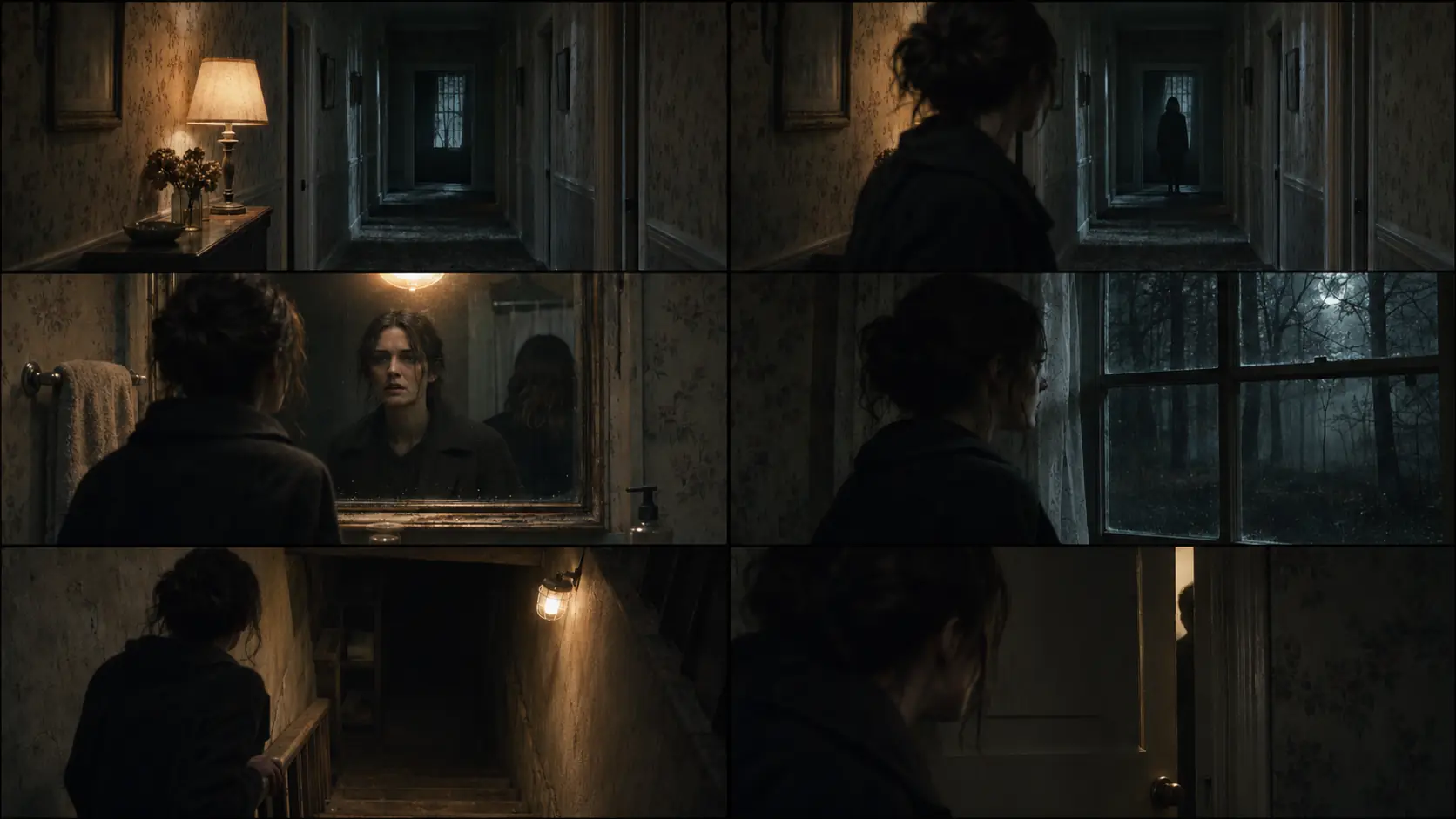
Build the sequence as an escalation of information, not an escalation of gore. Frame one: the empty space. Frame two: a detail that is wrong. Frame three: the character notices. Frame four: the threat is partly visible. Frame five: the threshold is crossed. Frame six: the reveal, still incomplete.
The same character, house and light logic must hold across all six frames. If the hallway changes shape or the lamp moves, the sequence becomes a series of unrelated scary images. A contact sheet is the fastest way to check whether the escalation reads.
The reaction shot is the load-bearing frame. Put the character’s face between the empty space and the partial threat; the viewer reads the fear before they see the cause. If the sequence cuts straight from an empty hallway to the creature, the audience has no time to imagine anything. Give them one beat of the character listening, one beat of the wrong detail, then the partial reveal.
- Empty space: establish the room and the dark area.
- Wrong detail: a door ajar, a reflection, a shadow with no source.
- Character notices: a reaction shot, not the threat.
- Partial threat: silhouette, edge, scale or occlusion.
- Threshold: the character moves toward the off-screen space.
- Incomplete reveal: the threat is closer, still not fully shown.
How do you avoid gore and jump-scare clichés?
Skip blood, torn bodies and screaming faces. They close the image instead of opening it. The horror still should leave a question: what is behind the door, why is the reflection late, why is the figure not moving? A frame that answers everything is a poster, not a scene.
Avoid the generic fog-and-abandoned-house look. If the location is a suburban house, make it specific: the carpet, the wallpaper, the light switch, the family photo turned face down. Specificity is what makes the wrong detail land.
- No blood, no gore, no wounds.
- No full creature reveal in the first frame.
- No generic fog machine over an empty house.
- One specific wrong detail per frame.
- A real, lived-in location, not a set of horror props.
- A reaction shot before the threat shot.
Which six horror scenes should you brief?
The six-scene spine is: empty hallway, figure at the end of the hall, mirror, forest edge, basement stair and door crack. Each scene isolates a different fear — emptiness, approach, reflection, wilderness, descent and threshold.
| Scene | Light | Lens | Prompt anchor |
|---|---|---|---|
| Empty hallway | One warm sconce, cold moonlight from a side room. | 35mm, wide. | Long hallway, worn carpet, dark doorway at the end. |
| Figure at the end | Same sconce, figure backlit in the doorway. | 50mm, medium wide. | Small motionless silhouette, face not visible. |
| Mirror | Cold bathroom light, one warm bulb. | 50mm, medium. | Reflection slightly wrong, character looking away. |
| Forest edge | Cold moonlight, no practical. | 35mm, wide. | Window framing dark trees, one shape between trunks. |
| Basement stair | Single bulb at the bottom, darkness above. | 35mm, low angle. | Stairs descending into black, hand on the rail. |
| Door crack | Warm light through a narrow opening. | 85mm, close. | Partial silhouette in the gap, no full reveal. |
How do you keep one look across a sequence?
Fix the house, the wardrobe, the light logic and the lens, then change only the blocking and the amount of information revealed. The second frame should feel like the same night in the same house, not a different horror movie. Keep the warm practical in the same part of the frame and the cold ambient on the same side.
Review the sequence as a contact sheet at thumbnail size; the escalation should read before the detail does. Use Soul ID for the character and Palette Lock for the warm accent. If the sequence is going to motion, the storyboard-to-video workflow takes over after the stills are approved.
What are common horror AI mistakes?
The first mistake is showing too much. The second is lighting the monster evenly. The third is using fog as a substitute for atmosphere. The fourth is a generic abandoned-house location with no specific detail. The fifth is a sequence where the house changes between frames.
The sixth is confusing horror with gore. Blood and wounds make an image explicit; a door left open makes it linger. If the frame does not make the viewer search the dark, it is not doing the genre’s work.
- Full creature reveal in the first frame.
- Evenly lit monster with no shadow.
- Generic fog over a generic house.
- No specific wrong detail.
- House, wardrobe or lamp position changing between frames.
- Gore substituting for dread.
Frequently asked
How do I write a horror movie AI prompt?
Start with a real location, one warm practical, a cold ambient source and a small threat placed in the frame. Name the negative space and the partial occlusion. “Empty suburban hallway, one warm sconce, distant motionless figure in the doorway, 35mm, deep shadows” is a useful brief.
How do I make an AI horror image scarier without gore?
Use negative space, a partial reveal and one specific wrong detail. The viewer should have to search the frame. A figure at the end of a hallway is scarier than a close-up of a wound because the distance does the work.
Which light is best for horror stills?
A single warm practical in a cold room is the most reliable. Add a cold window or doorway as the second source, keep the fill low and let part of the frame stay dark. Underlighting and hard side keys make faces read as wrong.
How many frames should a horror sequence have?
Six frames is a useful spine: empty space, wrong detail, reaction, partial threat, threshold and incomplete reveal. The point is escalation of information, not escalation of gore.
Why does my horror image look like a costume photo?
The creature is probably fully visible and evenly lit. Hide part of it, put it farther away, give it a silhouette or place it behind a threshold. The frame should withhold information.
Does Soul Cinema generate horror video?
No. Soul Cinema renders stills and keyframes. A horror sequence can be planned as a storyboard or treatment, but motion and editing happen in a separate video workflow.
Your first cinematic frame is one prompt away
Sign in with Google, pick a plan and keep every still at the resolution the model produced. Plans from $12/month, cancel at any time. No watermark, no re-encode.