
Cinematic fog AI
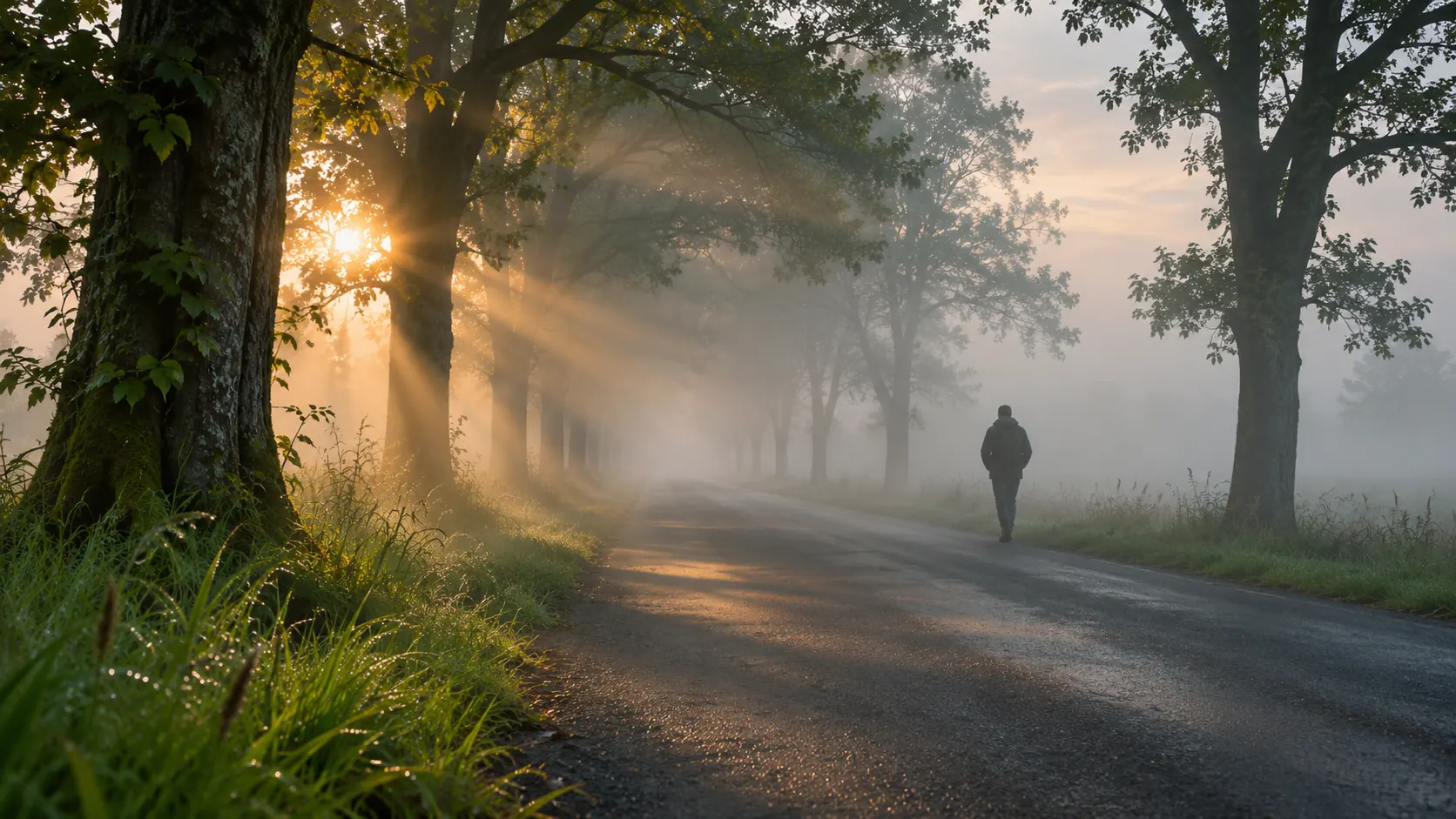
A layered fog workflow for AI stills: crisp foreground, wispy midground and diffuse background, lit by one motivated source instead of a gray overlay.
What makes fog cinematic?
Fog is a depth tool. It separates the foreground from the background, hides the far edge of the world and gives light a body. A frame with fog should still have a crisp near plane, a midground that is partially veiled and a background that dissolves. When all three planes are equally gray, the image goes flat.
The second requirement is light. Fog is only visible when it scatters a source: a low sun, a streetlamp, a window, a car headlight. Fog under flat ambient light becomes a gray wash. Fog against a bright source becomes volume.
Use the lighting cheat sheet to pick the source and the depth of field guide to control the focus planes. The location guide has settings that already contain depth for fog.
How do you build fog in three depth layers?
Describe three distances separately: foreground, midground and background. The foreground stays crisp with almost no haze. The midground carries wisps, patches or a thin veil. The background loses contrast, color and edge detail. That gradient is what the eye reads as atmosphere.
Use different words for each layer. “Crisp foreground grass, wispy mist around the trees in the midground, faded silhouettes in the far background” gives the model a depth map. “Heavy fog everywhere” gives it a single gray value and flattens the frame.
| Layer | Haze | What stays visible |
|---|---|---|
| Foreground | Almost none. | Texture, edge detail, true color. |
| Midground | Wisps, patches, a thin veil. | Shapes, one or two highlights, partial color. |
| Background | Dense and diffuse. | Silhouettes, a light source, a horizon line. |
| Sky | Soft gradient. | A pale sun or a flat bright field. |
| Light path | Visible shafts. | The source and the direction it travels. |
| Ground | Low-lying mist. | Reflections and the base of objects. |
Where does the light need to come from?
Backlight and side light make fog visible. A source behind the fog creates separation and shafts; a source to the side creates modeling and long shadows through the haze. Front light flattens the fog into a gray screen and removes the depth you were trying to build.
Keep one bright source and let the rest of the frame fall away. The source can be the sun, a streetlamp, a window, a car headlight or a practical fire. It should have a direction and a reason, and the fog should be denser between the camera and the source than behind it.
- One dominant backlight or side light.
- A source with a visible direction.
- Denser fog between camera and source.
- A dark anchor in the foreground or midground.
- Visible shafts only when the source is in frame.
- Avoid flat frontal ambient light.
How do you avoid flat gray mush?
Flat fog comes from asking for density without contrast. Keep a dark anchor: a tree trunk, a figure, a vehicle, a doorway. Keep the foreground sharp. Keep one highlight bright enough to anchor the eye. Without those three, the image becomes a gray rectangle with vague shapes.
Color also helps. Fog does not have to be neutral gray; it can carry the color of the source — warm gold at sunrise, sodium amber at night, blue-gray at dusk. Pick one temperature for the fog and one accent for the subject, then keep the background cooler and lower in contrast.
| Problem | Cause | Fix |
|---|---|---|
| Uniform gray frame | One fog value at every distance. | Split foreground, midground and background. |
| No focal point | No bright source or dark anchor. | Add one light shaft and one silhouette. |
| Muddy colors | Warm fog plus warm subject. | Cool the background, keep one warm accent. |
| Fog in front of the face | Atmosphere placed at the camera. | Move the haze behind the subject. |
| Plastic background | Fog used as a blur instead of depth. | Keep shapes and a horizon line in the far layer. |
Fog, haze, mist or smoke: which word should you use?
The words are not interchangeable. Fog is dense and low; mist is thinner and often ground-level; haze is a broad atmospheric veil that reduces contrast over distance; smoke comes from a source and moves with the air. Each one produces a different texture and a different light response.
Choose the word that matches the physical cause. A street at dawn has mist or fog. A mountain range has haze. A room with a fire has smoke. A studio beam has haze or smoke. If you use “fog” for everything, the model defaults to a uniform gray veil.
| Term | Density | Behavior | Typical scene |
|---|---|---|---|
| Fog | Dense, low. | Hides the background, sits in layers. | Street, field, harbor at dawn. |
| Mist | Thin, ground-level. | Wraps the base of objects, leaves the tops clear. | Forest floor, lake, graveyard. |
| Haze | Broad, even. | Reduces contrast with distance, keeps shapes. | Mountains, city skyline, desert. |
| Smoke | Local, directional. | Rises, drifts, catches beams. | Fire, interior, aftermath. |
| Steam | Local, bright. | Rises from a source, catches hard light. | Kitchen, street vent, bathroom. |
| Dust | Fine, suspended. | Catches beams, adds texture to air. | Attic, road, abandoned room. |
How do you keep fog consistent across a sequence?
Fix the density, the wind direction and the light source, then change only the subject and the framing. Fog that sits low in one frame and fills the sky in the next breaks continuity. The source should also stay in the same part of the sky or street.
Review the set as a contact sheet at thumbnail size. Keep the palette with Palette Lock and the location with location consistency. The rain guide covers the wet version of the same atmosphere problem.
Which six fog scenes should you brief?
Six briefs cover the useful range: the tree-lined road, the harbor at dawn, the streetlamp alley, the mountain ridge, the interior beam and the post-rain field. Each one uses a different fog term and a different light direction.
| Scene | Term | Light | Prompt anchor |
|---|---|---|---|
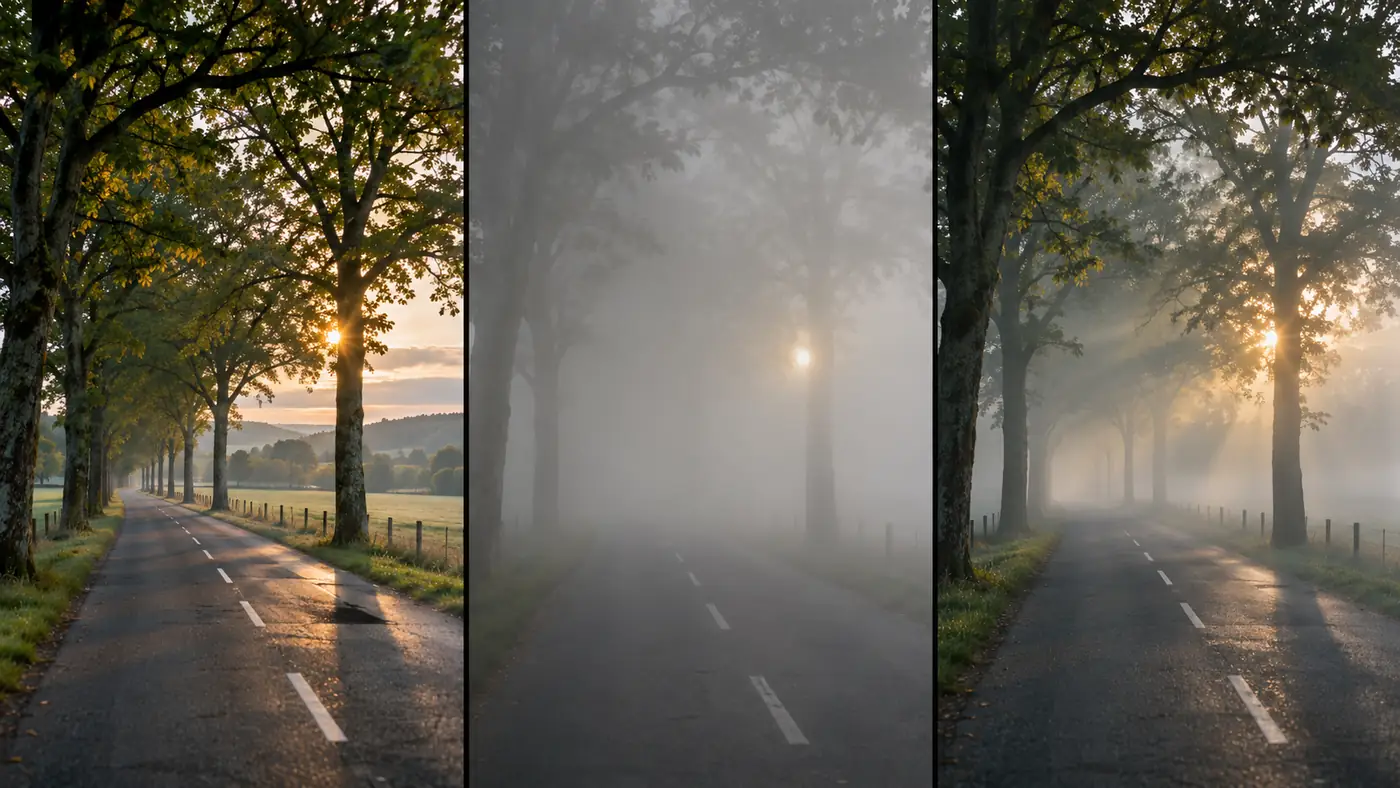
| Tree-lined road | Fog. | Low sun behind the trees. | Crisp foreground road, wispy midground, faded trees, light shafts. |
| Harbor at dawn | Mist. | Pale sun over water. | Ground mist, silhouette of a boat, flat bright sky. |
| Streetlamp alley | Haze. | Single sodium lamp. | Cone of light in the haze, wet bricks, dark foreground. |
| Mountain ridge | Haze. | Sun from the side. | Layered ridges fading with distance, warm rim on the near ridge. |
| Interior beam | Smoke or haze. | Hard window light. | Visible beam through a dark room, dust, one bright window. |
| Post-rain field | Mist. | Blue hour ambient. | Low mist over wet grass, cool background, one warm distant light. |
What are common cinematic fog mistakes?
The first mistake is uniform fog at every distance. The second is fog with no light source. The third is fog in front of the face instead of behind the subject. The fourth is a background with no shapes left at all.
The fifth is using “fog” when the scene needs haze, mist or smoke. The sixth is fog that changes density or direction between frames. Atmosphere is a continuity decision as much as a look decision.
- One fog value across every depth plane.
- Fog with no backlight or side light.
- Haze between the camera and the face.
- A background with no silhouette or horizon.
- “Fog” used for haze, mist and smoke alike.
- Density or wind direction changing between frames.
Frequently asked
How do I write a cinematic fog prompt?
Describe three depth layers and one light source: crisp foreground, wispy midground, diffuse background, with a low sun or streetlamp behind the fog. For example: “crisp foreground road, wispy mist in the midground, faded trees in the background, low sun behind the trees, visible shafts.”
Why does my AI fog look flat?
The fog probably has the same density at every distance and no light source. Split the scene into foreground, midground and background, keep the foreground crisp, and backlight the haze with one bright source.
What is the difference between fog, haze and mist?
Fog is dense and low, mist is thin and ground-level, haze is a broad veil that reduces contrast over distance, and smoke comes from a source. Use the word that matches the physical cause; “fog” for everything produces a uniform gray veil.
Where should the light be in a foggy image?
Behind or to the side of the fog, so the haze scatters the light and creates depth. Front light flattens the fog into a gray screen and removes the separation between planes.
How do I keep fog consistent across a sequence?
Fix the density, wind direction and light source, then change only the subject and framing. Check the set as a contact sheet so the fog sits at the same height and density in every frame.
Does Soul Cinema render the fog and the light together?
Yes. Soul Cinema renders the still, including the atmosphere and the light interaction described in the prompt. Motion, drifting fog and sound are added later in a video workflow.
Your first cinematic frame is one prompt away
Sign in with Google, pick a plan and keep every still at the resolution the model produced. Plans from $12/month, cancel at any time. No watermark, no re-encode.