
AI location consistency
Keep the same place across a sequence by building a location plate, locking six visual anchors and testing the room through a six-angle continuity pass.
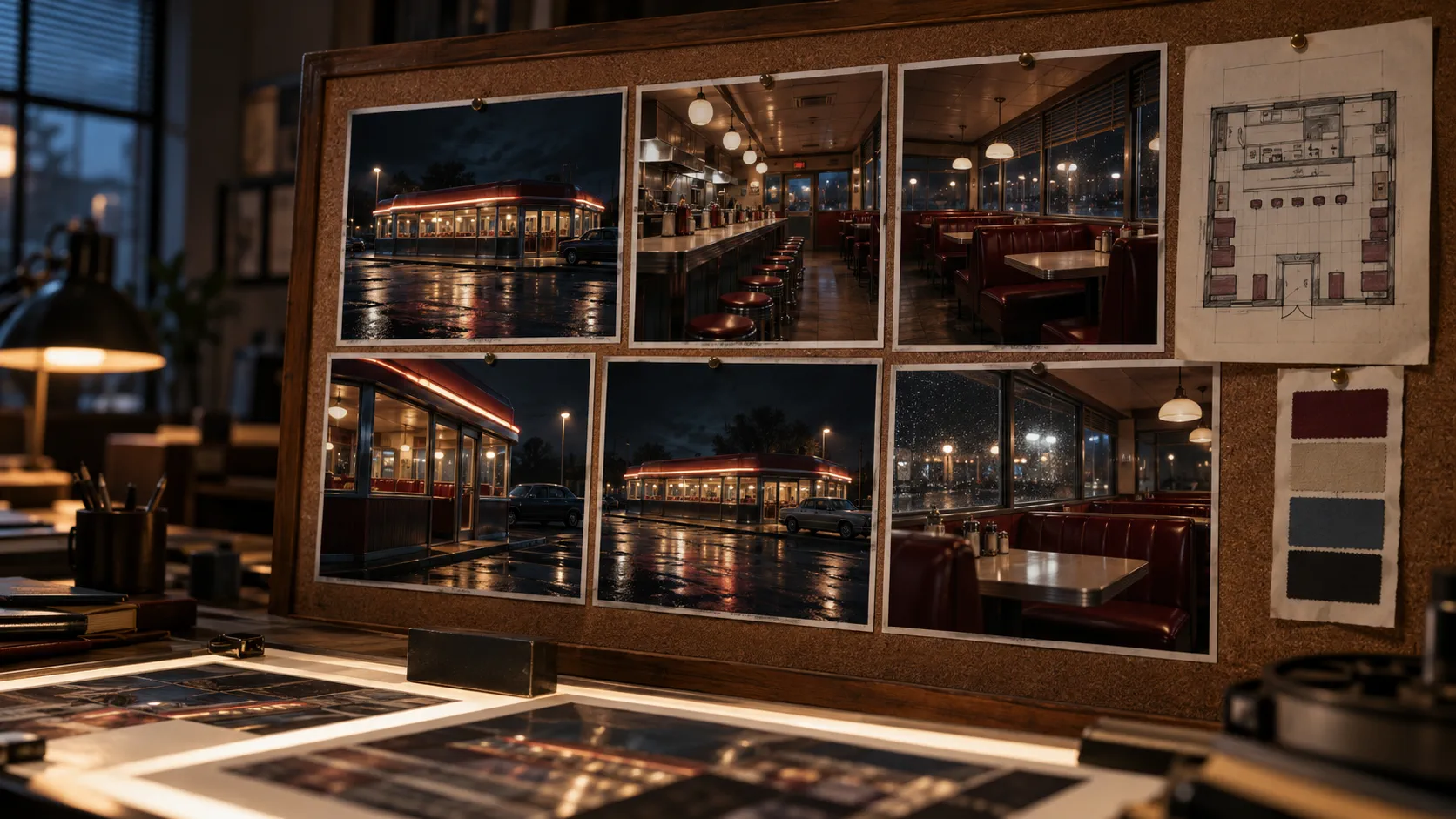
What is AI location consistency?
AI location consistency means the same place survives a change of camera angle, character blocking, focal length or time of day. The room must still have the same door on the same wall, the same window view, the same fixed furniture and the same light sources. It is the location half of visual continuity.
A repeated location description is useful but not enough. Image models interpret architecture differently when the camera moves. Build a location plate first: one approved frame that records the spatial map, fixed props, materials, palette and lighting logic. Every later frame is judged against that plate.
Location inspiration and location continuity are separate jobs. Use cinematic locations to choose a world, then use this guide to keep one room or street readable across a sequence. Character identity is handled separately by Soul ID.
Why is location consistency harder than character consistency?
A character can be locked to a face and wardrobe reference, but a room has many independent relationships to preserve. The door must remain beside the same wall, the bed must face the same window, the crack must stay above the same headboard and the practical lamp must remain the dominant warm source.
Viewers notice spatial contradictions quickly, even when they cannot name them. If a reverse angle invents a second door or moves the window behind the bed, the sequence stops reading as one place. A strong character in an unstable room still looks like a different film from shot to shot.
Which six anchors keep a location consistent?
Use six anchors in every prompt: architecture, layout, fixed props, materials, light sources and time of day. Put the anchors into the same wording every time. Change only the camera and the people. The descriptive sentence is a continuity contract, not a mood board.
| Anchor | Write this | Failure sign |
|---|---|---|
| Architecture | Low roadside motel with two exterior floors and repeated dark doors. | The building gains a third floor or changes roof shape. |
| Layout | Bed under the window, bathroom door to camera right, nightstand between. | A reverse angle puts the bathroom opposite the original wall. |
| Fixed props | Amber ceramic lamp on a chipped dark-wood nightstand. | The lamp changes shape, material or side of the bed. |
| Materials | Faded teal plaster, burgundy quilted bedspread, worn brown carpet. | The room becomes a clean modern hotel between panels. |
| Light sources | Cool parking-lot light through the window; warm lamp as the interior key. | A new ceiling light appears and changes the shadow logic. |
| Time of day | Blue-hour exterior with the same lit parking-lot fixture. | The sky changes from dusk to noon without a story reason. |
How do you build a reusable location plate?
Render the room empty and wide first. The establishing frame should show the complete spatial map: entrances, windows, fixed furniture and light sources. Approve that frame before introducing characters, because a person can hide the exact architectural evidence you need to compare.
Use the approved empty frame as a start reference in the Soul Cinema console. Keep the location paragraph identical, then add the character and camera instruction. A palette lock can protect the accent colour while a Soul ID reference protects the actor.
- Choose one wide angle that shows the room’s geography without obstruction.
- Write the six anchors as short, literal phrases and keep them unchanged.
- Render the room empty at 2K and reject invented doors, windows or furniture.
- Add the character only after the location plate passes.
- Create one medium and one reverse angle to test the spatial map.
- Save the accepted frame, prompt and palette as the location kit.
How should you prompt a consistent AI location?
Write location information before character style. Start with the room or street and its fixed relationships, then describe the camera, then add the actor. If the prompt begins with a detailed face, the model spends its attention on the character and treats the set as replaceable background.
Use a short paragraph rather than ten disconnected adjectives: “The same cream-curtained motel room with a burgundy bedspread, one cracked wall above the dark-wood headboard and a warm ceramic lamp beside the bed; the parking-lot fixture remains visible through the window.” That paragraph can be copied into every shot.
- Name only fixed props; leave temporary objects to the shot-specific line.
- State the relationship between objects: beside, opposite, above and camera left.
- Keep the same window view and exterior light in every angle.
- Say when a light changes because of the story, and make that action visible.
- Use the same lens family unless a deliberate perspective change is required.
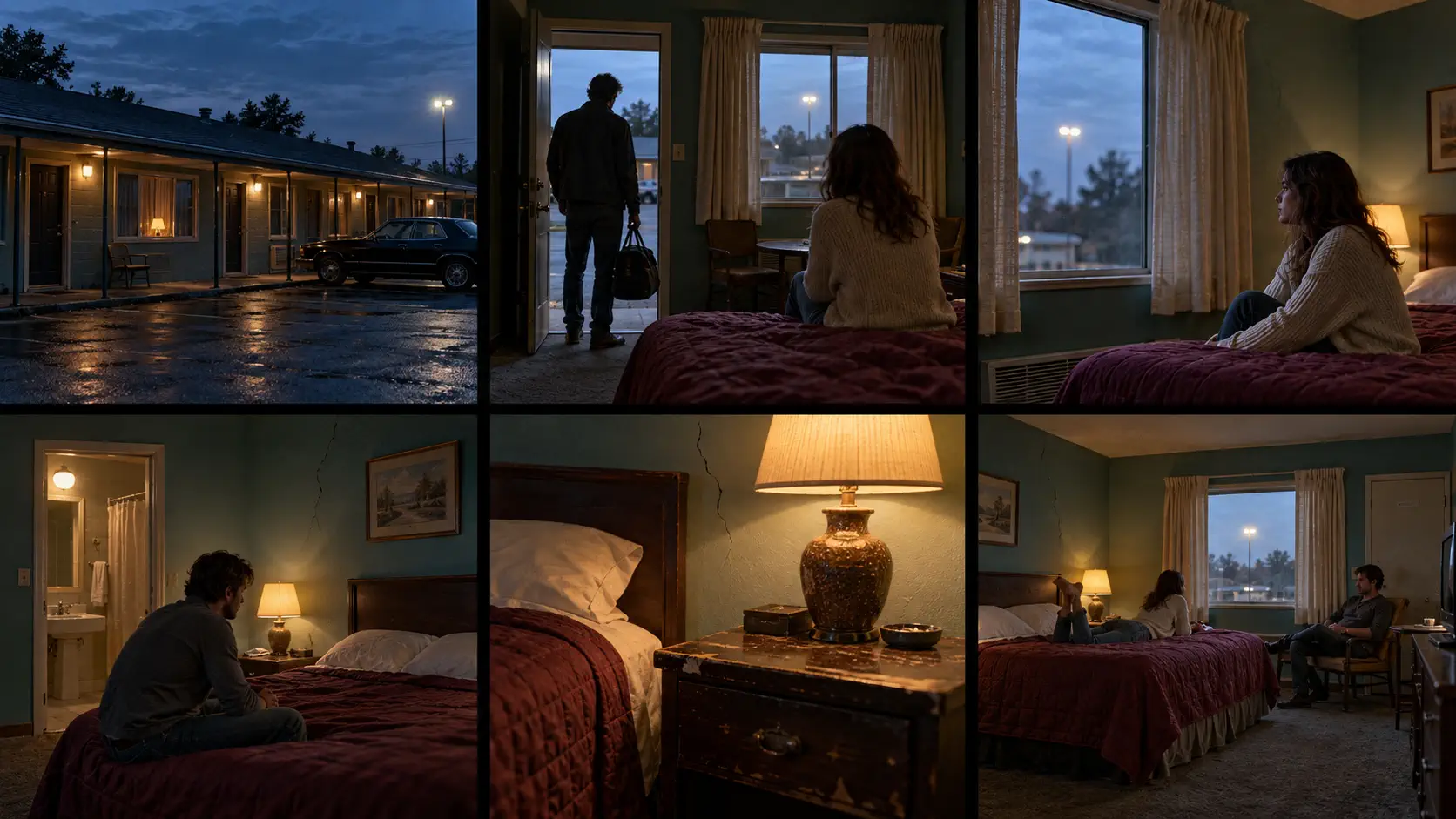
How do you test six frames for location drift?
Put the six panels in story order and compare them like a continuity editor. Do not begin with the most beautiful frame. Begin with the frame that best explains the room, then check every later angle against its doors, windows, fixed props and light direction.
- Exterior establishing shot: does the building have the same shape and fixture?
- Threshold shot: does the entrance lead into the same room layout?
- Window shot: does the exterior view line up with the wide frame?
- Reverse angle: do the bathroom door, bed and nightstand stay on the correct sides?
- Detail shot: is the fixed prop the same material, colour and condition?
- Final wide shot: can you map every actor back into the original room?
How do characters and locations stay consistent together?
Lock the actor and the room as separate references, then keep their descriptions independent. A character moving from a doorway to a bed should not cause the bed to move. The model needs both anchors present in the prompt, but the anchors should not be blended into one long sentence about mood.
The AI character reference sheet defines the actor; the location kit defines the set. The combination is useful for storyboards, coverage tests and short stills sequences. For a structured sequence, pair this workflow with the shot-list guide.
What are the most common location-consistency mistakes?
The first mistake is writing a beautiful location prompt instead of a repeatable one. A new adjective in every panel gives the model a new set to build. The second is using a close-up as the location master; the viewer needs a wide frame before detail can be checked against it.
The third is changing too many variables at once. If the camera, wardrobe, lens and time of day all move between panels, there is no way to know which change broke continuity. Lock the anchor paragraph, then change one visual variable per test.
- No wide location plate before close-ups and reverse angles.
- A new description of the room in every prompt.
- Fixed props changing size, side or material.
- Time of day changing without a scene transition.
- Lighting direction reset with each camera angle.
- Using image similarity as the only test instead of checking spatial logic.
Frequently asked
What is AI location consistency?
It is the ability to keep the same architecture, layout, fixed props, materials, lighting and time of day across AI-generated shots. The goal is that a new camera angle reveals the same place rather than redesigning it.
Can I keep the same background in different AI images?
Yes. Make an empty wide frame the location master, save its prompt and use it as a start reference. Repeat the exact location anchors in every prompt and add only the character, blocking and camera changes required by the shot.
Should the location prompt include every object in the room?
No. Include only fixed objects that establish geography or continuity: doors, windows, large furniture, a distinctive lamp or a visible wall detail. Temporary props belong in the shot-specific prompt so they can change with the action.
How can I tell whether the location has drifted?
Compare six frames as a sequence: exterior, threshold, window, reverse angle, detail and final wide. Map each door, window and fixed object back to the establishing frame. If two shots cannot occupy the same room, continuity has failed.
Does location consistency require a reference image?
A reference makes the work more reliable, but the written anchors still matter. The reference supplies visual evidence; the prompt explains which relationships in that evidence must survive the new camera angle.
Your first cinematic frame is one prompt away
Sign in with Google, pick a plan and keep every still at the resolution the model produced. Plans from $12/month, cancel at any time. No watermark, no re-encode.