
AI tilt-shift
A miniature-effect workflow: high angle, narrow focus band, heavy blur and known-size objects, with six scene briefs and a strength test.
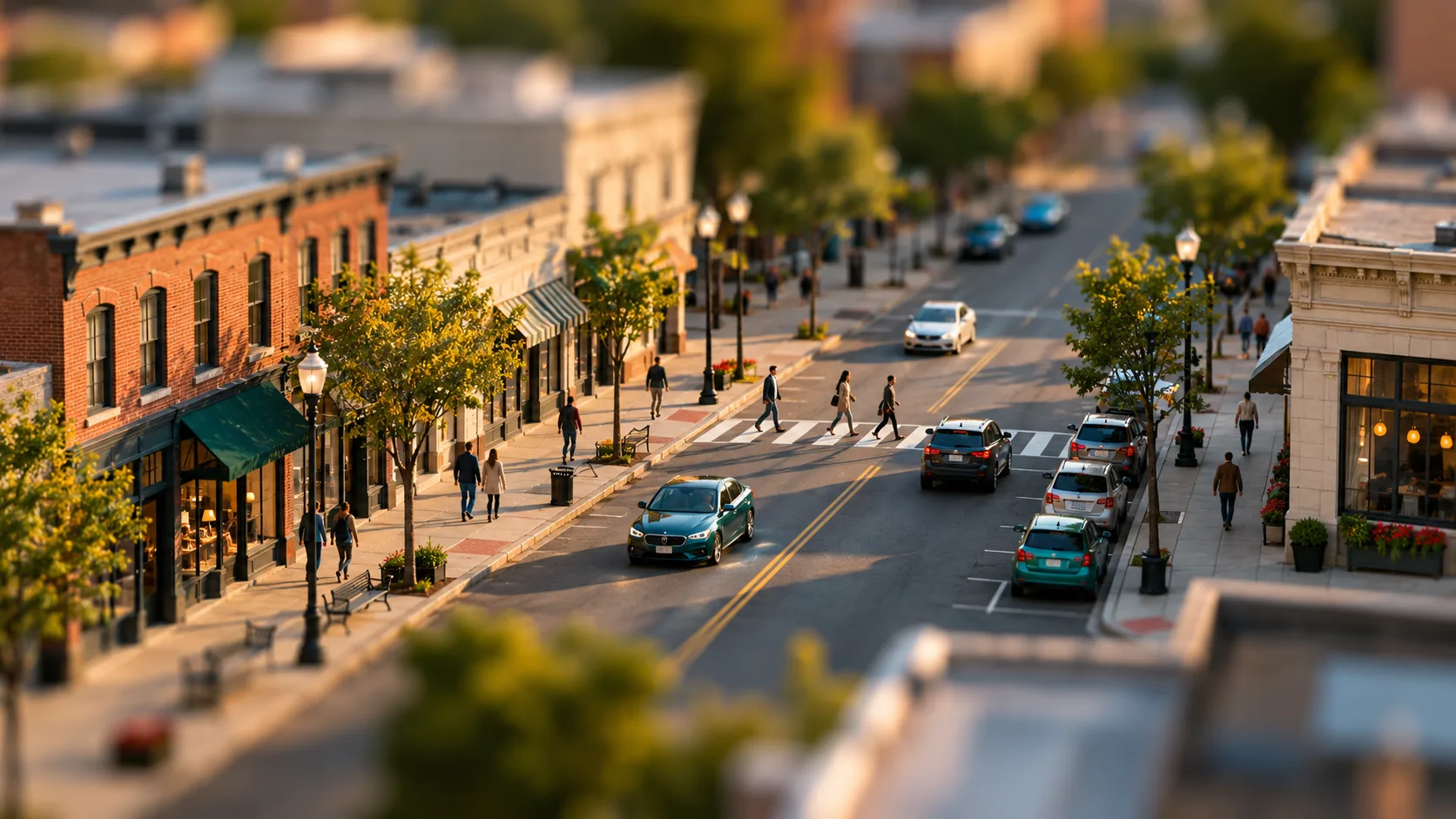
What is tilt-shift photography?
A tilt-shift lens can tilt the plane of focus and shift the image circle. Tilt makes a narrow band of the frame sharp while the rest falls away; shift keeps vertical lines parallel when the camera looks up at a building. The famous “miniature city” effect is a tilt effect, not a scale effect.
The miniature illusion depends on three things: a high angle, a narrow focus band and objects that look like toys. If the angle is at eye level, the effect reads as a blur, not as a model.
The depth of field guide covers ordinary focus falloff; this page covers the tilted plane. The composition guide covers the high-angle frame.
How do you prompt the miniature effect?
Name the high angle, the narrow focus band and the heavy blur outside it. “High-angle view of a city intersection, a narrow horizontal band of sharp focus across the middle, the foreground and background heavily blurred, cars and pedestrians looking like toys” is a complete instruction.
Add scale cues: small cars, crosswalks, awnings, tiny figures. The viewer needs objects whose real size they know. Without those cues, the blur is just a blur.
- High angle, looking down.
- A narrow horizontal focus band.
- Heavy blur above and below the band.
- Cars, crosswalks and figures for scale.
- Warm side light for long shadows.
- No readable text or logos.
When does tilt-shift fail?
It fails when the angle is too low. At eye level, a blurred foreground and background looks like a broken lens, not a miniature. It also fails when the focus band is too wide or too narrow: a wide band loses the effect, a one-pixel band looks like a mistake.
Avoid text and logos in the sharp band. Readable signs break the illusion because real miniature models rarely have crisp typography. Keep the sharp detail to cars, people, crosswalks and architecture.
| Problem | Cause | Fix |
|---|---|---|
| Looks like a blur | Low camera angle. | Raise the camera to a high angle. |
| No miniature feeling | Focus band too wide. | Narrow the band, increase blur outside. |
| Looks like a mistake | Band too narrow. | Widen the band slightly. |
| Scale is unclear | No known-size objects. | Add cars, figures, crosswalks. |
| Illusion breaks | Readable text or logos. | Keep the sharp band free of legible text. |
| Too toy-like | Oversaturated colors and blur. | Restrain color, keep realistic materials. |
What is the difference between tilt and shift?
Tilt changes the plane of focus. It is the effect behind the miniature look and the “slice of focus” in landscape and product photography. Shift moves the image circle to correct perspective, keeping vertical lines parallel when the camera looks up.
For a miniature city, you want tilt. For architecture, you want shift. A frame that needs both is possible, but it is a technical setup, not a mood.
| Movement | What it does | Use for | Visual result |
|---|---|---|---|
| Tilt | Rotates the focus plane. | Miniature effect, selective focus. | A sharp band with heavy blur outside. |
| Shift | Moves the image circle. | Architecture, verticals. | Parallel vertical lines, no keystone. |
| Tilt + shift | Both movements. | Architectural models, technical work. | Selective focus with corrected perspective. |
| No movement | Ordinary lens. | Normal photography. | Standard depth of field and perspective. |
Which six tilt-shift scenes should you brief?
Six scenes cover the effect: the city intersection, the beach crowd, the train yard, the market, the highway and the stadium. Each one uses a high angle and a narrow band to turn a real place into a model.
| Scene | Angle | Focus band | Prompt anchor |
|---|---|---|---|
| City intersection | High angle. | Across the crosswalk. | Cars and pedestrians like toys, long shadows. |
| Beach crowd | High angle. | Along the shoreline. | Umbrellas, tiny figures, soft surf. |
| Train yard | High angle. | Across the tracks. | Freight cars, containers, rails. |
| Market | High angle. | Along the stalls. | Awnings, produce, shoppers. |
| Highway | High angle. | Across the lanes. | Trucks, cars, overpass, long light. |
| Stadium | High angle. | Across the field. | Players, crowd, floodlights. |
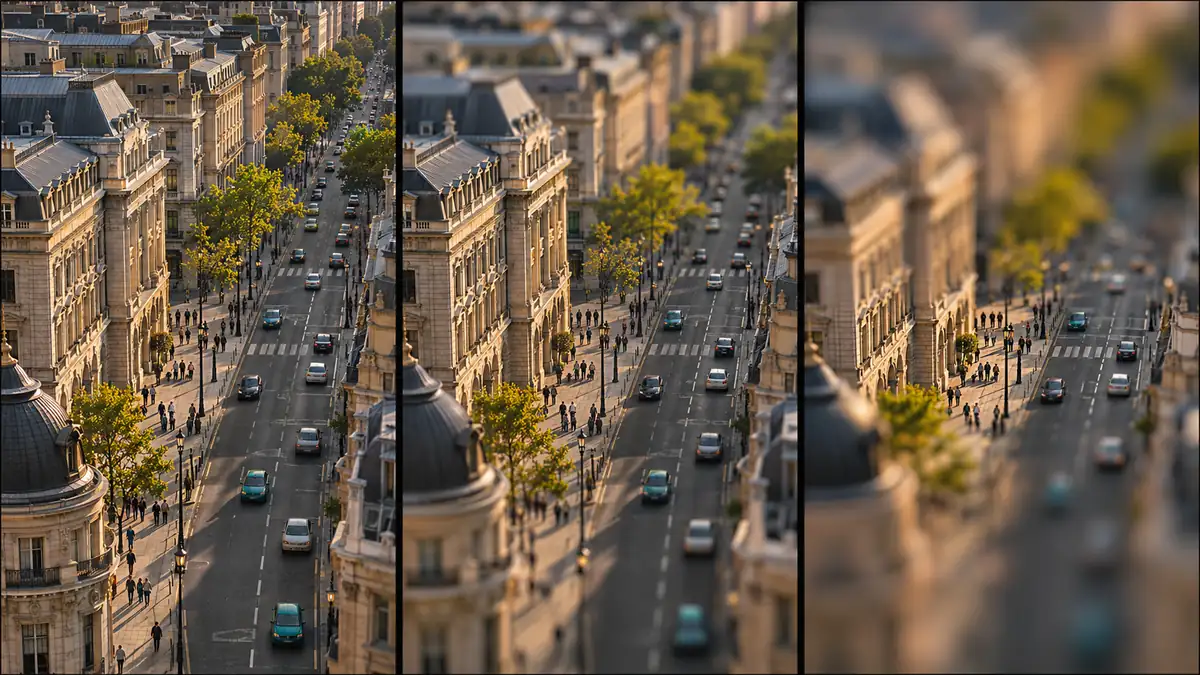
How do you keep the look across a sequence?
Fix the camera height, the focus band width and the light direction. Change the location and the action, not the tilt. A sequence that alternates between a high-angle miniature and an eye-level street loses the effect immediately.
Review the set as a contact sheet and keep the palette with Palette Lock. The aspect ratio guide covers the wide composition.
What are common tilt-shift AI mistakes?
The first mistake is a low angle. The second is a blur that looks like a gradient overlay instead of an optical effect. The third is a focus band with readable text. The fourth is over-saturated toy colors. The fifth is a band that changes position between frames.
The sixth is using tilt-shift on a subject that needs no miniature effect. The technique is a specific illusion; if the frame does not need it, it becomes a gimmick.
- Low camera angle.
- A gradient blur instead of a focus plane.
- Readable text in the sharp band.
- Over-saturated toy colors.
- The band moving between frames.
- Tilt-shift used as a default gimmick.
Frequently asked
How do I write a tilt-shift AI prompt?
Name the high angle, the narrow focus band and the blur outside it. For example: “high-angle view of a city intersection, narrow horizontal band of sharp focus across the crosswalk, foreground and background heavily blurred, cars looking like toys.”
Why does my tilt-shift image look like a blur?
The camera angle is probably too low. The miniature effect needs a high angle looking down, plus a narrow focus band and known-size objects such as cars and people.
What is the difference between tilt and shift?
Tilt changes the plane of focus and creates the miniature effect. Shift moves the image circle to correct perspective, keeping vertical lines parallel in architecture.
How wide should the focus band be?
Narrow enough to leave most of the frame soft, wide enough to read the subject. A band of roughly 10 to 20 percent of the frame height is a useful starting point.
Should a tilt-shift image have text?
No. Readable text or logos in the sharp band breaks the miniature illusion. Keep the detail to cars, figures, crosswalks and architecture.
Can Soul Cinema render a tilt-shift miniature effect?
Yes. Soul Cinema responds to high-angle, focus-band and miniature language. The result is an interpretation of the effect, not a simulation of a specific lens movement.
Your first cinematic frame is one prompt away
Sign in with Google, pick a plan and keep every still at the resolution the model produced. Plans from $12/month, cancel at any time. No watermark, no re-encode.