
AI telephoto compression
A focal-length workflow: stack background layers, isolate the subject and keep the city readable, with six scene briefs and a compression sequence.
What is telephoto compression?
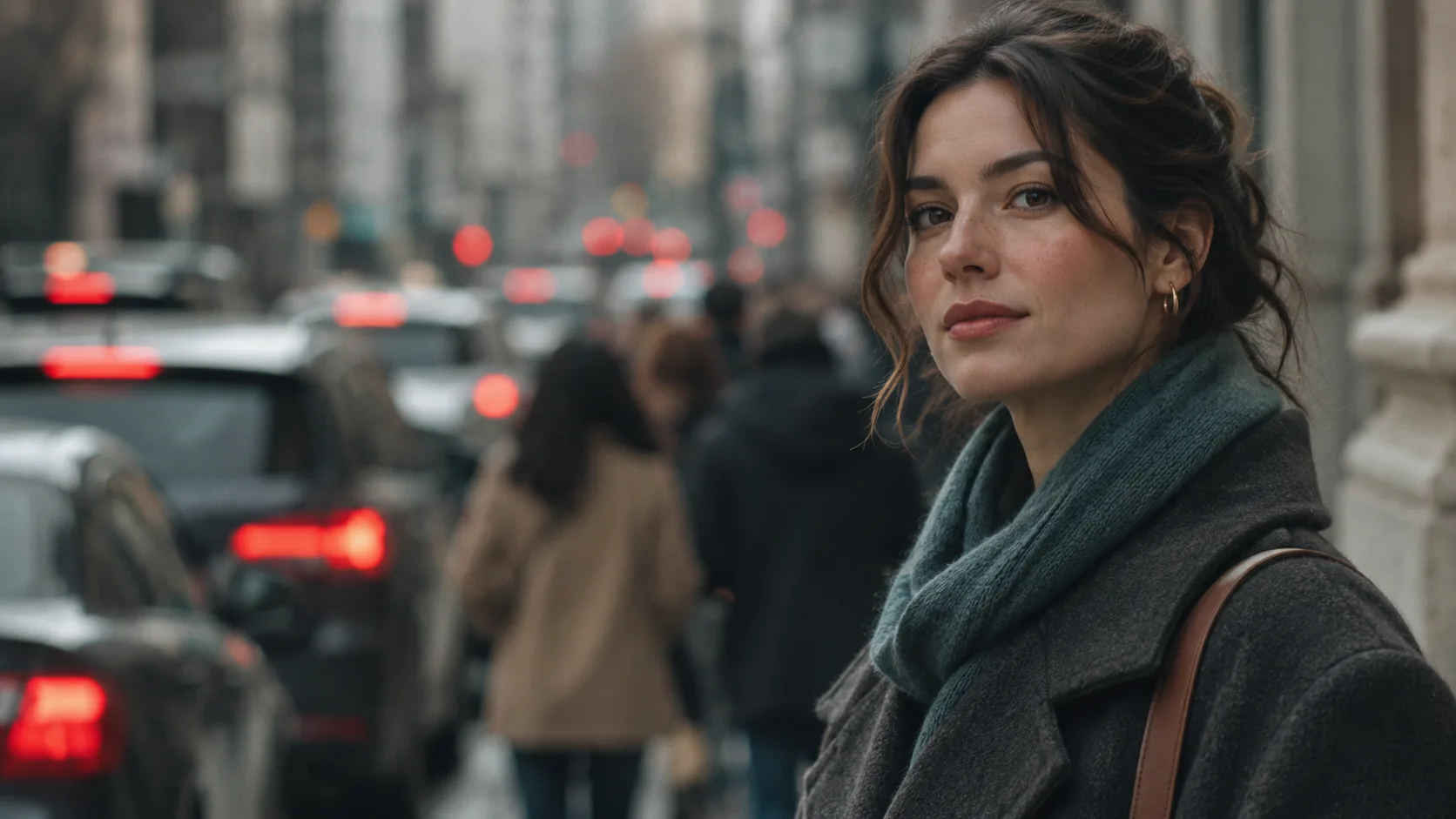
A telephoto lens makes distant planes appear closer together. The subject stays the same size in the frame while the background grows and flattens behind them. The result is isolation and pressure: the city seems to crowd the face.
Compression is not the same as shallow depth of field. A long lens can compress a background that is still readable, and a wide lens can blur a background that remains spatially distant. The two controls work together, but they do different jobs.
The depth of field guide covers focus and bokeh; this page covers focal length and compression. The camera angle guide covers the angle itself.
Which focal length should you name?
35mm keeps the street in the frame and the background at a natural distance. 50mm is a neutral portrait lens. 85mm begins to compress and is the safest cinematic portrait choice. 135mm stacks the background heavily. 200mm turns the background into a wall behind the subject.
Pick the length by how much context you want to keep. If the place matters, stay wide. If the face matters and the place should become pressure, go long.
| Focal length | Compression | Best for | Watch out for |
|---|---|---|---|
| 35mm | Minimal. | Street portrait, context, movement. | Background still feels far away. |
| 50mm | Neutral. | Dialogue, medium portrait. | Less separation than 85mm. |
| 85mm | Moderate. | Classic cinematic portrait. | Background can become generic. |
| 135mm | Strong. | Compressed city portrait, isolation. | Flattens the face slightly. |
| 200mm | Heavy. | Distant subject, background wall. | Very little context survives. |
| 300mm+ | Extreme. | Surveillance, crowds, abstraction. | Subject and background merge. |
How do you prompt compression?
Name the lens, the distance and the background behavior. “135mm telephoto, subject sharp on the right third, traffic and buildings stacked close behind, compressed background” gives the model three linked instructions. “Telephoto” alone often produces a normal portrait with a blurry background.
Describe the background as layers, not detail. A compressed background is a stack of shapes and colors: cars, signs, windows, people. If you ask for a sharp background, the model may ignore the compression and render a deep-focus street.
- Name the focal length.
- Name the subject distance: across the street, down the block.
- Ask for stacked background layers.
- Keep the subject sharp and the background soft.
- Describe shapes and color, not readable detail.
- Use “compressed background” as an explicit cue.
How do you keep the background readable?
Compression works best when the background is still legible as a place. Keep large shapes: a car, a sign, a row of windows, a crossing signal. Blur the detail but preserve the color and the silhouette.
If the background disappears completely, the image becomes a studio portrait with a long lens. If it stays fully sharp, the compression is not visible. The target is a soft, stacked, colorful wall behind the subject.
| Background element | Keep | Lose |
|---|---|---|
| Traffic | Car silhouettes, tail lights. | License plates, badges. |
| Buildings | Window grids, rooflines. | Readable signs, addresses. |
| People | Silhouettes, umbrellas. | Faces, logos on clothing. |
| Street furniture | Traffic lights, poles. | Readable text, maps. |
| Vegetation | Tree canopy shapes. | Individual leaves. |
| Weather | Rain streaks, haze. | Sharp droplets on the lens. |
Which six telephoto scenes should you brief?
Six scenes cover the look: the city portrait, the street crossing, the stadium crowd, the car in traffic, the window from across the street and the mountain compression. Each one uses compression for a different kind of pressure.
| Scene | Lens | Background | Prompt anchor |
|---|---|---|---|
| City portrait | 135mm | Traffic and buildings stacked. | Subject on the right third, compressed street, soft tail lights. |
| Street crossing | 200mm | Crowd and crosswalk. | Subject isolated in the crowd, layered silhouettes. |
| Stadium crowd | 300mm | Rows of spectators. | One face sharp, crowd compressed into color. |
| Car in traffic | 135mm | Cars stacked behind. | Driver in the window, compressed traffic, wet road. |
| Window across the street | 200mm | Facade and fire escape. | Figure in the window, compressed building layers. |
| Mountain compression | 200mm | Ridges stacked. | Hiker small against layered ridges, haze between. |
How do you keep the look across a sequence?
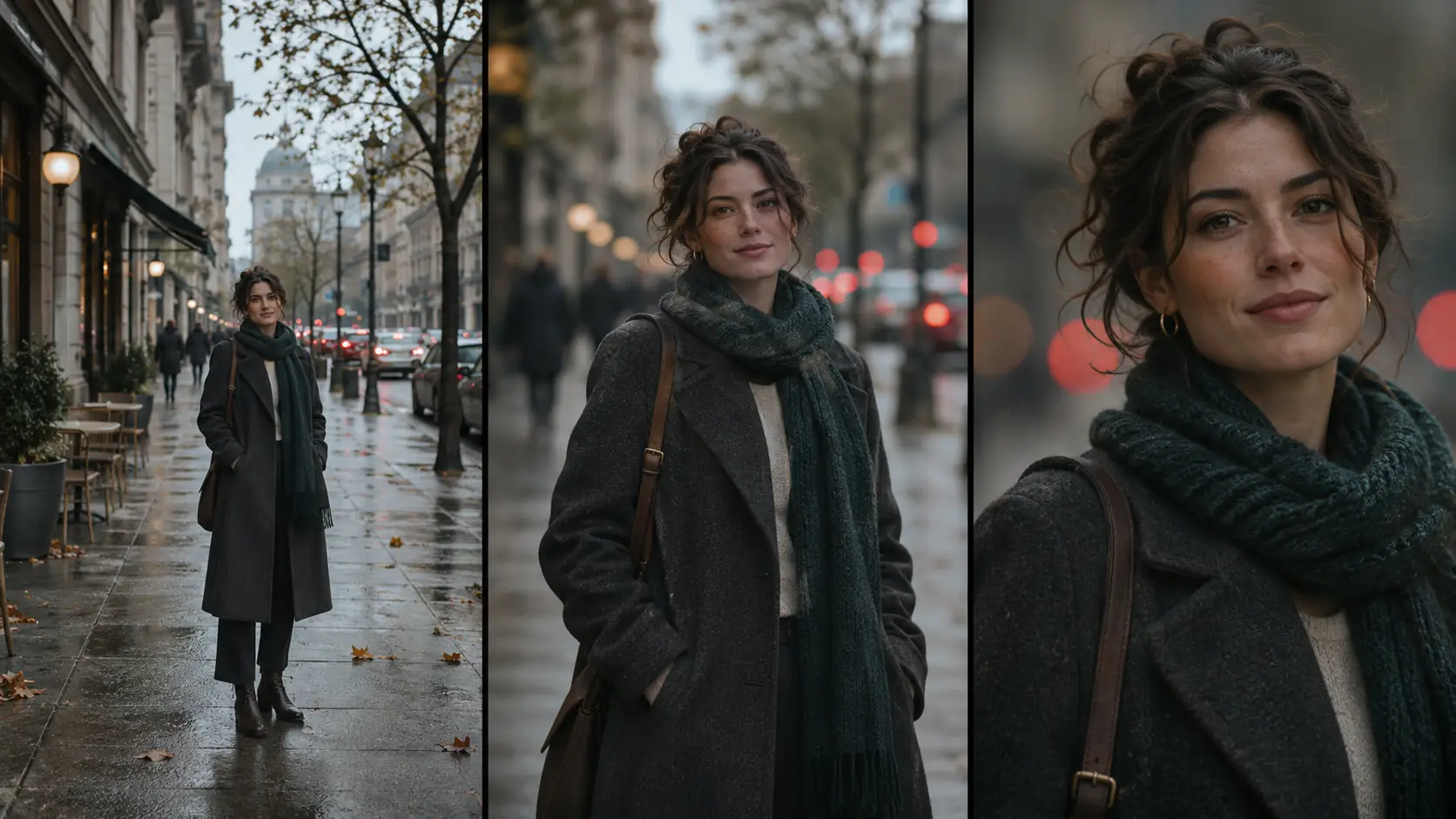
Fix the focal length, the subject distance and the background stack. Change the pose and the location, not the optics. If the first frame is 135mm and the second is 35mm, the city jumps away from the face.
Review the set as a contact sheet and keep the palette with Palette Lock. The film stock guide covers the texture around the lens.
What are common telephoto AI mistakes?
The first mistake is “telephoto” with a wide-looking background. The second is a completely sharp background that kills the compression. The third is a background with readable text. The fourth is a focal length that changes between frames.
The fifth is using compression on a subject that needs context. The sixth is a face flattened by an extreme lens. Compression is a tool, not a default.
- “Telephoto” with a wide-angle background.
- A fully sharp background.
- Readable text in the layers.
- Focal length changing between frames.
- Compression on a scene that needs context.
- An extreme lens flattening the face.
Frequently asked
How do I prompt telephoto compression in AI?
Name the focal length, the subject distance and the background behavior. For example: “135mm telephoto, subject across the street, traffic and buildings stacked close behind, compressed background, subject sharp.”
What is the difference between compression and bokeh?
Compression is the optical stacking of background planes by a long lens. Bokeh is the shape of out-of-focus highlights. A long lens compresses; a wide aperture blurs. You can have one without the other.
Which focal length is best for portraits?
85mm is the safest cinematic portrait length. 135mm gives stronger compression and isolation; 50mm keeps more context; 35mm is an environmental portrait lens.
Why does my telephoto image look normal?
The model probably kept the background at a wide-angle distance. Ask for stacked background layers, a compressed background and a subject across the street or down the block.
Should the background be blurry or sharp?
Soft but readable. Keep the shapes and colors, lose the detail and text. A fully sharp background hides the compression; a fully blurred background loses the place.
Can Soul Cinema simulate a specific focal length?
It responds to focal length language and produces a plausible compression effect, but it does not simulate a specific physical lens. Keep the focal length fixed across a sequence for consistency.
Your first cinematic frame is one prompt away
Sign in with Google, pick a plan and keep every still at the resolution the model produced. Plans from $12/month, cancel at any time. No watermark, no re-encode.