
AI macro photography
A scale-shift workflow: one object, a razor-thin focus plane, close light and honest texture, with six subject briefs and a focus test.
What makes macro photography cinematic?
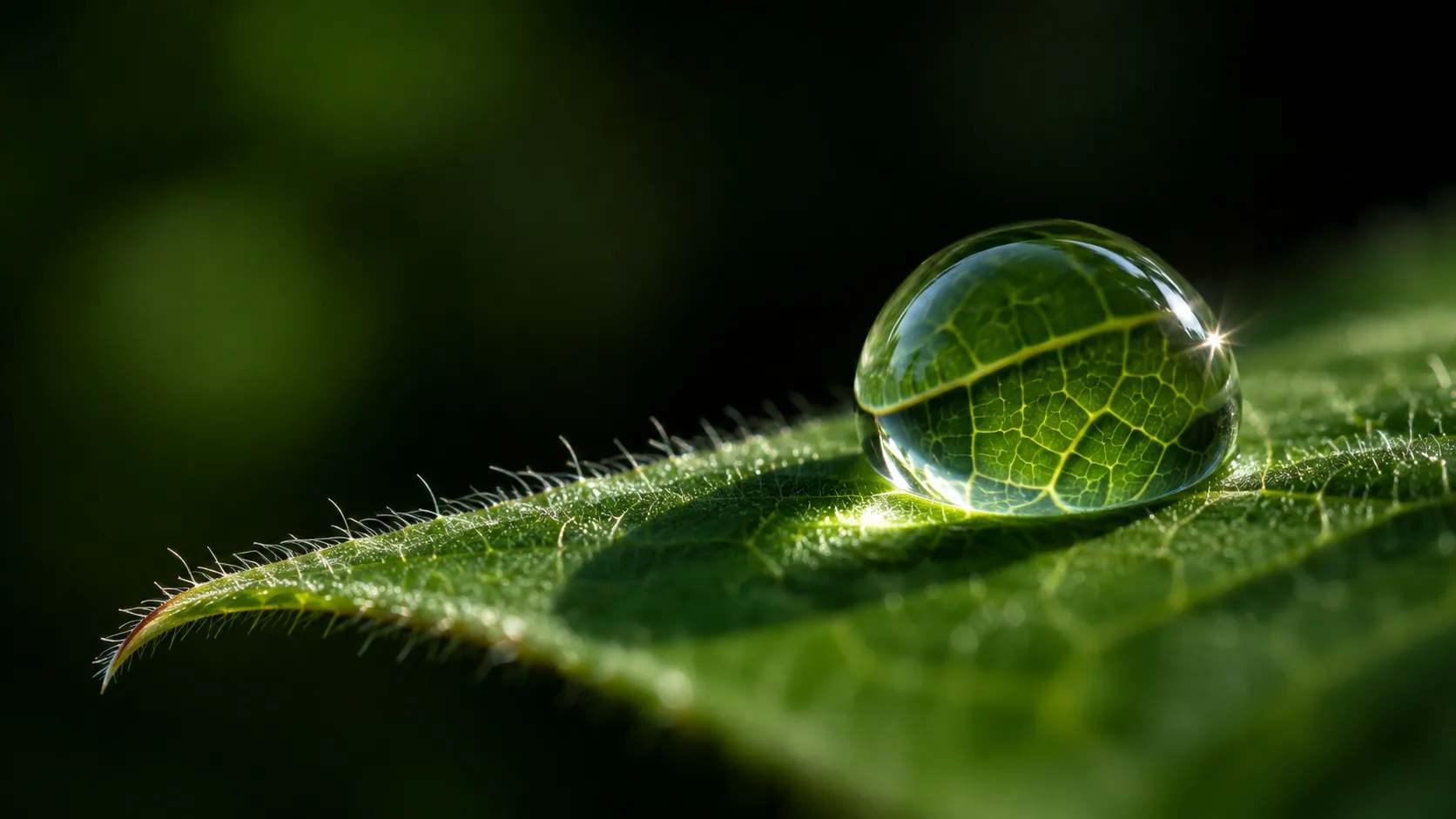
Macro is a scale shift. A droplet, a leaf edge or a watch gear becomes a landscape. The frame works when one object fills the image, the focus plane is razor-thin and the light describes the surface. It is not a close-up with a blurry background; it is a different way of seeing.
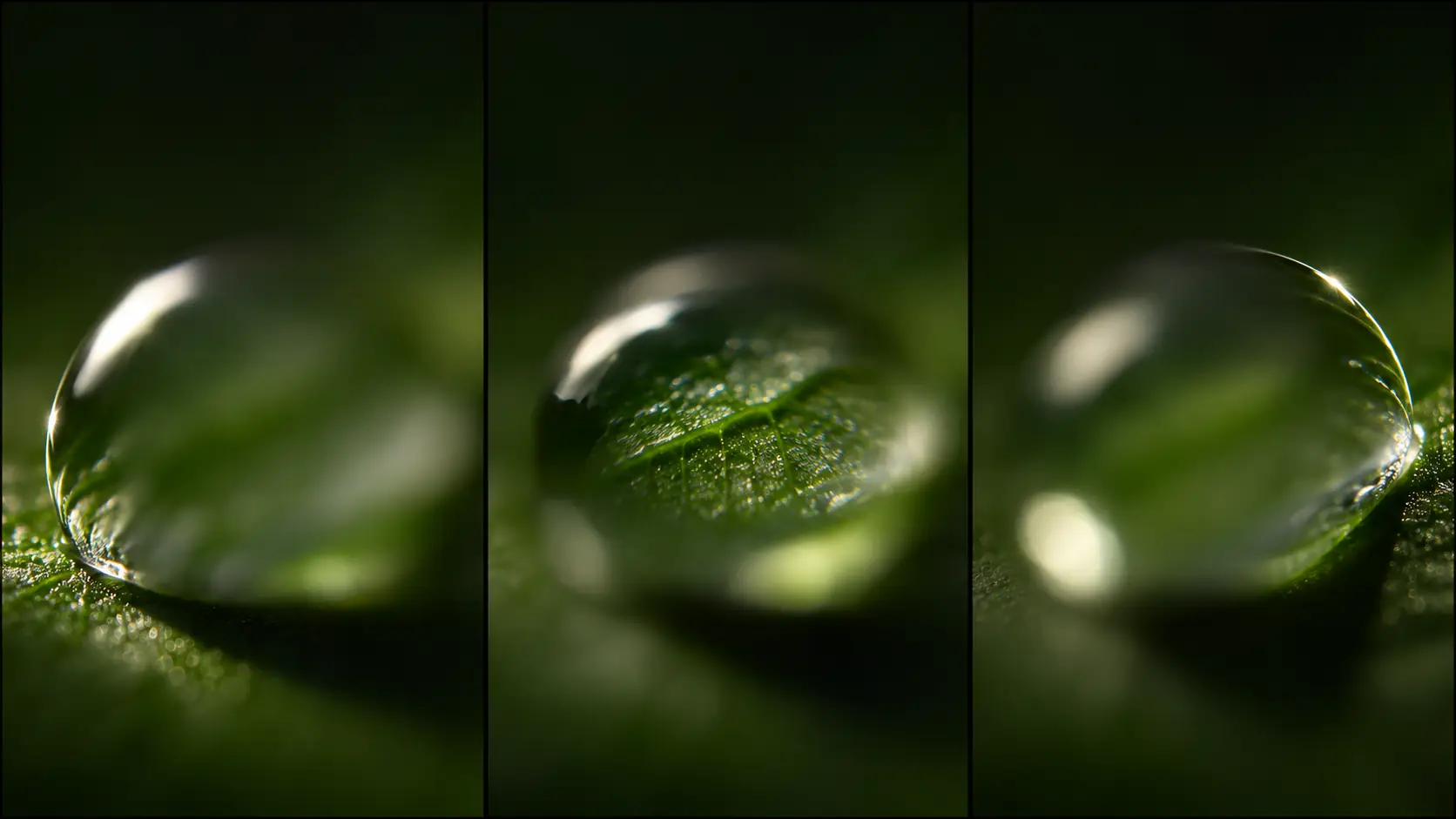
The most important control is the focus plane. In macro, only a sliver of the image is sharp. Where that sliver sits decides what the viewer reads: the front edge, the center, the back edge or a single detail.
The depth of field guide covers aperture and falloff; this page covers the extreme close-up. The product guide covers glossy surfaces and reflection.
How do you control the focus plane?
Name the sharp sliver and what falls away. “Focus on the front edge of the droplet, the center and background soft” is a usable instruction. “Macro” alone often produces a sharp subject with a generic blur, which is not the same thing.
Use focus to direct the eye. In a portrait-like macro, focus on the eye or the petal edge. In a texture study, focus on the center and let both ends fall away. In a product detail, focus on the logo area or the seam.
| Focus plane | Reads as | Best for |
|---|---|---|
| Front edge | Arrival, texture, depth behind. | Droplets, petals, fabric edges. |
| Center | A single detail isolated. | Watch dials, coins, seams. |
| Back edge | Mystery, soft foreground. | Insects, leaves, glass. |
| One eye | Portrait-like intimacy. | Extreme close portrait. |
| A line across | Graphic texture band. | Paper, bark, woven fabric. |
| Everything sharp | Focus stacking, scientific. | Product documentation, not cinema. |
How do you light macro?
Macro light is close and hard or close and diffused. A hard side light reveals texture and creates a deep shadow; a diffused source wraps the object and keeps highlights controlled. Backlight makes translucent subjects glow. A ring light gives even, flat detail.
The source should be close enough to shape the object. At macro distance, a small source becomes relatively large, so the falloff is steep. Describe the distance and the quality: “hard side light close to the leaf” or “soft diffused light from above”.
| Light | Effect | Best for | Watch out for |
|---|---|---|---|
| Hard side | Texture, sharp shadow. | Leaves, fabric, skin, stone. | Blown highlights on glossy surfaces. |
| Diffused | Soft gradient, controlled highlights. | Product detail, petals, glass. | Flat, catalog-like texture. |
| Backlight | Glow, translucency, rim. | Droplets, leaves, sheer fabric. | The front can go too dark. |
| Ring light | Even frontal detail. | Documentation, insects, coins. | No shape, no depth. |
| Window light | Soft directional gradient. | Natural still life, paper. | Weak texture without contrast. |
| Practical close-up | Warm pool, dark surround. | Jewelry, watch, night detail. | Color cast and hot spots. |
How do you keep the scale readable?
A macro image needs one recognizable anchor: a water droplet, a leaf vein, a watch hand, a stitch. Without an anchor, the image becomes abstract texture and the viewer loses scale.
Keep the composition simple. One object, one surface, one light. If the frame has three objects, the focus plane cannot hold them all and the image becomes a busy blur.
- One recognizable object.
- One surface or background.
- One sharp sliver.
- One light source.
- A known texture for scale.
- No more than two supporting elements.
Which six macro subjects should you brief?
Six subjects cover the range: the droplet, the leaf edge, the watch movement, the fabric weave, the coin and the skin detail. Each one pairs a texture with a focus plane and a light.
| Subject | Focus | Light | Prompt anchor |
|---|---|---|---|
| Water droplet | Front edge. | Hard side. | Droplet refracting leaf veins, sharp edge, soft background. |
| Leaf edge | Center vein. | Backlight. | Translucent leaf, glowing veins, dark background. |
| Watch movement | Center gear. | Diffused plus a hard accent. | Metal gears, jewel bearing, shallow plane. |
| Fabric weave | A line across. | Hard grazing light. | Visible threads, shadow in the weave, neutral color. |
| Coin | Relief edge. | Hard side. | Metal texture, raised edge, dark background. |
| Skin detail | One eye or freckle. | Soft window light. | Pores, fine hair, shallow focus, no retouching. |
How do you keep a macro sequence consistent?
Fix the object, the light, the focus plane and the background. Change the angle and the detail, not the world. A macro sequence is usually one subject explored from several positions, so the surface and the light must stay identical.
Review the set as a contact sheet and keep the palette with Palette Lock. The film grain guide covers the texture that supports the close-up.
What are common macro AI mistakes?
The first mistake is a close-up with everything sharp. The second is a focus plane with no clear subject. The third is a ring-light flatness that removes texture. The fourth is too many objects in the frame. The fifth is a background that is either pure black or fully detailed.
The sixth is a scale with no anchor. Macro is about seeing one thing clearly; if the viewer cannot tell what it is, the image fails.
- Everything sharp in a macro frame.
- No clear focus plane.
- Flat ring light with no texture.
- Too many objects in the frame.
- A pure black or fully detailed background.
- No recognizable anchor for scale.
Frequently asked
How do I write a macro photography AI prompt?
Name one object, the sharp sliver, the light and the background. For example: “extreme macro of a water droplet on a leaf, focus on the front edge of the droplet, hard side light, deep green background, background soft.”
Why does my macro image look like a normal close-up?
The focus plane is probably too deep. Macro needs a razor-thin sharp area and a clear falloff. Name the exact sliver that stays sharp and what falls away.
What light is best for macro photography?
Hard side light for texture, diffused light for controlled highlights, backlight for translucency, ring light for flat documentation. Choose by the material and the story.
How do I keep scale in a macro image?
Use one recognizable anchor: a droplet, a leaf vein, a watch hand, a stitch. Without an anchor, the image becomes abstract texture.
Should a macro image be fully sharp?
Usually no. A razor-thin focus plane is part of the look. Full sharpness is useful for scientific or product documentation, but it reads less cinematic.
Can Soul Cinema render extreme close-ups?
Yes. Soul Cinema responds to macro language, focus plane descriptions and close light. The result is an interpretation of macro optics, not a physical lens simulation.
Your first cinematic frame is one prompt away
Sign in with Google, pick a plan and keep every still at the resolution the model produced. Plans from $12/month, cancel at any time. No watermark, no re-encode.