
AI cyberpunk movie stills
A high-tech, low-life workflow for cyberpunk stills: human scale, restricted neon palettes, wet streets and a six-scene sequence that avoids the preset look.
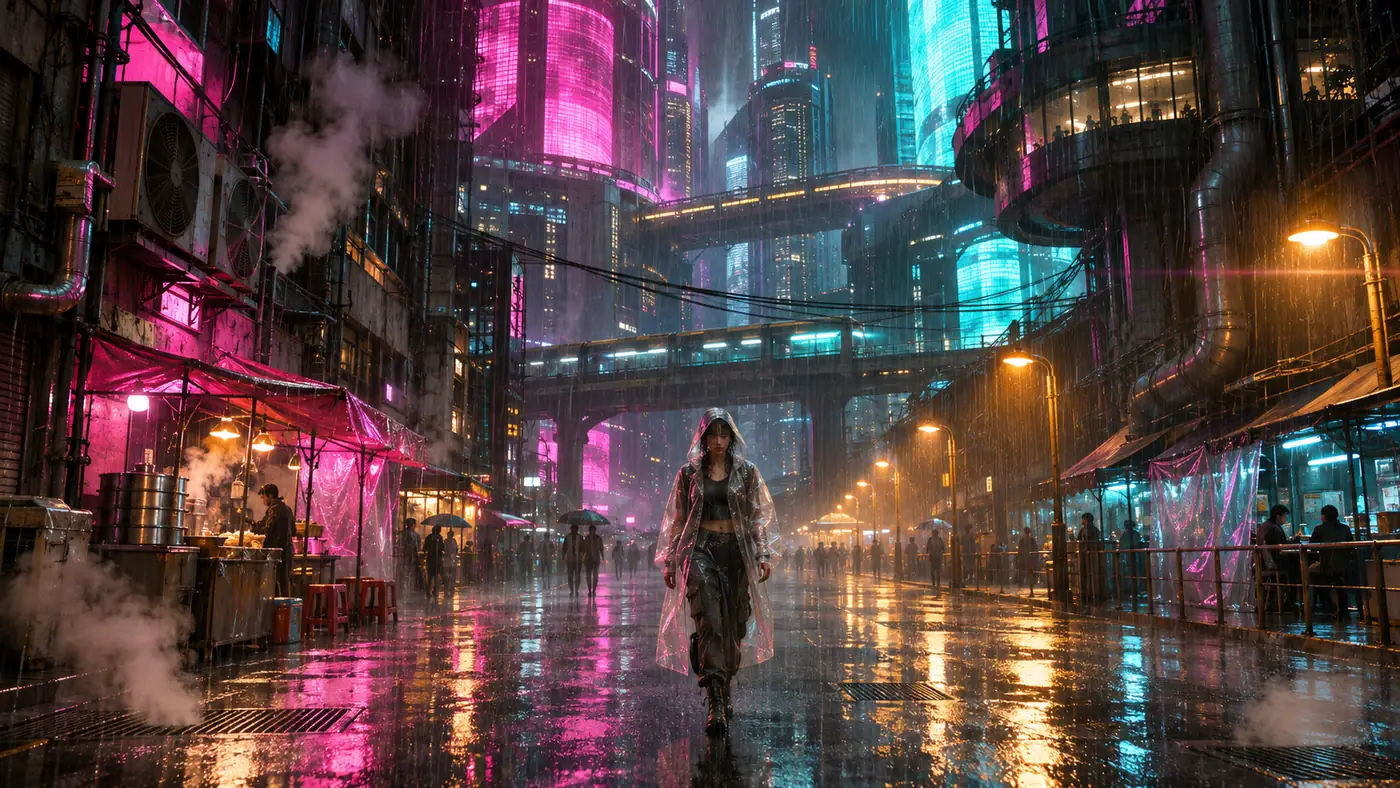
What makes a cyberpunk still?
Cyberpunk is a collision of scale and intimacy: corporate towers that dwarf a person, street-level clutter that feels lived in, and technology that is everywhere but rarely clean. The frame needs a human anchor, not just neon.
The genre’s useful visual rule is “high tech, low life”. Show the infrastructure above and the mess below. A wet street, a food stall, a tangled cable, a vent of steam: those details make the future feel used. Without them, the image is a science-fiction showroom.
Use the sci-fi stills guide when the frame is about scale and technology; use this page when the street and the human cost are the point. The rain workflow covers wet light and reflections.
How do you avoid the neon cliché?
The default cyberpunk image is magenta plus cyan plus rain. It reads instantly, but it also reads as a preset. Build a palette with a job: a cold corporate base, a sodium street layer, and one neon accent that belongs to a specific place.
A restricted palette is more convincing than a saturated one. Concrete gray, wet black and one acid green sign can feel more futuristic than a rainbow of LEDs. The accent should come from a motivated source — a sign, a screen, a vehicle — not a global color grade.
| Palette | Base | Accent | Best for |
|---|---|---|---|
| Corporate cool | Concrete gray, steel blue, white screens. | One warning red. | Tower interiors, lobbies, transit. |
| Street sodium | Wet black, sodium amber, grime. | One cyan sign. | Markets, alleys, noodle stalls. |
| Neon accent | Charcoal, deep blue, rain. | Magenta or green, one source. | Night streets, portraits, doorways. |
| Toxic daylight | Overcast gray, sickly green haze. | Orange warning light. | Industrial zones, daylight dystopia. |
| Monochrome plus one | Black, white, silver. | One saturated color. | Graphic, high-contrast frames. |
| Domestic neon | Warm tungsten, worn paint. | Small screen or appliance glow. | Apartments, intimate scenes. |
How do you keep human scale?
Put a person in the frame and let the architecture tower over them. A tiny figure at the base of a corporate entrance does more for scale than a wide shot of an empty skyline. Foreground clutter — a food cart, a bike, a puddle — adds a second layer of scale.
Lens choice matters. A 24mm or 35mm lens exaggerates the height of the towers; an 85mm compresses the street and isolates the face. Use the wide lens for the world and the long lens for the human cost, then alternate between them in the sequence.
- One human figure for scale.
- Towers or infrastructure above the figure.
- Foreground clutter at street level.
- 24–35mm for vertical scale.
- 85mm for intimate portraits.
- Alternate wide and long across the sequence.
How do you light a cyberpunk street?
Light comes from the world: signage, screens, vehicle lights, streetlamps and apartment windows. Pick one source to key the subject and let the rest become ambient color. Backlight the rain so the water reads, and keep the wet ground reflecting the same sources.
Steam and haze make the light visible. A vent, a kettle, a broken pipe: the source should have a physical reason. Fog without a source is just a gray overlay; steam with a practical behind it becomes volume.
The night portrait guide covers face lighting at street level. The color grading guide covers how to keep the neon from taking over the skin.
Cyberpunk versus sci-fi: what is the difference?
Science fiction asks what technology does to the world; cyberpunk asks who pays for it. The sci-fi frame often looks up at a clean structure; the cyberpunk frame looks down at the street. Both can share a palette, but the subject and the social texture are different.
If the image has a pristine lab, a starship or a vast clean interior, it is closer to sci-fi. If it has a noodle stall under a corporate tower, a repair shop, a crowded transit car or a rain-soaked alley, it is cyberpunk. Choose one mode before writing the prompt.
| Question | Sci-fi still | Cyberpunk still |
|---|---|---|
| Subject | Technology, scale, discovery. | People living under technology. |
| Camera height | Looking up or across. | Street level or looking down. |
| Texture | Clean surfaces, controlled light. | Grime, cables, steam, worn surfaces. |
| Palette | Cool white, steel, one accent. | Sodium, neon, wet black, concrete. |
| Human role | Explorer or scientist. | Worker, courier, outsider. |
| Typical frame | Lab, ship, megastructure. | Market, alley, apartment, transit. |
Which six cyberpunk scenes should you brief?
Six scenes cover the genre’s visual spine: the corporate entrance, the street market, the noodle stall, the transit car, the rooftop and the apartment. Each one changes the balance of scale, clutter and intimacy.
| Scene | Scale | Light | Prompt anchor |
|---|---|---|---|
| Corporate entrance | Monumental. | Cold white interior, one red warning. | Tiny figure at the base, polished stone, rain outside. |
| Street market | Human. | Sodium bulbs, one cyan sign. | Crowded stalls, cables, steam, wet pavement. |
| Noodle stall | Intimate. | Warm cooking light, cool street behind. | Counter, rising steam, lone customer, rain beyond. |
| Transit car | Crowded. | Fluorescent interior, neon outside. | Passengers, reflections, city streaking past. |
| Rooftop | Vast. | Sign glow and distant towers. | Figure at the edge, antennas, haze, city below. |
| Apartment | Domestic. | Screen glow and one warm lamp. | Small room, cables, window with neon, lived-in detail. |
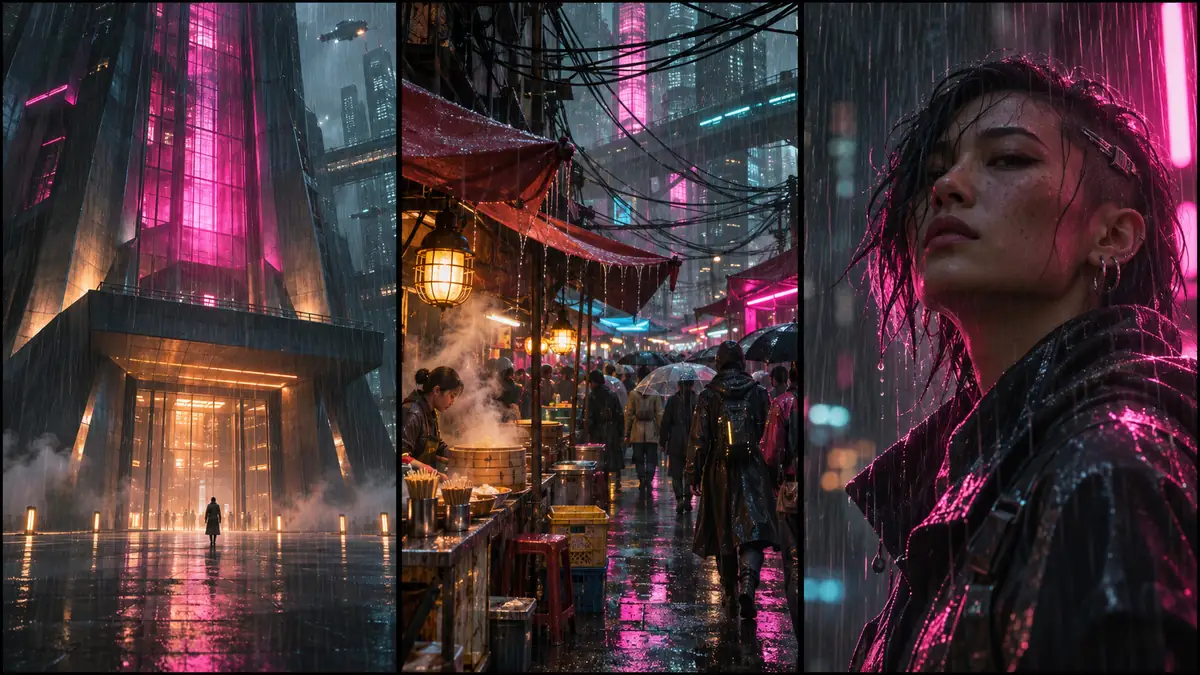
How do you keep the sequence consistent?
Fix the city rules: the palette, the signage logic, the weather, the level of grime and the time of night. Then change only the location and the distance. If the street is clean in one frame and flooded in the next, the city stops feeling like one place.
Keep signage abstract. Models will invent readable text that looks wrong or becomes a legal problem. Ask for “abstract neon signage, no readable text” and add any real branding later if the production needs it.
Review the set as a contact sheet and keep the palette with Palette Lock. The noir workflow is the closest reference for hard night light and moral shadow.
What are common cyberpunk AI mistakes?
The first mistake is magenta plus cyan with no human anchor. The second is a clean, empty street with no clutter. The third is readable signage that looks like a real brand. The fourth is a character who looks like a costume rather than a person who lives there.
The fifth is confusing scale: a tiny figure in a small alley, or a close-up with no city context. The sixth is a different city on every frame. Cyberpunk is a world-building genre; continuity is part of the look.
- Neon palette with no human anchor.
- Clean, empty streets with no clutter.
- Readable signage or invented brands.
- Costume-like characters with no lived-in detail.
- Scale that contradicts the location.
- A different city on every frame.
Frequently asked
How do I write a cyberpunk AI prompt?
Name the human anchor, the infrastructure above, the street-level clutter, one motivated key source and a restricted palette. For example: “lone courier under a corporate tower, wet market street, sodium bulbs and one cyan sign, backlit rain, concrete gray and amber.”
Why does my cyberpunk image look like a preset?
It probably relies on magenta and cyan without a human anchor or street-level detail. Build a palette with a base, a street layer and one accent, then add clutter, steam and a person for scale.
What is the difference between cyberpunk and sci-fi stills?
Sci-fi looks at technology and scale; cyberpunk looks at who lives under it. If the frame has a market, an alley, a transit car or an apartment, it is cyberpunk even when the technology is advanced.
How do I keep signage from rendering as text?
Ask for abstract neon signage with no readable text, and keep signs out of focus or at an angle. Add real branding later in a design tool if the production needs it.
How do I keep a cyberpunk sequence consistent?
Fix the palette, weather, time of night, grime level and signage logic, then change only the location and distance. Review the set as a contact sheet before rendering more frames.
Does Soul Cinema generate a cyberpunk film?
No. Soul Cinema renders stills and keyframes. Motion, sound and editing happen in a separate video workflow.
Your first cinematic frame is one prompt away
Sign in with Google, pick a plan and keep every still at the resolution the model produced. Plans from $12/month, cancel at any time. No watermark, no re-encode.