
Anamorphic lens AI
An optical workflow for anamorphic stills: 2.39 framing, oval bokeh, one horizontal flare and a restraint test that avoids the overlay look.
What does an anamorphic image look like?
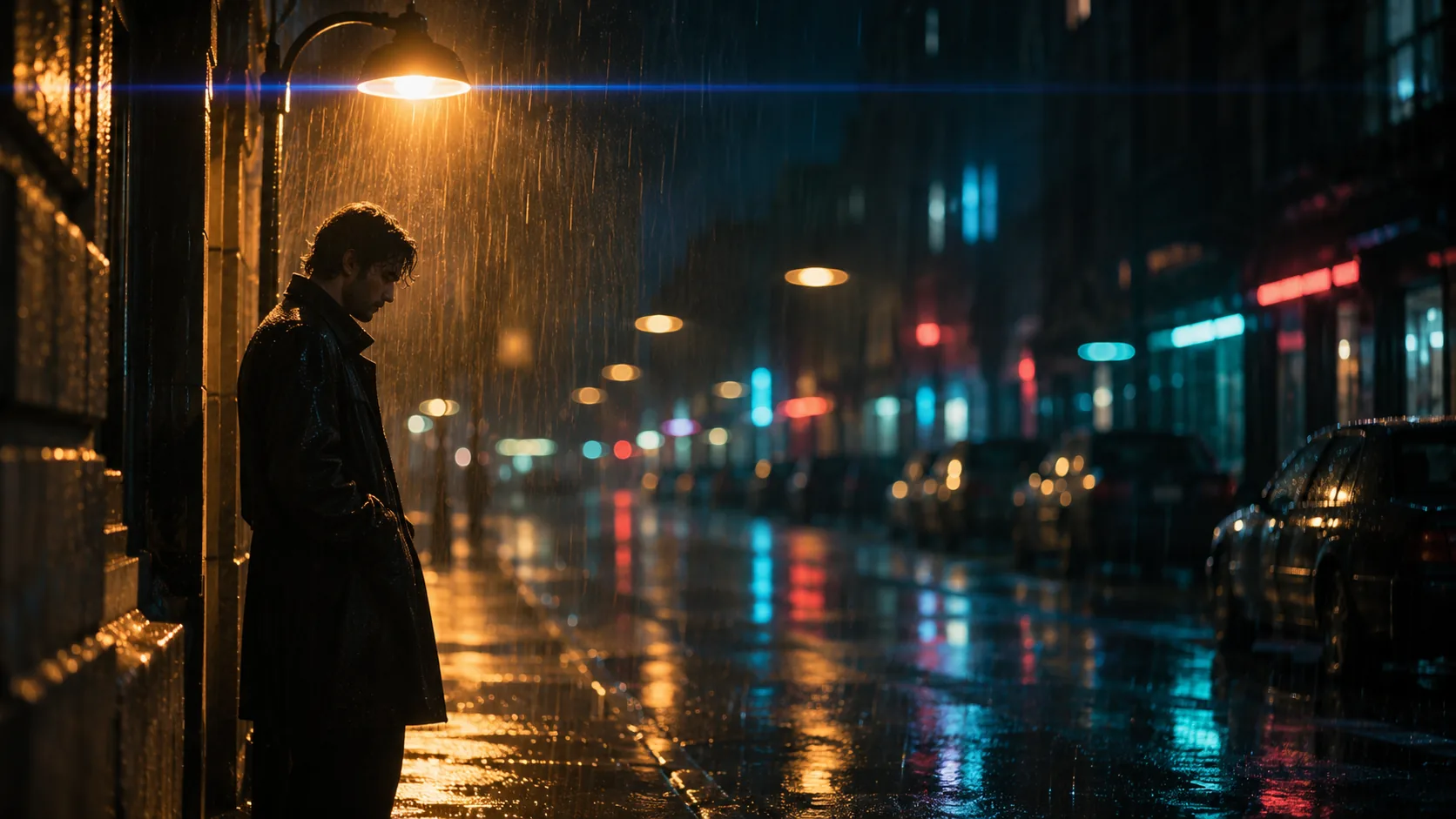
An anamorphic lens squeezes a wide image onto a narrower sensor and stretches it back in projection. The visible result is a wide frame, oval bokeh, horizontal flares, a gentle falloff at the edges and a slightly organic distortion. The look is optical, not a color grade.
The most recognizable cue is the background highlight: out-of-focus points become ovals, not circles. The second cue is the horizontal flare from a bright source. Everything else — the wide ratio, the softness, the falloff — supports those two.
Use the aspect ratio guide for 2.39 framing and the depth of field guide for focus. This page covers the anamorphic artifacts themselves.
Which artifacts should you prompt?
An anamorphic look has five useful artifacts: oval bokeh, a horizontal flare, a blue streak, edge falloff and mild distortion. Pick one or two. A frame with all five at full strength looks like a filter, not a lens.
The strongest combination is oval bokeh plus one horizontal flare with a named source. The bokeh tells the viewer the lens is anamorphic; the flare tells them where the light is. The other artifacts should stay subtle or absent.
| Artifact | Prompt cue | Strength |
|---|---|---|
| Oval bokeh | Oval out-of-focus highlights in the background. | Primary cue, keep visible. |
| Horizontal flare | A horizontal blue flare from a streetlamp at the frame edge. | One source, subtle. |
| Blue streak | A thin blue streak crossing the highlights. | Only with a bright source. |
| Edge falloff | Gentle softness and darkening at the frame edges. | Subtle. |
| Distortion | Slight barrel distortion, horizon bowing at the edges. | Very subtle or absent. |
| Focus breathing | Focus shifting as the subject moves. | Video only, not a still cue. |
How do you write the anamorphic prompt?
Start with the subject and the scene, then add the optics. “Lone figure under a streetlamp, wet asphalt, oval bokeh in the background, one horizontal blue flare from the lamp, 40mm anamorphic, 2.39:1” gives the model a scene and two optical cues.
Do not lead with “anamorphic” and hope the model invents the rest. Name the ratio, the lens, the bokeh shape and the flare source. The source matters: a flare without a light is a random streak.
- Subject and scene first.
- Name 2.39:1 or 2.00:1 framing.
- Name the lens: 40mm, 50mm or 75mm anamorphic.
- Ask for oval bokeh in the background.
- Give the flare one named source.
- Add mild edge falloff only if needed.
How do you avoid anamorphic overdose?
Overdone anamorphic looks like a sci-fi overlay: every highlight streaks, the edges are smeared and the frame glows. Real anamorphic is mostly a wide, soft frame with oval bokeh and one or two flares. Restraint is the difference between a lens and a plugin.
Keep the face and the subject sharp. If the flare crosses the eyes or washes out the skin, move the source to the frame edge or reduce the flare to a subtle streak.
| Problem | Cause | Fix |
|---|---|---|
| Every highlight streaks | “Anamorphic flares” with no limit. | One flare, one named source. |
| Soft, smeared edges | Too much edge falloff or distortion. | Remove distortion, keep subtle falloff. |
| Face washed out | Flare crossing the subject. | Move the source to the edge. |
| Bokeh looks circular | No oval cue, spherical lens. | Add “oval bokeh” explicitly. |
| Frame looks like 16:9 | No ratio specified. | Add 2.39:1 and compose for width. |
| Sci-fi glow | Flare plus bloom plus neon. | Choose one optical effect. |
Which lens and ratio should you name?
A 40mm anamorphic is the classic wide-to-normal look; a 50mm is a good dialogue and portrait lens; a 75mm compresses the background and isolates the face. The ratio is usually 2.39:1, sometimes 2.00:1 for a modern streaming frame.
If the delivery is 16:9, compose the anamorphic frame inside it or crop deliberately. Do not stretch a 16:9 image to fake 2.39; the proportions will look wrong.
- 40mm: wide street, environment, group.
- 50mm: dialogue, medium portrait.
- 75mm: compressed portrait, isolated face.
- 2.39:1: classic scope.
- 2.00:1: modern streaming.
- 16:9: compose inside or crop, do not stretch.
Which six anamorphic scenes should you brief?
Six scenes cover the look: the night street, the neon alley, the desert road, the car interior, the close portrait and the rain window. Each one uses the bokeh and the flare for a different reason.
| Scene | Bokeh source | Flare source | Prompt anchor |
|---|---|---|---|
| Night street | Streetlamps and car lights. | One streetlamp at the edge. | Figure under the lamp, oval bokeh, horizontal blue flare. |
| Neon alley | Neon signs and wet reflections. | One neon tube. | Magenta and cyan ovals, thin streak, deep shadow. |
| Desert road | Sun highlights on chrome. | Low sun at the horizon. | Car on the road, oval bokeh, warm streak. |
| Car interior | Dashboard lights and streetlights. | Headlights through the glass. | Driver in profile, oval bokeh, soft streak on the window. |
| Close portrait | City lights behind the subject. | One practical behind the shoulder. | Face sharp, oval bokeh, subtle edge flare. |
| Rain window | Streetlights through droplets. | One sign reflected in the glass. | Droplets as ovals, streak along the glass, face behind. |
How do you keep the look across a sequence?
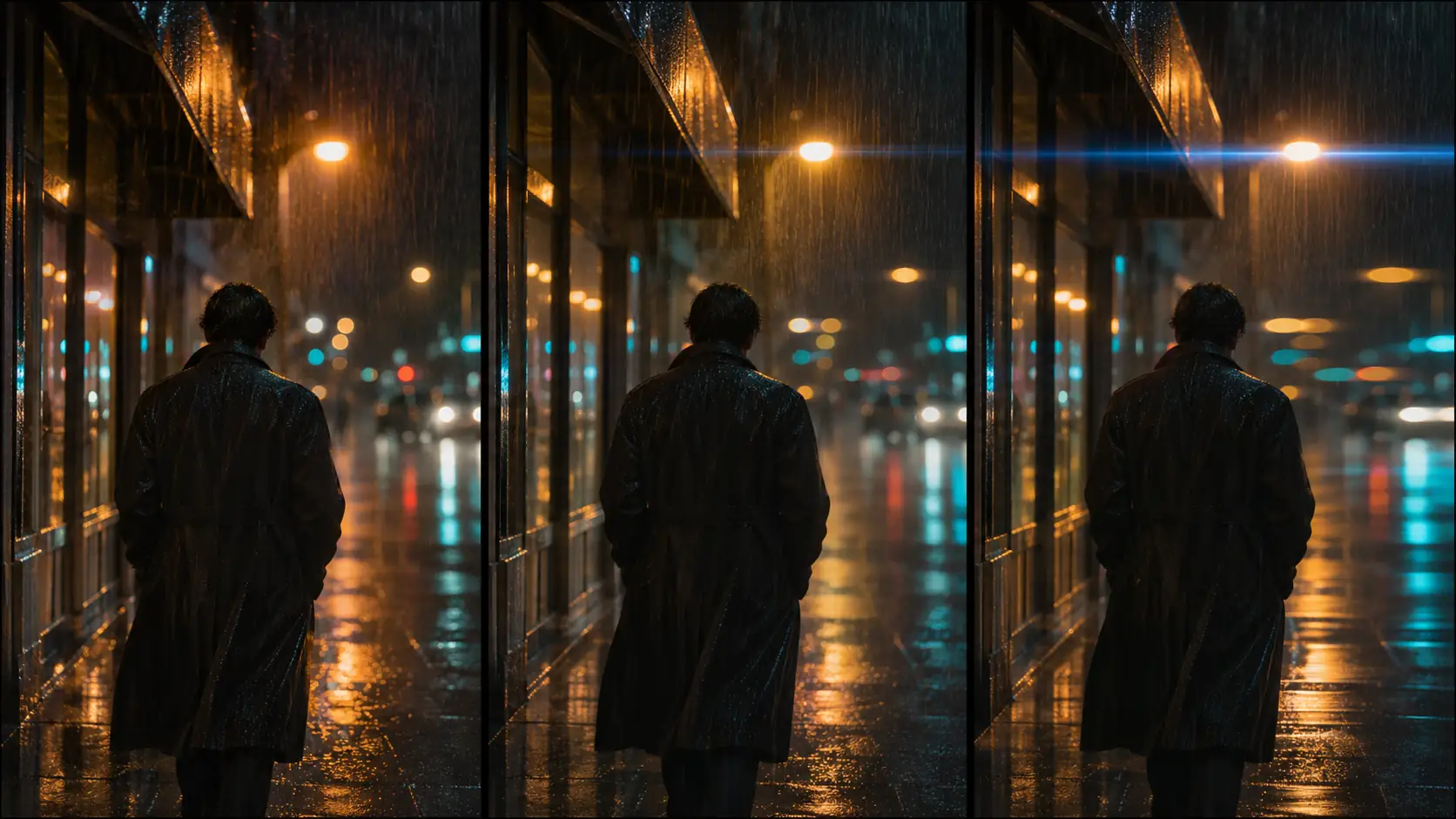
Fix the lens, the ratio, the bokeh shape and the flare logic. Change the scene and the distance, not the optics. If the first frame has oval bokeh and the second has circles, the sequence changes lenses.
Review the set as a contact sheet and keep the palette with Palette Lock. The film stock guide covers the grain and color response around the optics.
What are common anamorphic AI mistakes?
The first mistake is a flare with no source. The second is every highlight streaking. The third is a 16:9 frame with a fake 2.39 crop. The fourth is circular bokeh. The fifth is distortion so strong the horizon bends.
The sixth is a different lens look on every frame. Anamorphic is an optical system; the sequence holds when the optics stay fixed.
- Flare with no source.
- Every highlight streaking.
- Fake 2.39 bars on a 16:9 image.
- Circular bokeh with an anamorphic label.
- Extreme barrel distortion.
- A different lens look on every frame.
Frequently asked
How do I write an anamorphic lens AI prompt?
Name the scene, the lens, the ratio, the bokeh shape and one flare source. For example: “lone figure under a streetlamp, wet asphalt, oval bokeh, one horizontal blue flare from the lamp, 40mm anamorphic, 2.39:1.”
What is the most recognizable anamorphic cue?
Oval bokeh. Out-of-focus highlights become ovals instead of circles. A horizontal flare from a bright source is the second cue, but it should be used once, not on every highlight.
How do I get horizontal lens flares in an AI image?
Name one bright source and ask for a horizontal flare from that source only. A flare without a source becomes a random streak; a frame with flares on every highlight looks like a digital overlay.
Should an anamorphic image be 2.39:1?
Usually yes, but 2.00:1 is also valid for a modern streaming frame. If the delivery is 16:9, compose the wide frame inside it or crop deliberately; do not stretch the image.
Why does my anamorphic image look fake?
It probably has too many artifacts at full strength: flares on every highlight, smeared edges, heavy distortion and circular bokeh. Keep one or two cues and leave the rest subtle.
Can Soul Cinema render an anamorphic look?
Yes. Soul Cinema responds to ratio, lens and optical language such as oval bokeh and horizontal flares. The result is an interpretation of the look, not a simulation of a specific physical lens.
Your first cinematic frame is one prompt away
Sign in with Google, pick a plan and keep every still at the resolution the model produced. Plans from $12/month, cancel at any time. No watermark, no re-encode.