
AI gothic horror stills
An architectural gothic workflow: decaying rooms, candle against moonlight, fog and withheld detail, with six scene briefs and a dread sequence.
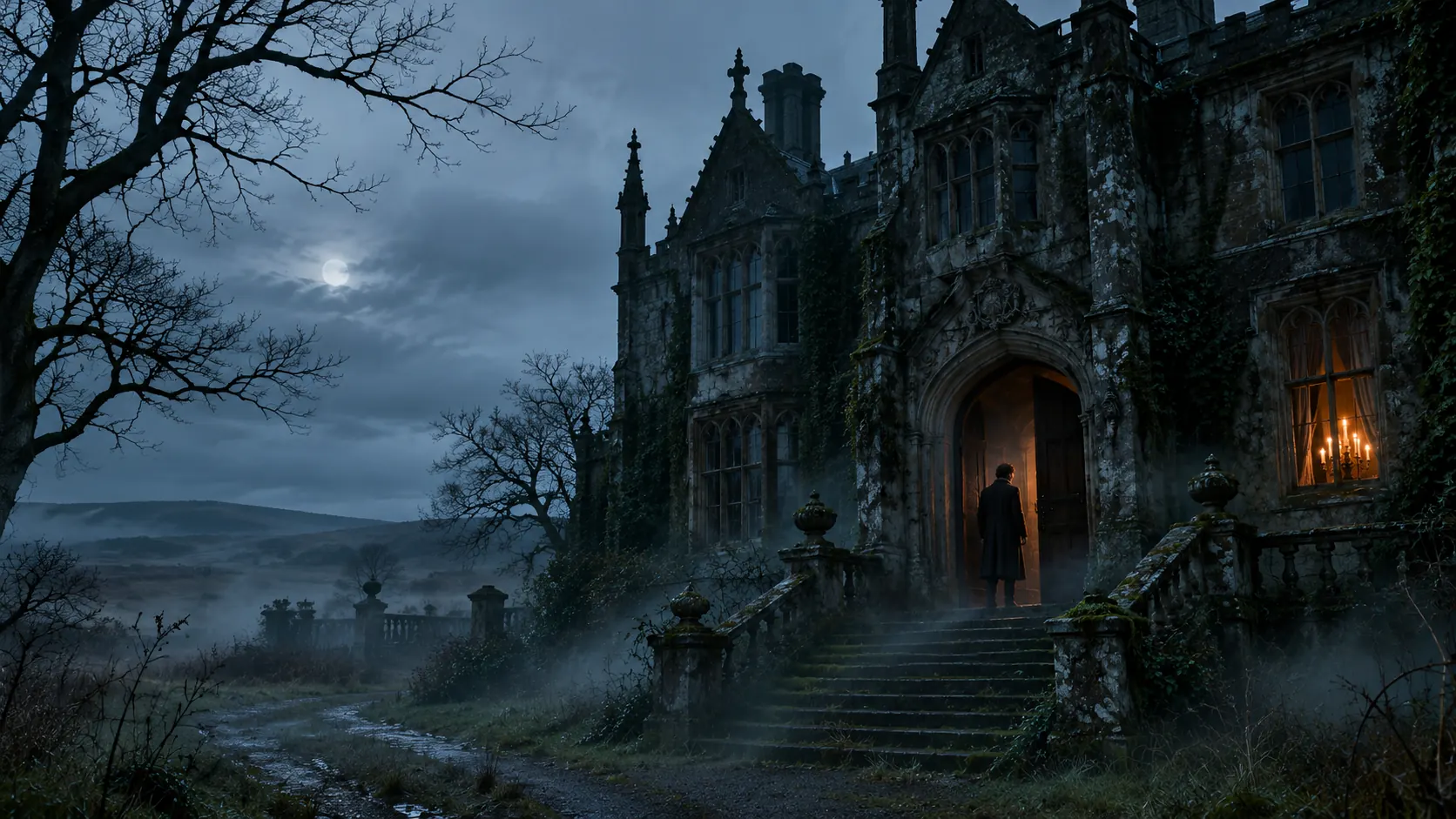
What makes a gothic horror still?
Gothic horror is a place before it is a monster. The house, the corridor, the moor and the weather carry the dread. Architecture is the antagonist: too tall, too old, too empty. The people in the frame are small, and the building is always watching.
The look depends on decay and contrast: peeling wallpaper, cold stone, candlelight against blue moonlight, fog at the threshold. It is slower and more romantic than modern horror, which often relies on the shock of the present. Gothic dread is historical and architectural.
The modern horror guide covers negative space and the partial reveal; this page covers the gothic branch. The fog guide covers haze as a depth tool.
Which light creates gothic dread?
Use two temperatures: cold moonlight and warm candle. The contrast between them divides the frame into safety and danger. A single candle in a large dark room is more frightening than a fully lit set, because it defines how little the character can see.
Keep the light motivated. A window, a candle, a fireplace, a lantern. If the source has no logic, the frame becomes a mood board. The gothic look is precise: one warm pool, one cold edge and a lot of shadow.
| Light | Temperature | Best for | Watch out for |
|---|---|---|---|
| Candle | Warm, small, unstable. | Corridors, bedside, close portrait. | Too little reach for a wide room. |
| Moonlight | Cold blue, soft, directional. | Windows, moors, exterior. | Blue overload and fake glow. |
| Fireplace | Warm, low, flickering. | Library, parlor, confrontation. | Horror-orange saturation. |
| Window light | Cold, soft, framed. | Bedroom, attic, arrival. | Flat, modern daylight. |
| Lantern | Warm, moving, small. | Stairs, cellar, outdoors. | Modern LED look. |
| Lightning | Cold, brief, hard. | Exterior, climax. | Music-video flashing. |
How do you build the house?
Describe the architecture with age and material: tall windows, carved wood, cracked plaster, worn stone stairs, a corridor that recedes too far. The building should feel larger than the people and older than the story.
Decay needs specificity. Water stains, peeling wallpaper, dust sheets, a broken banister, a carpet worn through. One or two details are enough; a room full of cobwebs becomes a haunted-house attraction instead of a home.
- Tall windows and high ceilings.
- Cracked plaster and peeling wallpaper.
- Worn stone or dark wood floors.
- One broken or covered object.
- A corridor or staircase with depth.
- Dust in the light, not everywhere.
How do you stage dread without gore?
Dread is what the frame withholds. A door half-open, a figure at the end of a corridor, a hand on a banister, a portrait with the face turned away. The viewer should look for the threat, not be shown it.
Keep the frame still and the composition formal. Symmetry, long corridors and centered doorways make the space feel controlled and oppressive. A tilted camera adds panic; gothic horror usually prefers the calm frame that is wrong in one detail.
| Device | Prompt cue | Effect |
|---|---|---|
| Half-open door | A door ajar at the end of a corridor, darkness beyond. | Invites the eye into the unknown. |
| Distant figure | A small silhouette at the far end of the hall. | Scale and waiting. |
| Turned portrait | A framed portrait facing the wall. | Suggests a story without showing it. |
| Candle shadow | A shadow that does not match the object. | Quiet wrongness. |
| Fog at the threshold | Fog entering under a door. | The outside getting in. |
| Empty chair | A chair pulled out, still facing the room. | Absence as presence. |
Which six gothic scenes should you brief?
Six scenes cover the genre: the approach, the threshold, the corridor, the bedroom, the library and the cellar. Each one uses architecture and a single source to build dread without showing the threat.
| Scene | Space | Light | Prompt anchor |
|---|---|---|---|
| The approach | Manor exterior at dusk. | Cold moonlight, one lit window. | Fog on the steps, bare trees, small figure at the door. |
| The threshold | Front hall. | Candle and cold window light. | High ceiling, dark staircase, one open door. |
| The corridor | Long upstairs hall. | Candle at the near end. | Peeling wallpaper, distant doorway, deep shadow. |
| The bedroom | Canopy bed, tall window. | Moonlight through glass. | Dust sheets, one candle, empty chair. |
| The library | Dark wood shelves. | Fireplace. | One figure, one lamp, a turned portrait. |
| The cellar | Stone stairs and arches. | Lantern. | Wet walls, low ceiling, darkness beyond the light. |
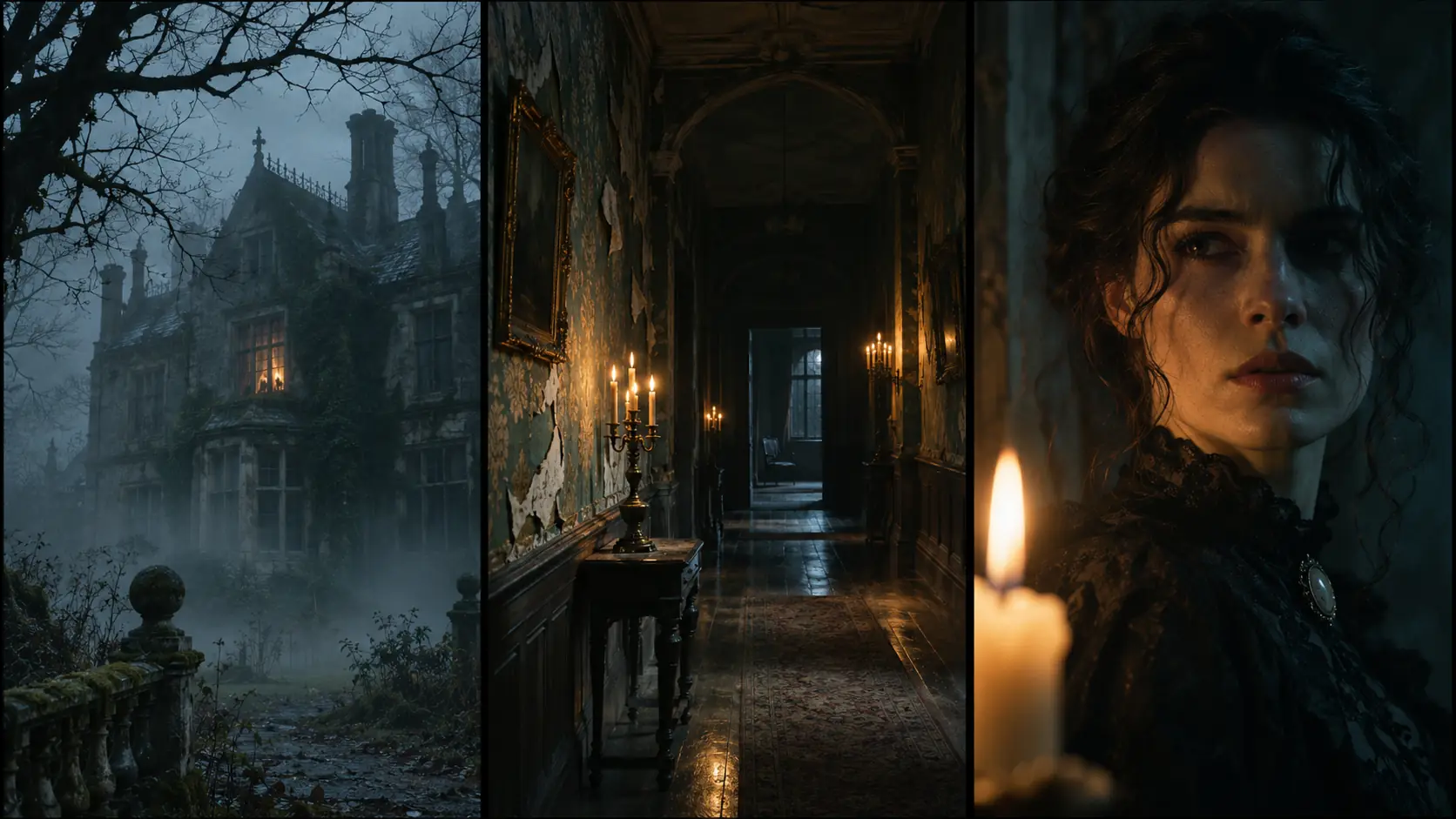
How do you keep the sequence consistent?
Fix the architecture, the wallpaper, the wood tone, the candle color and the moonlight direction. Change the room and the distance, not the house. The viewer should recognize the same corridor even when the camera is close.
Review the set as a contact sheet and keep the palette with Palette Lock. The location consistency guide covers the architecture across frames.
What are common gothic horror AI mistakes?
The first mistake is a fully lit haunted house. The second is cobwebs everywhere. The third is a modern prop or a clean surface. The fourth is showing the monster too clearly. The fifth is an orange-and-teal grade that turns the frame into fantasy.
The sixth is a different house in every frame. Gothic horror depends on the same architecture becoming more oppressive as the sequence goes on.
- A fully lit house with no shadow.
- Cobwebs as the only texture.
- Modern props or clean surfaces.
- The threat shown too clearly.
- Orange-and-teal fantasy grade.
- A different house in every frame.
Frequently asked
How do I write a gothic horror AI prompt?
Name the architecture, the decay, the two light temperatures and the withheld detail. For example: “decaying gothic manor at dusk, one candlelit window, cold blue moonlight, fog on the steps, a small figure at the door, 35mm.”
What is the difference between gothic horror and modern horror?
Gothic horror is architectural and historical: the house, the fog, the candle and the past carry the dread. Modern horror often relies on negative space, the present and a sudden reveal.
How do I light a gothic scene?
Use two temperatures: cold moonlight or window light plus one warm candle, fire or lantern. Keep the warm source small and motivated, and leave most of the frame in shadow.
Should a gothic horror image show the monster?
Usually no. A half-open door, a distant figure or a shadow that does not match is more effective. If the threat appears, keep it partial and at the edge of the light.
How do I make a gothic house look real?
Describe specific decay: cracked plaster, peeling wallpaper, worn stone, dust sheets and water stains. One or two details are enough; too many turn the house into a set.
Can Soul Cinema keep the same house across a sequence?
Yes. Fix the architecture, wallpaper, wood tone, candle color and moonlight direction in the prompt, and review the set as a contact sheet before adding more rooms.
Your first cinematic frame is one prompt away
Sign in with Google, pick a plan and keep every still at the resolution the model produced. Plans from $12/month, cancel at any time. No watermark, no re-encode.