
AI fantasy movie stills
A grounded fantasy workflow: worn materials, practical light, human scale and one impossible element, with six scene briefs and a sequence test.
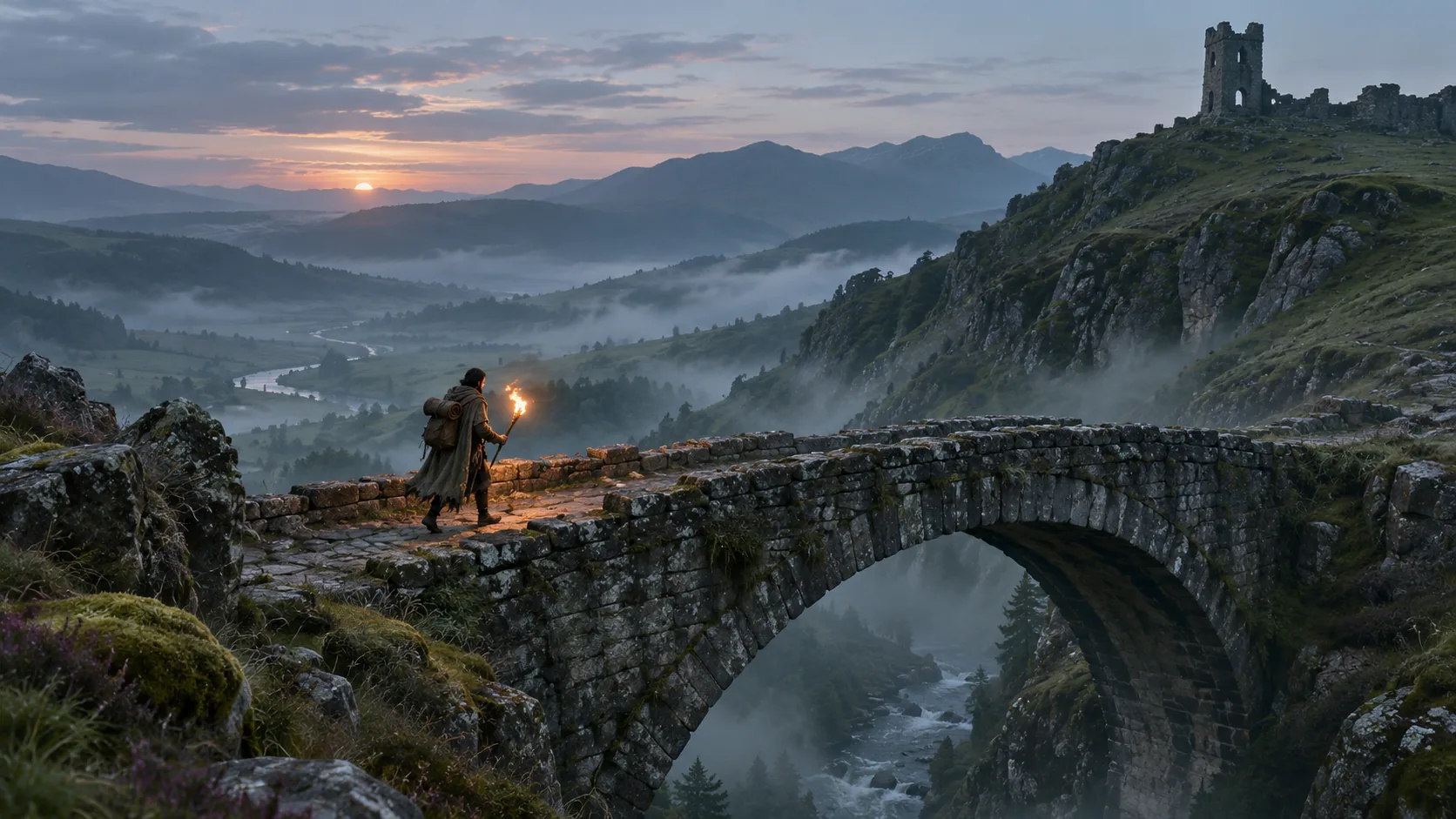
What makes a fantasy still cinematic?
Fantasy becomes cinematic when the world feels lived in. A stone bridge is worn by feet, a cloak is dirty at the hem, a hall smells of smoke. The viewer believes the world because the materials have weight, not because the sky has two moons.
The opposite is CGI gloss: clean armor, glowing runes, floating islands and a camera that has no relationship to the ground. Ground the frame with real textures, practical light and human scale, then let one impossible element carry the fantasy.
The war guide covers mud and smoke; the gothic horror guide covers old architecture. This page covers the grounded fantasy world.
How do you avoid the CGI look?
CGI gloss comes from smooth surfaces, uniform light and a lack of weather. Add dirt, wear and weight: chipped stone, wet wool, cracked leather, mud on boots, dust in the air. Use practical light sources and let the sky be overcast or hazy.
Keep the impossible element singular. One ruined tower, one giant statue, one strange structure is enough. If everything is magical, nothing is. The frame should feel like a real place with one unexplained thing in it.
| Element | Grounded cue | Avoid |
|---|---|---|
| Stone | Chipped edges, moss, wet joints. | Polished, uniform masonry. |
| Cloth | Dirt at the hem, patched wool, rain-dark. | Clean, floating, synthetic fabric. |
| Leather | Creases, scuffs, wet sheen. | Glossy costume armor. |
| Wood | Split grain, soot, wear at the handle. | Perfectly smooth planks. |
| Weather | Overcast, mist, rain, dust. | Golden-hour glow everywhere. |
| Magic | One impossible element, subtle light. | Glowing runes and particles. |
Which light should you use?
Practical light makes fantasy feel real. A torch, a window, a fire, a lantern or an overcast sky gives the frame a source the viewer can understand. Magic light should be an accent, not the main source.
Dawn and overcast light suit travel and landscape; firelight suits halls and camps; window light suits interiors and character scenes. Pick one source per frame and let the rest fall away.
| Light | Best for | Prompt cue |
|---|---|---|
| Overcast dawn | Travel, valleys, ruins. | Soft gray sky, cool ambient, no direct sun. |
| Torch | Caves, night travel, close portraits. | Small warm flame, hard falloff, dark surround. |
| Window | Halls, chambers, character scenes. | Cold window light, one warm candle. |
| Fire | Camps, ruins, aftermath. | Low warm firelight, deep shadow. |
| Lantern | Corridors, cellars, night streets. | Small moving pool of warm light. |
| Magic accent | One impossible element. | Faint cold glow, not a light show. |
How do you build scale?
Put a person against something older and larger: a bridge, a statue, a hall, a tree. The figure should be small enough to feel the world, but close enough to read as a person. A 35mm lens exaggerates the height; an 85mm compresses the distance.
Use layers: foreground grass or stone, midground traveler, background valley or structure. Atmospheric haze separates the layers. Scale is a composition problem before it is a visual-effects problem.
- One human figure for scale.
- One structure older than the story.
- Foreground, midground and background layers.
- 35mm for height, 85mm for intimacy.
- Haze between the layers.
- One impossible element, not ten.
Which six fantasy scenes should you brief?
Six scenes cover the grounded fantasy world: the bridge, the valley, the hall, the camp, the ruin and the forest. Each one pairs a real material with one strange element.
| Scene | Place | Light | Prompt anchor |
|---|---|---|---|
| The bridge | Old stone bridge over a valley. | Overcast dawn. | Traveler small on the bridge, mist below, ruined tower on the ridge. |
| The valley | Highland valley with a road. | Low sun through haze. | Long road, tiny figures, layered ridges. |
| The hall | Carved stone hall. | Window plus candle. | Long table, worn wood, one seated figure. |
| The camp | Forest camp at night. | Firelight. | Small fire, cloaks, dark trunks, one lookout. |
| The ruin | Broken watchtower. | Overcast. | Collapsed stone, moss, one figure at the base. |
| The forest | Old-growth forest. | Dappled cold light. | Tall trunks, narrow path, one traveler looking back. |
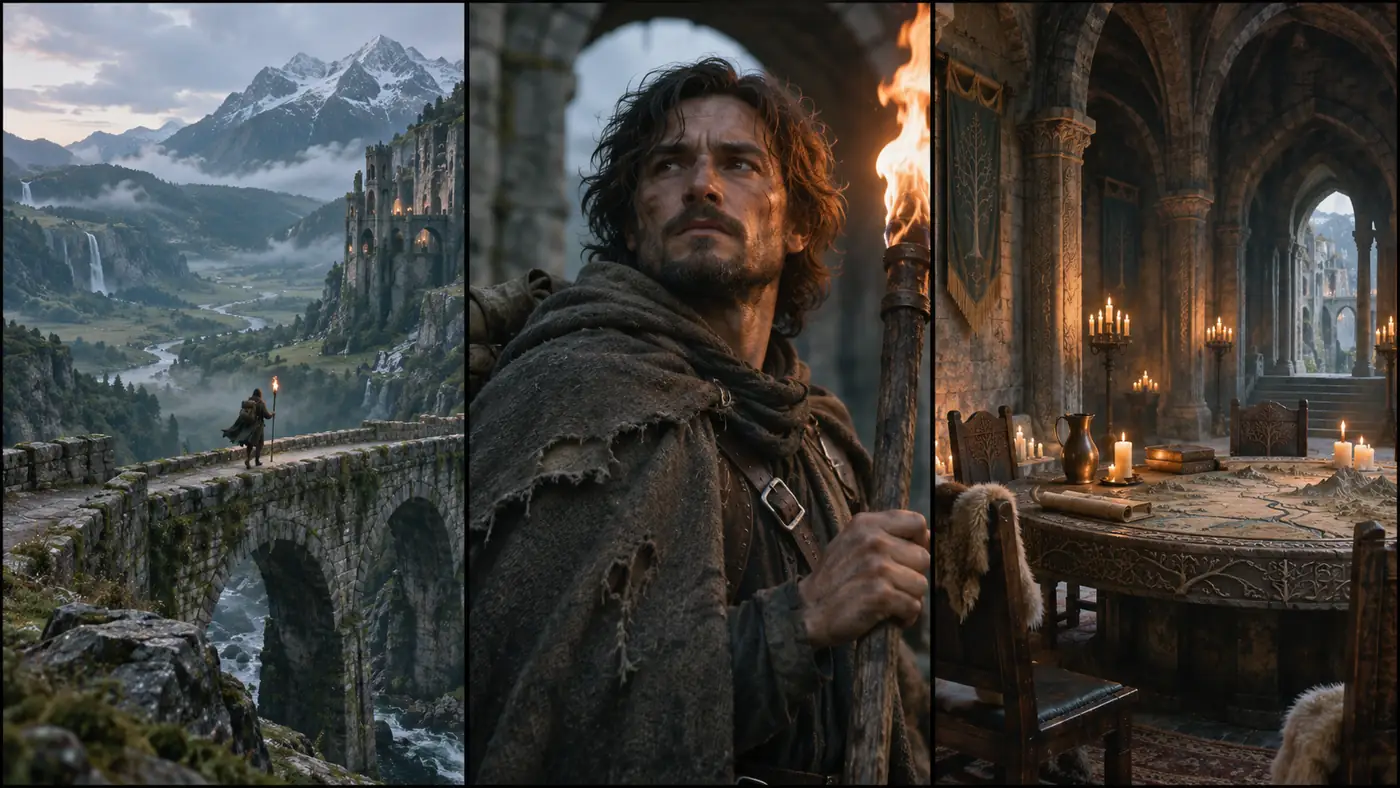
How do you keep the sequence consistent?
Fix the world rules: materials, weather, architecture, clothing and one impossible element. Change the place and the distance, not the rules. If the first frame is overcast and the second is golden hour, the world changes films.
Review the set as a contact sheet and keep the palette with Palette Lock. The treatment workflow is the place to decide the world rules before the first frame.
What are common fantasy AI mistakes?
The first mistake is glowing everything. The second is clean costumes and polished stone. The third is a world with no weather. The fourth is too many impossible elements in one frame. The fifth is a camera angle that ignores the ground.
The sixth is a sequence that changes the architecture or the palette between frames. Fantasy works when the world is consistent and one thing is impossible.
- Glowing runes and particles everywhere.
- Clean costumes and polished stone.
- No weather or ground texture.
- Too many impossible elements.
- A floating camera with no ground relationship.
- Architecture or palette changing between frames.
Frequently asked
How do I write a fantasy movie AI prompt?
Name the place, the material, the weather, the human anchor and one impossible element. For example: “old stone bridge over a misty valley at overcast dawn, a lone traveler with a torch, ruined watchtower on the ridge, worn stone, 35mm.”
How do I avoid the CGI fantasy look?
Add weight and weather: chipped stone, wet wool, cracked leather, mud, dust and overcast light. Keep one impossible element and make everything else physically believable.
What light works for fantasy scenes?
Practical light: torch, fire, lantern, window or overcast dawn. Magic light should be a subtle accent, not the main source. One source per frame keeps the world grounded.
How do I show scale in a fantasy image?
Put a small human figure against an older, larger structure and separate the layers with haze. A 35mm lens exaggerates height; an 85mm compresses distance.
How many magical elements should a fantasy frame have?
One. A single impossible structure, creature or light is enough. If everything is magical, the world stops feeling real and the frame becomes generic fantasy art.
Can Soul Cinema keep a fantasy world consistent?
Yes. Fix the materials, weather, architecture, clothing and one impossible element in the prompt, then review the sequence as a contact sheet before adding more scenes.
Your first cinematic frame is one prompt away
Sign in with Google, pick a plan and keep every still at the resolution the model produced. Plans from $12/month, cancel at any time. No watermark, no re-encode.