
AI war movie stills
A restrained war workflow: mud, smoke, desaturated dawn light and human scale, with six scene briefs and a sequence that avoids spectacle.
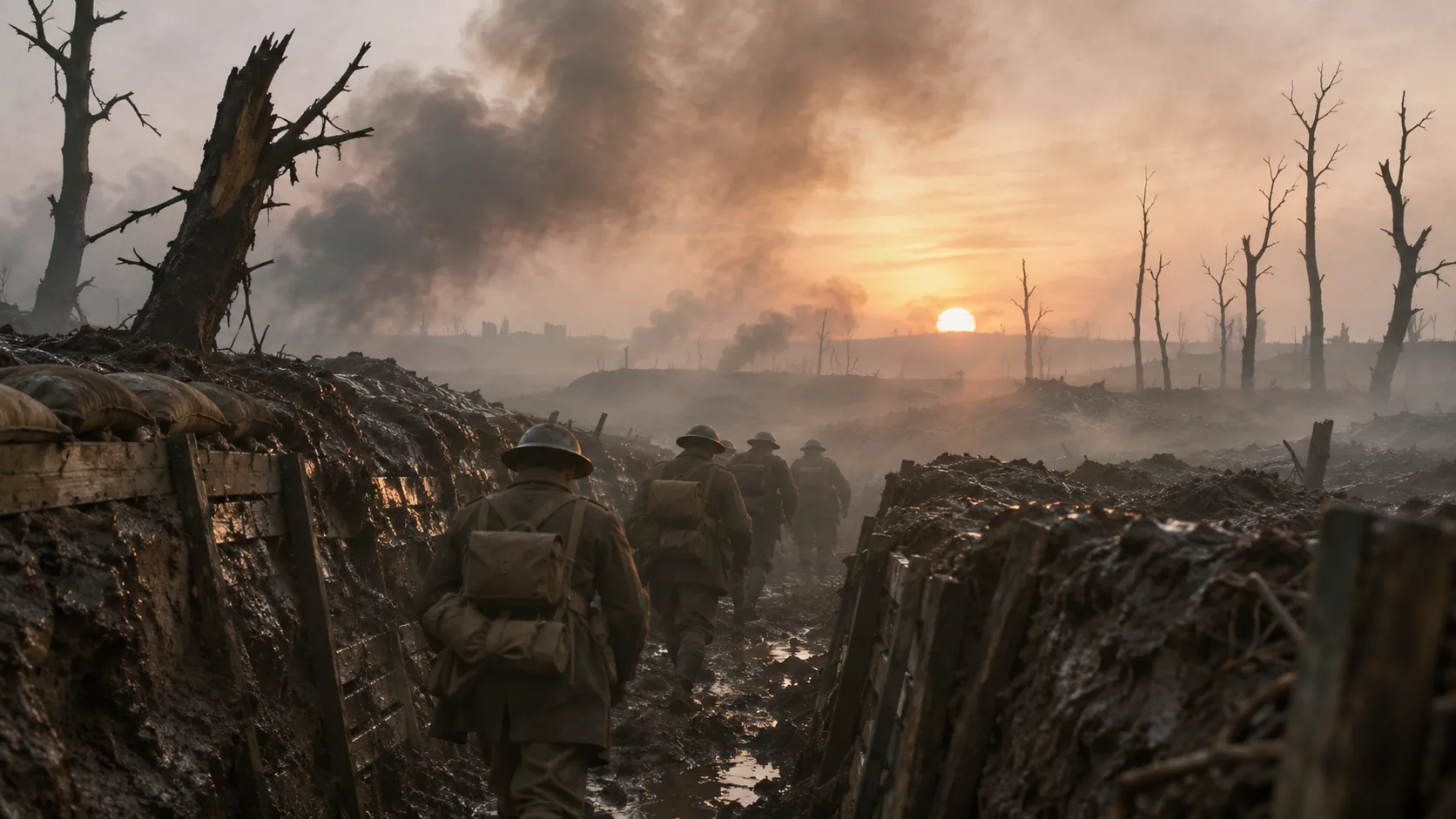
What makes a war still cinematic?
A war film still is not a battle painting. It is a frame about people in a place that has been ruined by weather, weight and time. Mud, smoke, exhaustion and scale do more than explosions. The viewer should feel the cold and the distance, not just the action.
The strongest war images are quiet: a soldier sitting in a trench, a column moving through dust, a village that is no longer a village. Spectacle without a human anchor becomes generic. Keep one person, one object or one piece of ground as the emotional scale.
The fog guide covers smoke and haze as light; the western guide covers dust and wide landscapes. This page covers the war-specific problem of mud, ruin and human scale.
Which palette and light should you use?
War palettes are usually desaturated, but not monochrome. Wet earth, olive drab, smoke gray and a pale cold sky are the base; one warm source — fire, a flare, a window — gives the frame a pulse. A completely gray image loses the human warmth.
Dawn and overcast light suit the genre because they flatten the landscape and isolate silhouettes. Hard sun can work for a specific scene, but it turns the frame into adventure rather than exhaustion. Choose the light by the emotional temperature.
| Light | Feel | Best for | Watch out for |
|---|---|---|---|
| Cold dawn backlight | Silhouette, distance, dread. | Columns, trenches, horizons. | Faces lost in shadow. |
| Overcast flat | Exhaustion, mud, no drama. | Aftermath, field hospital, rain. | Flat and boring without texture. |
| Dust and smoke | Scale, heat, confusion. | Columns, ruins, evacuation. | Detail disappearing completely. |
| Firelight | Warmth, ruin, night. | Camp, ruined interior, aftermath. | Horror-movie orange. |
| Hard sun | Heat, glare, exposure. | Desert, open ground, patrol. | Adventure-poster look. |
| Moonlight | Isolation, fear, quiet. | Night patrol, ruins, river. | Blue overload. |
How do you keep human scale?
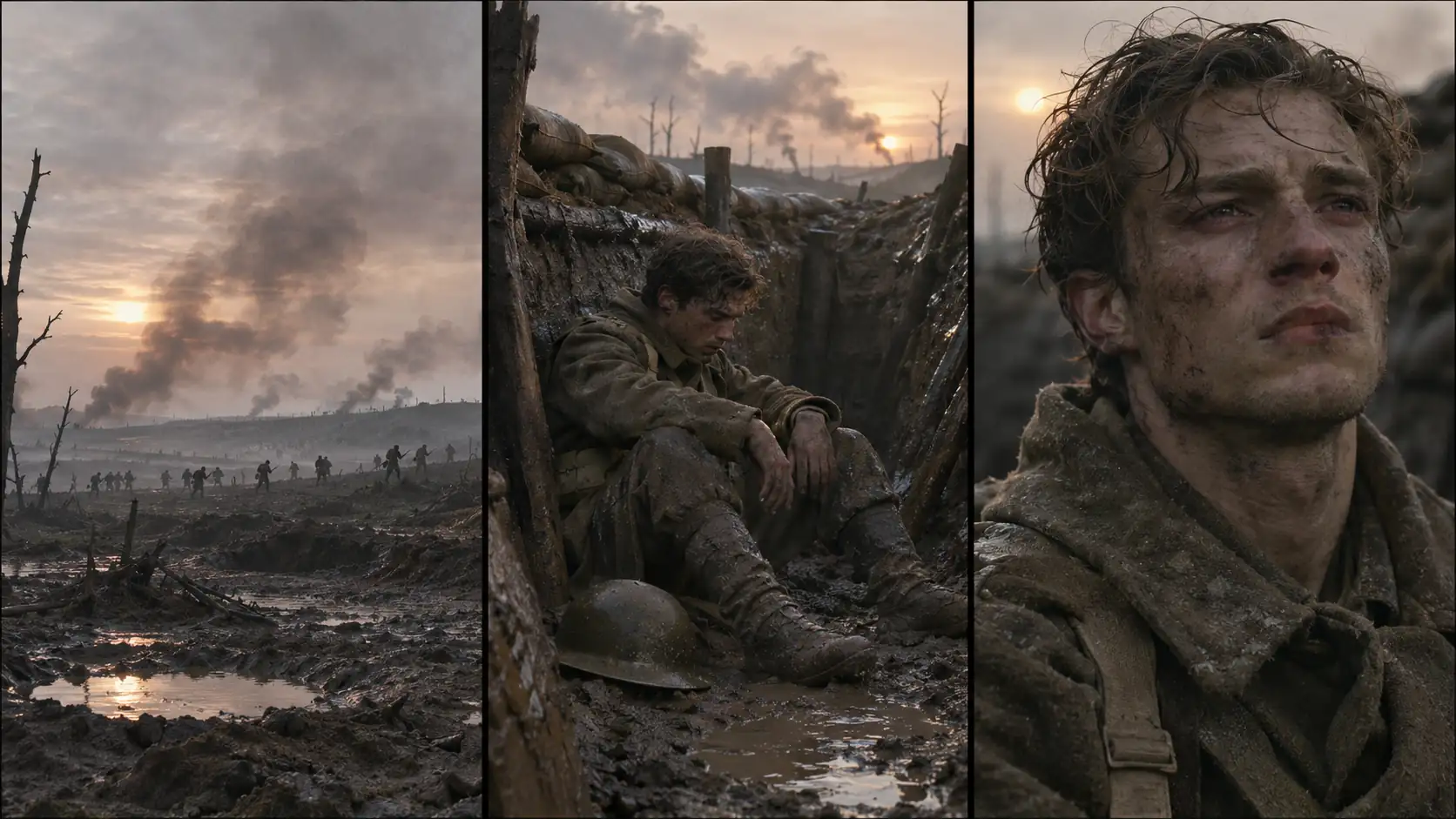
Put a person in the frame and let the ground and the sky dwarf them. A tiny figure on a broken road does more for scale than a wide shot of explosions. Then give the viewer a face: dirt, stubble, a helmet, a hand. The contrast between the wide and the close is the genre.
Use a 35mm lens for the environment and an 85mm for the face. Keep the same person or the same unit across the sequence; the audience needs someone to follow through the ruin.
- One human figure for scale.
- A face with dirt, sweat and exhaustion.
- A wide frame that dwarfs the figure.
- A close frame that restores the person.
- A repeated object: helmet, letter, mug.
- Alternate wide and close across the sequence.
How do you handle mud, smoke and weather?
Mud is a texture and a light problem. Wet earth catches a cold sky, boots sink, wheels stall, reflections appear in puddles. Describe the ground as wet, churned, standing water, not just “battlefield”. Smoke and dust need a source and a light to read.
Weather should be continuous. If the sequence starts in rain, the ground stays wet and the uniforms stay dark. If the smoke blows left in one frame and right in the next, the sequence loses its geography.
| Element | Prompt cue | Continuity |
|---|---|---|
| Mud | Churned wet earth, standing water, deep boot tracks. | Same wetness across the sequence. |
| Smoke | Low smoke drifting left, lit from behind. | Same wind direction. |
| Dust | Fine dust in the air, backlit by a low sun. | Same density and color. |
| Rain | Steady rain, wet uniforms, dark ground. | Same rain direction and intensity. |
| Snow | Trampled snow, dark slush, cold breath. | Same accumulation. |
| Ash | Falling ash, burned ground, gray air. | Same source and drift. |
Which six war scenes should you brief?
Six scenes cover the genre without turning it into a battle reel: the trench dawn, the ruined village, the field hospital, the river crossing, the forest patrol and the homecoming. Each one isolates a different cost — cold, loss, care, exposure, fear and return.
| Scene | Focus | Light | Prompt anchor |
|---|---|---|---|
| Trench dawn | Cold and waiting. | Pale backlight, smoke. | Figures small against the sky, mud, wet helmets. |
| Ruined village | Loss and scale. | Overcast, dust. | Broken stone houses, one figure in the street. |
| Field hospital | Care and exhaustion. | Warm practical, canvas shadow. | Cots, lantern, one seated soldier, no gore. |
| River crossing | Exposure and weight. | Cold dawn, water reflection. | Figures in shallow water, packs, mist. |
| Forest patrol | Fear and silence. | Dappled cold light. | Small group among tall trunks, one looking back. |
| Homecoming | Return and distance. | Warm window, cold exterior. | Figure at a door, civilian room behind. |
How do you keep the sequence consistent?
Fix the weather, the ground, the palette and the unit. Change the distance and the moment, not the world. The same mud, the same smoke direction and the same cold sky should carry from the wide to the close.
Review the set as a contact sheet and keep the palette with Palette Lock. The film treatment is the place to define the rules before the first frame.
What are common war AI mistakes?
The first mistake is spectacle without a person. The second is clean uniforms and dry ground. The third is modern gear in a period scene. The fourth is gore used as a shortcut to seriousness. The fifth is a palette that is either fully gray or fully orange.
The sixth is a sequence where the weather, the unit or the geography changes without a reason. War imagery needs restraint; the more the frame tries to shock, the less it feels true.
- Explosions with no human anchor.
- Clean uniforms and dry ground.
- Modern gear in a period scene.
- Gore instead of consequence.
- Fully gray or fully orange palettes.
- Weather or geography changing between frames.
Frequently asked
How do I write a war movie AI prompt?
Name the period, the place, the weather, the human anchor and the light. For example: “First World War trench at dawn, churned wet mud, small squad silhouetted against a pale sun, low smoke drifting left, desaturated olive and gray, 35mm.”
How do I keep war images from looking like a video game?
Reduce the spectacle and add weight: mud, wet uniforms, exhausted faces, smoke with a source and a human figure at the right scale. Avoid clean armor, glowing explosions and a fully orange palette.
Should war AI images show gore?
Usually no. Consequence reads better through exhaustion, ruin, absence and scale than through gore. Keep the frame restrained and let the environment carry the cost.
Which palette works for war scenes?
Desaturated earth and smoke, with one warm source for contrast. Olive drab, wet brown, smoke gray and pale cold sky are a reliable base; fire or a window can add warmth without turning the frame orange.
How do I keep a war sequence consistent?
Fix the weather, ground, palette and unit, then change only the distance and the moment. Check the smoke direction, mud wetness and uniforms across the contact sheet.
Does Soul Cinema render period-accurate uniforms?
It can suggest a period through silhouette and gear, but it does not guarantee historical accuracy. Real insignia, medals and unit markings should be avoided or verified with a historical reference.
Your first cinematic frame is one prompt away
Sign in with Google, pick a plan and keep every still at the resolution the model produced. Plans from $12/month, cancel at any time. No watermark, no re-encode.