
AI heist movie stills
A tension-first heist workflow: night city practicals, crew silhouettes, empty targets and a six-frame sequence from plan to escape.
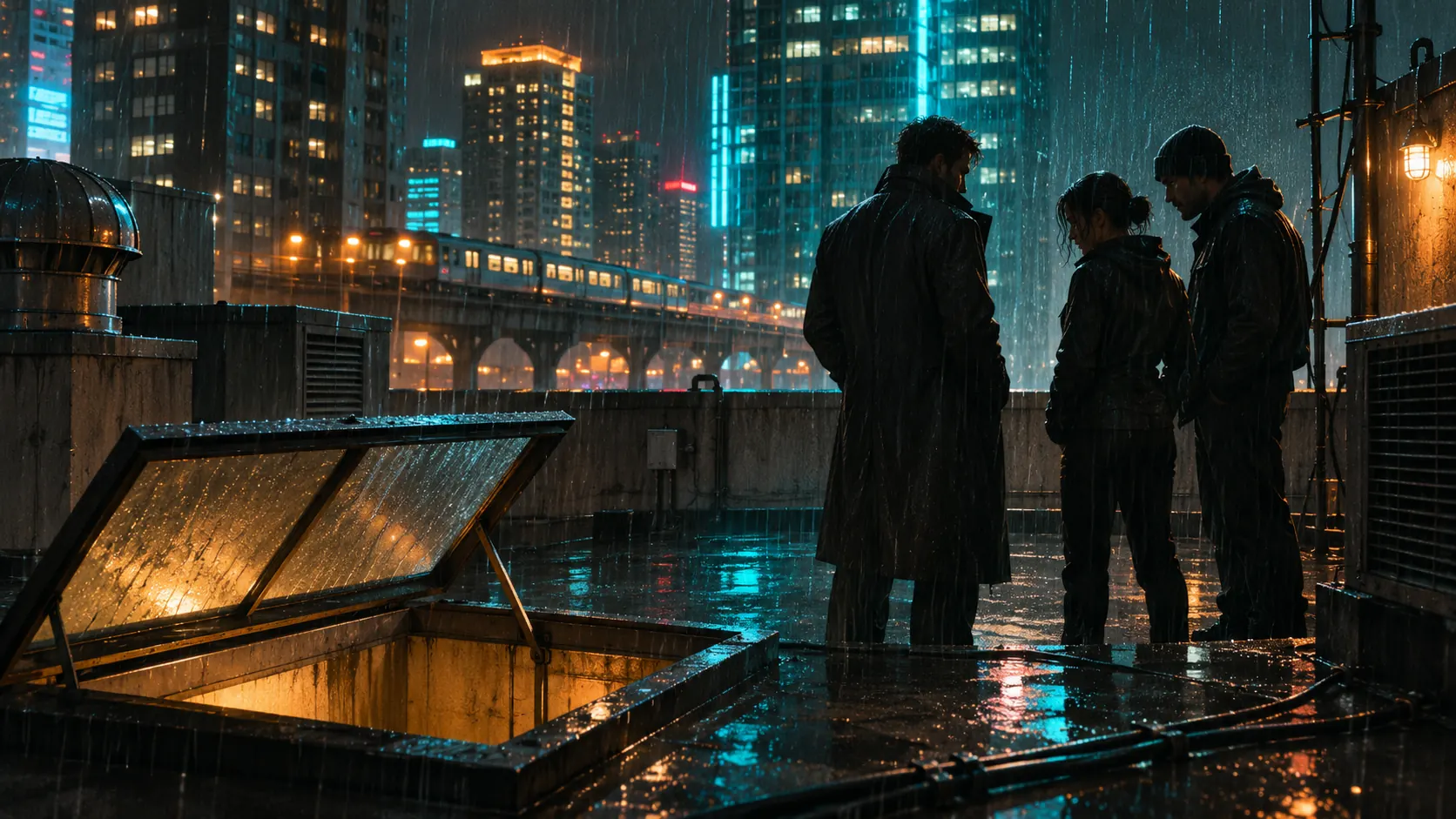
What makes a heist still cinematic?
A heist film is about planning, timing and nerve. The still should feel like the moment before something goes wrong: a crew on a rooftop, a corridor with one camera, a car waiting in the rain. Tension comes from restraint, not from action.
The city is a character. Wet streets, service corridors, loading docks, neon signs and empty lobbies describe the target and the escape at the same time. If the frame looks like a generic action scene, the heist has no plan.
The noir guide covers hard night light and moral shadow; the rain guide covers wet streets. This page covers crew, target and tension.
Which light should you use?
Heist light is practical and urban: sodium streetlamps, neon signs, fluorescent corridors, headlights and the glow of a laptop or phone. Pick one dominant source and let the rest be ambient reflections. The crew should be partly in shadow even when the city is bright.
Interiors often use fluorescent or hard ceiling light, which feels institutional and cold. Exteriors use sodium and neon, which feel warmer and more dangerous. The contrast between the two is the geography of the film.
| Light | Place | Feel | Prompt cue |
|---|---|---|---|
| Sodium streetlamp | Street, car park, alley. | Warm, dirty, urban. | Amber pool on wet asphalt, long shadow. |
| Neon | Storefront, rooftop, alley. | Color, nightlife, danger. | One cyan or magenta edge on a silhouette. |
| Fluorescent | Corridor, vault, office. | Cold, institutional, exposed. | Green-white ceiling tubes, flat shadows. |
| Headlights | Garage, street, escape. | Hard, low, directional. | Two cold beams, wet reflections. |
| Screen glow | Planning room, car. | Small, cold, intimate. | Laptop light on faces, dark room. |
| Practical lamp | Safe house, office, stairwell. | Warm, domestic, deceptive. | One warm pool, deep corners. |
How do you stage the crew?
The crew should read as a group with a hierarchy. Put them at different depths and heights: one at the edge, one at the skylight, one looking back. Silhouettes are useful because they hide identity and create tension; give one face a sliver of light.
Avoid a lineup. A heist crew is not a poster; they are people in a space, waiting. Spacing and posture do more than matching outfits. Keep the clothing practical and dark, with one distinguishing detail per person.
- Different depths and heights.
- Silhouettes with one lit face.
- Practical, dark clothing.
- One distinguishing detail per person.
- No lineup or hero pose.
- A shared focus: the target, the door, the street.
How do you build the target?
The target is architecture: a vault door, a service corridor, a glass lobby, a rooftop skylight. Describe the material and the security logic, not the loot. A concrete corridor with one camera and a red light is more tense than a room full of gold.
Keep the target empty or almost empty. The absence of people is what makes the space feel dangerous. One guard, one cleaner or one camera is enough to imply the system.
| Target | Material | Light | Prompt anchor |
|---|---|---|---|
| Vault corridor | Concrete, steel door. | Fluorescent. | Long corridor, one camera, one figure, cold floor. |
| Glass lobby | Marble, glass, security desk. | Cold ambient, one warm lamp. | Empty lobby, reflections, night city outside. |
| Rooftop | Wet concrete, vents, skylight. | Sodium and neon. | Crew at the skylight, city behind, rain. |
| Loading dock | Concrete, roller door, pallets. | Sodium. | Truck, open door, one figure in shadow. |
| Stairwell | Painted metal, worn steps. | Fluorescent. | Spiral stairs, one figure looking up. |
| Safe house | Worn apartment, maps, cables. | One lamp, screen glow. | Table, crew, city window, no readable text. |
Which six heist scenes should you brief?
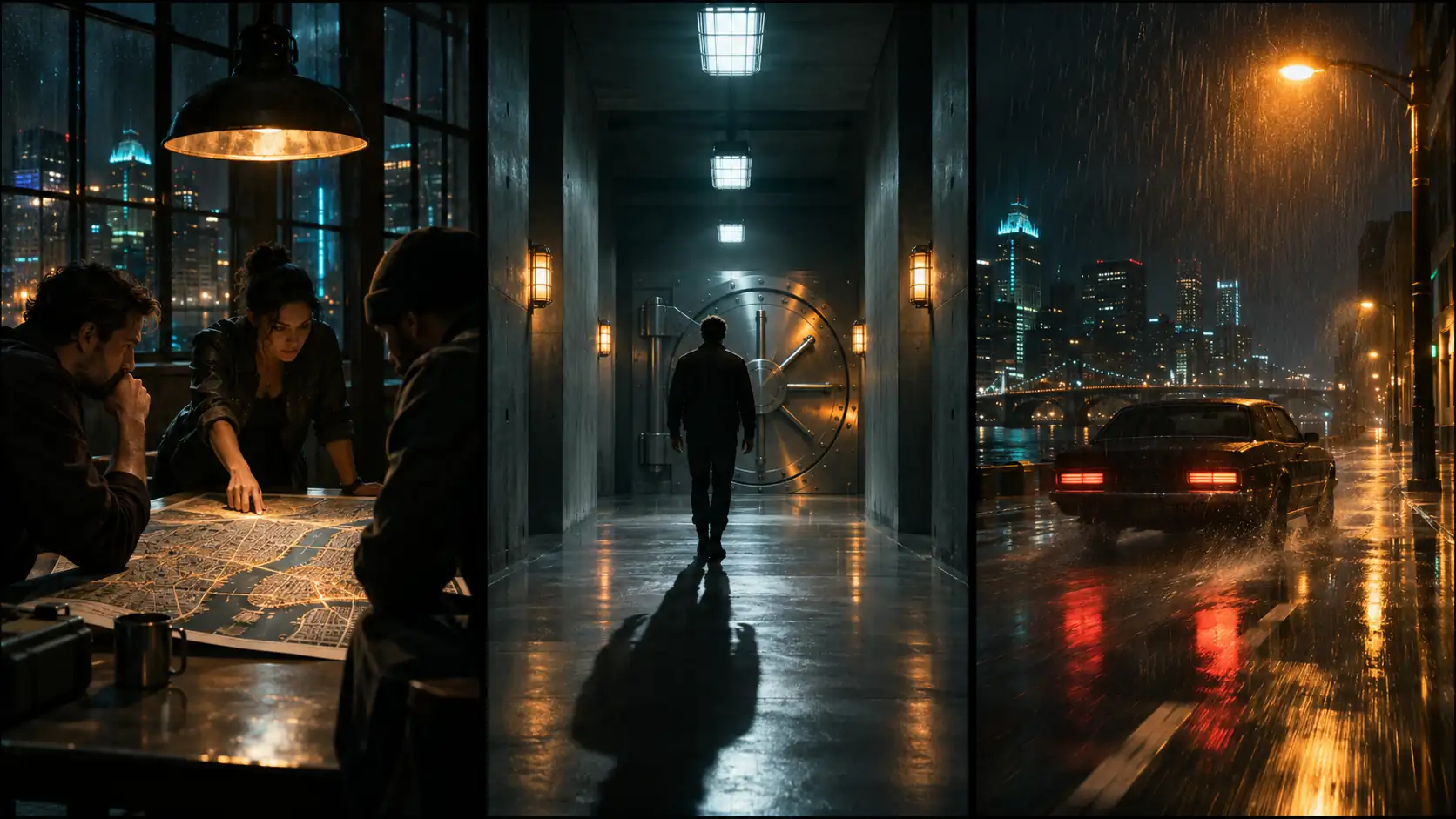
Six scenes cover the genre: the planning room, the rooftop, the lobby, the corridor, the getaway and the safe house. Each one isolates a different kind of tension — planning, approach, exposure, intrusion, escape and aftermath.
| Scene | Tension | Light | Prompt anchor |
|---|---|---|---|
| Planning room | Control. | One lamp and screen glow. | Table, city map with no text, three silhouettes. |
| Rooftop | Approach. | Sodium and neon. | Crew at an open skylight, rain, city depth. |
| Lobby | Exposure. | Cold ambient. | Empty marble lobby, one figure, reflections. |
| Corridor | Intrusion. | Fluorescent. | Long concrete corridor, one camera, hard shadow. |
| Getaway | Escape. | Headlights and sodium. | Car in rain, wet reflections, one figure at the wheel. |
| Safe house | Aftermath. | Warm lamp. | Crew around a table, money or bags out of focus, no text. |
How do you keep the sequence consistent?
Fix the city, the crew, the clothing and the light logic. Change the space and the distance, not the world. The same sodium streetlamp should appear outside the lobby and in the getaway frame.
Review the set as a contact sheet and keep the palette with Palette Lock. The night portrait guide covers face lighting in the same city.
What are common heist AI mistakes?
The first mistake is an action scene instead of a tension scene. The second is a crew lineup. The third is a target full of gold and guards. The fourth is a modern prop with a readable logo. The fifth is a city that changes between frames.
The sixth is over-lighting the night. Heist images need shadow and empty space; if every corner is visible, there is nothing to fear.
- Action instead of tension.
- A crew lineup or hero pose.
- A target full of loot and guards.
- Readable logos or text.
- A city that changes between frames.
- Over-lit night interiors.
Frequently asked
How do I write a heist movie AI prompt?
Name the space, the crew position, the practical light and the target. For example: “three silhouettes on a wet rooftop at night, one open skylight, sodium and cyan neon, city depth, 35mm anamorphic.”
How do I make a heist scene tense?
Use restraint: empty space, one camera, one guard, a crew waiting, a door half-open. Tension comes from what is about to happen, not from action.
What light works for heist scenes?
Sodium and neon outside, fluorescent inside, headlights for the escape. Pick one dominant source and keep the crew partly in shadow.
How do I stage a heist crew?
Put them at different depths and heights, with silhouettes and one lit face. Avoid a lineup; give them a shared focus such as the target, the door or the street.
Should a heist image show the loot?
Usually no. The target should be a space and a system, not a pile of gold. One vault door, one camera or one empty lobby is more tense than a room full of money.
Can Soul Cinema keep a heist city consistent?
Yes. Fix the city, the crew, the clothing and the light logic in the prompt, then review the sequence as a contact sheet before adding more scenes.
Your first cinematic frame is one prompt away
Sign in with Google, pick a plan and keep every still at the resolution the model produced. Plans from $12/month, cancel at any time. No watermark, no re-encode.