
AI disaster movie stills
A two-scale disaster workflow: storm, dust and aftermath around a human anchor, with six scene briefs and a sequence that avoids spectacle-only frames.
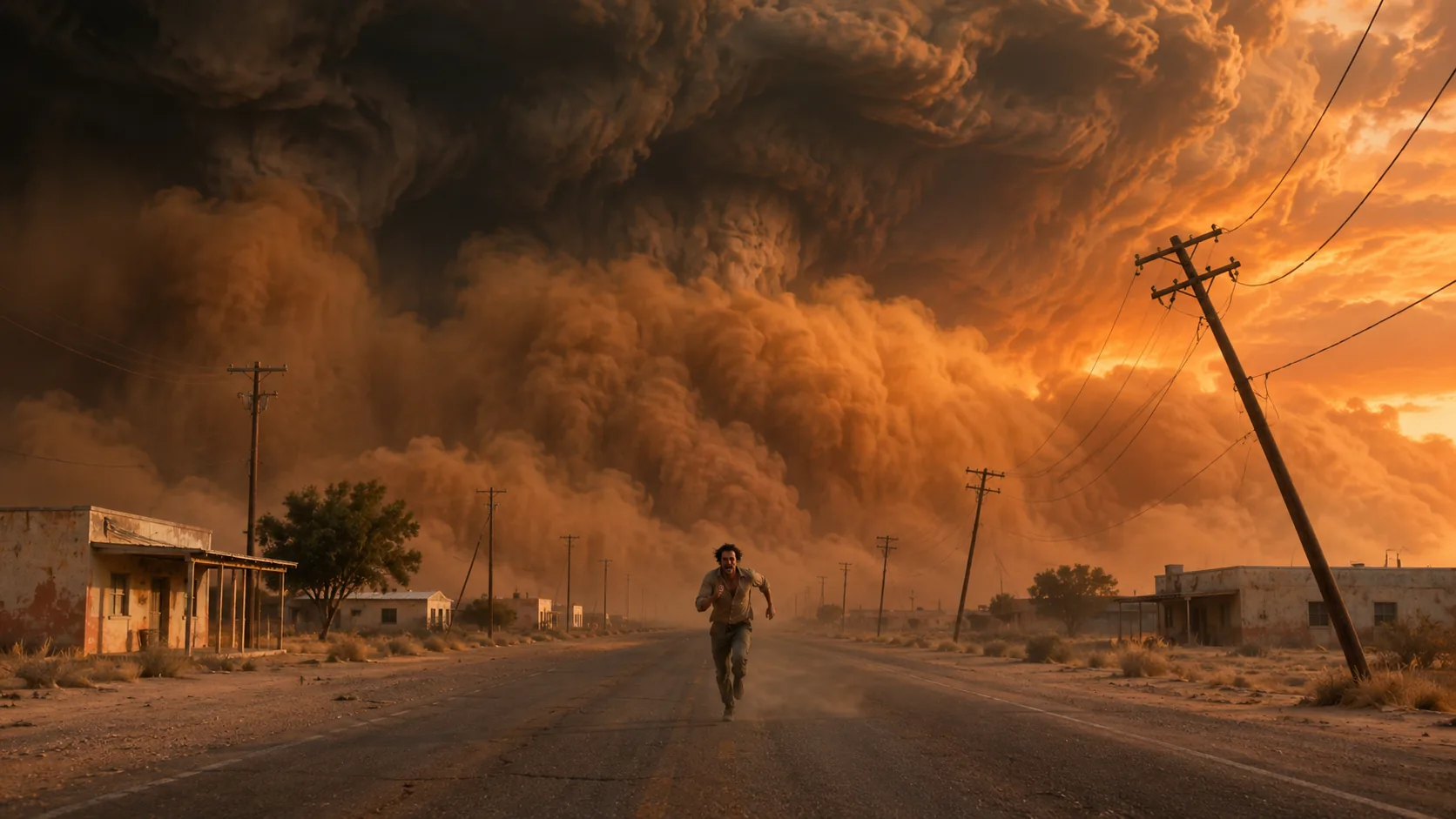
What makes a disaster still cinematic?
A disaster image needs two scales: the event and the person. The storm, the flood or the fire is the world; the human figure is the measure. Without a person, the frame is a visual-effects plate. Without the event, it is a portrait with dust.
The strongest disaster images are often before or after the peak: the wall of dust approaching, the shelter interior, the street after the water. The event is implied by what it has done to the world and to the people in it.
The fog guide covers haze and depth; the rain guide covers wet streets. This page covers storm scale, dust and aftermath.
Which disaster should you choose?
Each disaster has a different visual signature. A dust storm is amber and opaque; a flood is reflective and heavy; a wildfire is orange and smoky; an earthquake is gray and broken; a snowstorm is white and quiet. Pick one and commit to its physics.
Do not mix disasters unless the story demands it. A flood with fire in the same frame can work, but it needs a reason. The palette, the particles and the damage should all come from the same event.
| Disaster | Palette | Light | Signature |
|---|---|---|---|
| Dust storm | Ochre, gray, warning orange. | Amber backlight, dark core. | Opaque wall, horizontal motion, static charge. |
| Flood | Muddy brown, slate, cold white. | Overcast, reflected sky. | Heavy water, debris, wet surfaces. |
| Wildfire | Orange, black, ash gray. | Fire glow, smoke-filtered sun. | Ember rain, haze, glowing ridge. |
| Earthquake | Concrete gray, dust, rebar. | Flat daylight or emergency light. | Broken verticals, rubble, cracked ground. |
| Snowstorm | White, blue-gray, dark coats. | Flat overcast, low contrast. | Whiteout, buried shapes, cold breath. |
| Tornado | Green-gray sky, brown debris. | Storm light, one warm window. | Funnel, flying debris, low horizon. |
How do you keep human scale?
Place a person against the event and let the event dominate the frame. A figure running toward camera with a storm wall behind is a scale shot; a close-up of the same person is the emotional shot. The sequence needs both.
Use a 24mm or 35mm lens for the event and an 85mm for the face. Keep the person small in the wide frame and let the environment carry the threat. The viewer should feel how little the person is.
- One human figure for scale.
- The event filling most of the frame.
- A wide lens for the environment.
- A long lens for the face.
- A repeated object: bag, phone, pet, car.
- Alternate scale and intimacy.
How do you light dust, smoke and water?
Particles need a light source. Dust is visible when it is backlit by a low sun; smoke is visible when it crosses a beam; rain is visible against a streetlamp. Put the source behind the particle and keep the foreground darker.
Water adds reflection and weight. Wet ground, rising water, spray and debris all change the light. A flood frame should show the reflected sky and the objects floating in it, not just a blue overlay.
| Particle | Light | Prompt cue |
|---|---|---|
| Dust | Low backlight. | Amber sun behind a dust wall, dark foreground. |
| Smoke | Beam or fire. | Smoke crossing a hard shaft of light, deep shadow. |
| Rain | Streetlamp or headlight. | Backlit streaks, wet asphalt reflections. |
| Spray | Cold daylight. | Backlit spray, dark water, heavy sky. |
| Ash | Fire glow or overcast. | Falling ash against a gray sky, ember light. |
| Snow | Flat overcast. | Whiteout, low contrast, cold breath. |
Which six disaster scenes should you brief?
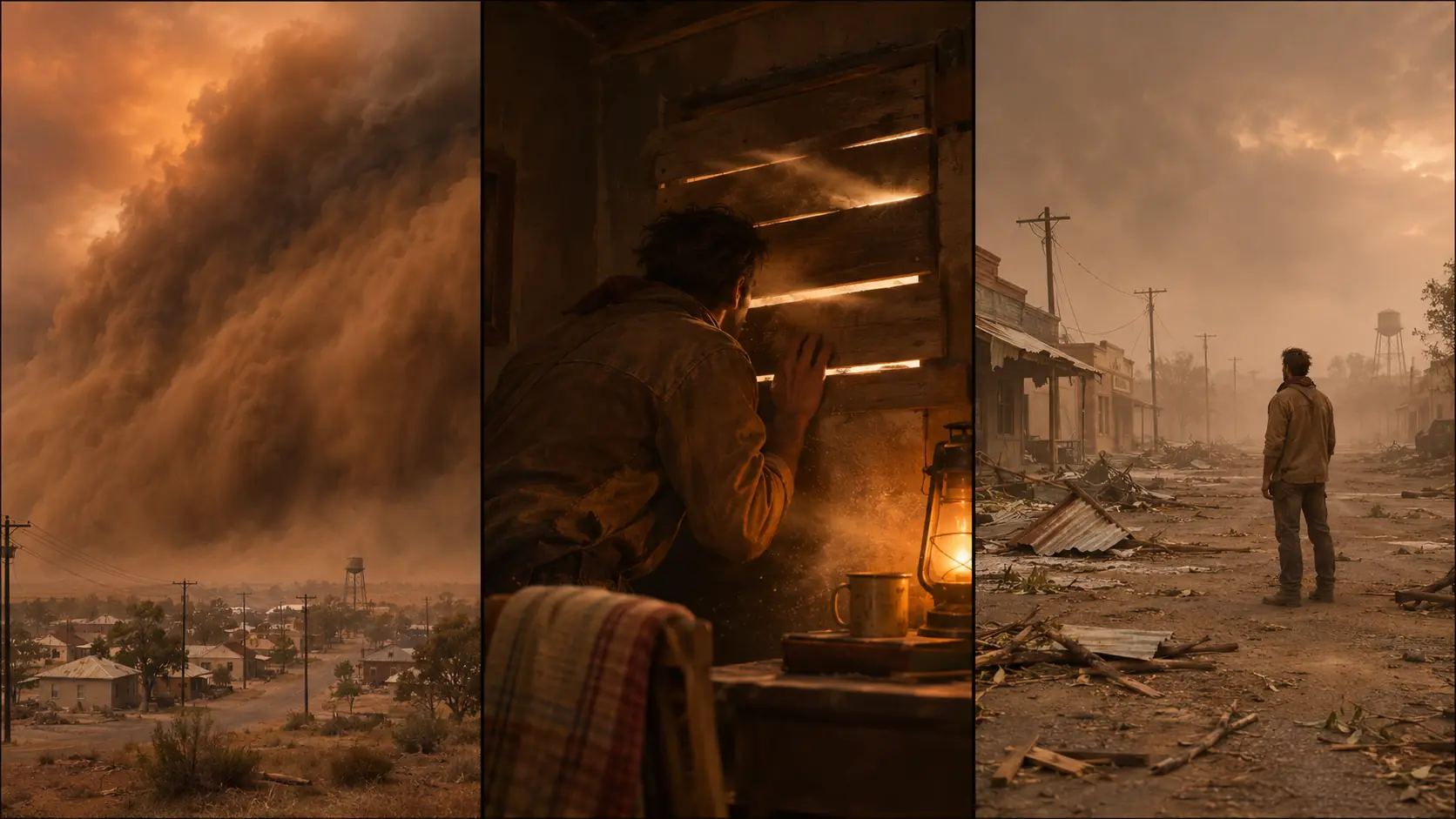
Six scenes cover the genre: the approach, the warning, the shelter, the escape, the aftermath and the reunion. Each one uses a different scale and a different relationship between the person and the event.
| Scene | Scale | Light | Prompt anchor |
|---|---|---|---|
| The approach | Vast. | Amber backlight. | Storm wall over a town, one figure running, power lines. |
| The warning | Human. | Screen or radio glow. | One face in a dark room, warning light, no readable text. |
| The shelter | Intimate. | One warm lamp. | Boarded window, dust leaking in, two figures. |
| The escape | Kinetic. | Headlights and storm light. | Car on a dark road, debris, rain, one driver. |
| The aftermath | Quiet. | Overcast or dust-filtered sun. | Debris street, one figure standing, dust settling. |
| The reunion | Emotional. | Warm practical against gray. | Two figures embracing, ruined background, soft light. |
How do you keep the sequence consistent?
Fix the event, the palette, the town and the weather. Change the distance and the moment, not the disaster. The dust should be the same color in the wide and the close; the same power line should appear in the approach and the aftermath.
Review the set as a contact sheet and keep the palette with Palette Lock. The treatment workflow is the place to define the rules before the first frame.
What are common disaster AI mistakes?
The first mistake is spectacle with no person. The second is mixing disasters. The third is particles with no light source. The fourth is a clean aftermath with no debris. The fifth is a palette that changes between frames.
The sixth is a close-up that loses the event entirely. Disaster is a scale relationship; if the frame forgets one of the two scales, it stops feeling like a disaster.
- Spectacle with no human anchor.
- Mixing disasters without a reason.
- Particles with no light source.
- A clean aftermath with no debris.
- A palette that changes between frames.
- A close-up that loses the event.
Frequently asked
How do I write a disaster movie AI prompt?
Name the event, the human anchor, the scale and the light. For example: “a wall of dust approaching a small desert town, one figure running toward camera, amber backlight, dark storm core, power lines leaning, 35mm.”
How do I make a disaster image feel cinematic?
Keep two scales: the event and the person. Light the particles from behind, add debris and aftermath, and keep the palette tied to one disaster.
Which disaster is easiest to render in AI?
Dust storms and wildfires are forgiving because haze and smoke hide detail and carry scale. Floods need convincing water and reflections; earthquakes need broken geometry and rubble.
How do I light dust and smoke?
Put a source behind the particle: a low sun, a fire, a streetlamp or a headlight. The foreground should stay darker so the particles read as volume.
How do I keep a disaster sequence consistent?
Fix the event, palette, town and weather, then change only the distance and the moment. Check the particles, debris and landmarks across the contact sheet.
Can Soul Cinema render a full disaster scene?
Yes. Soul Cinema renders the still, including the storm, debris and human figure described in the prompt. Motion, sound and simulation-level physics belong to a video workflow.
Your first cinematic frame is one prompt away
Sign in with Google, pick a plan and keep every still at the resolution the model produced. Plans from $12/month, cancel at any time. No watermark, no re-encode.