
Cinematic car photography AI
A reflection-led car workflow: body lines, one continuous highlight, static and rolling shots, night neon and a six-frame sequence.
What makes car photography cinematic?
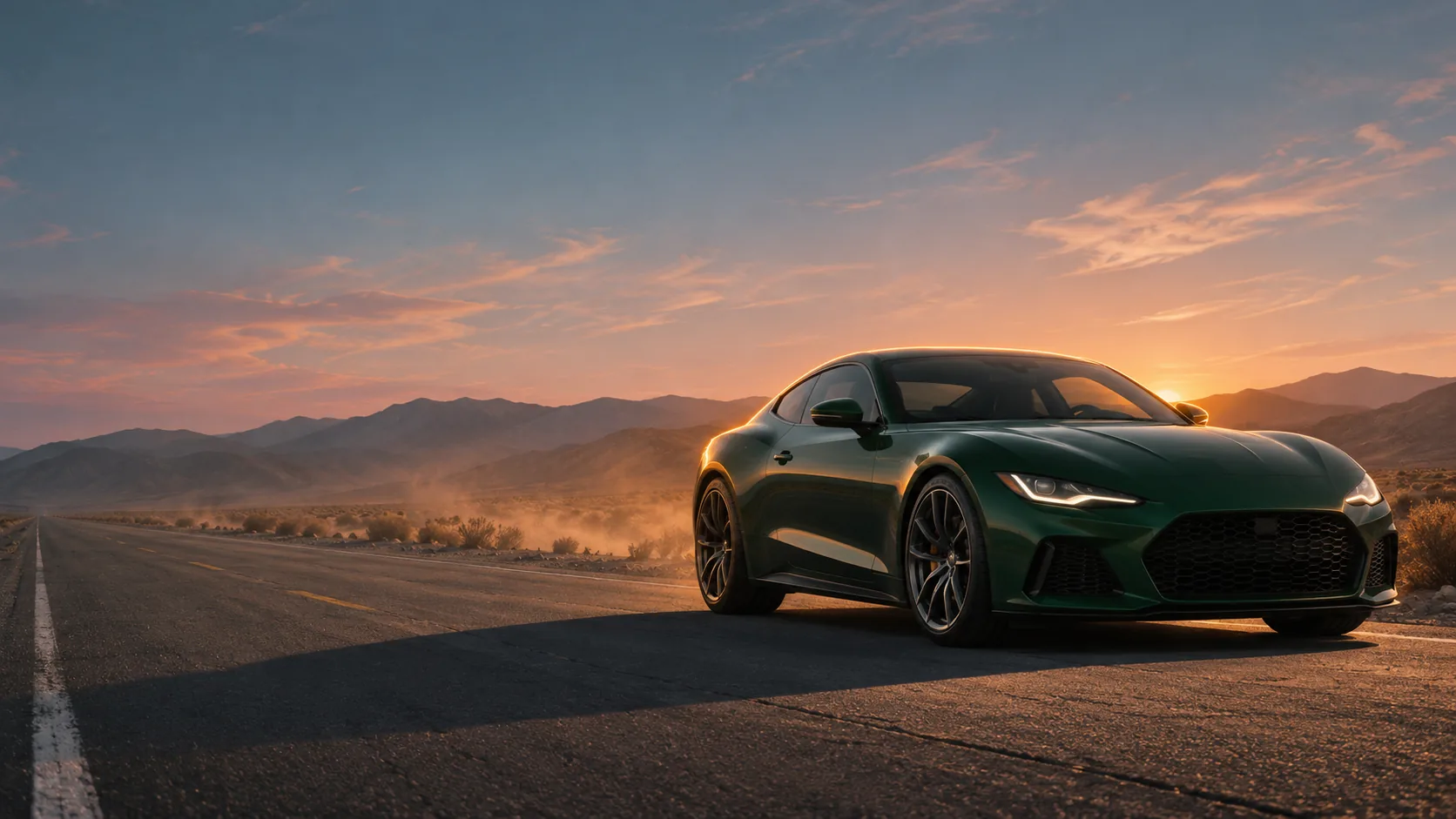
A car photograph is a study of one shape in one place. The body line, the wheel arch, the reflection running along the paint and the environment behind it all describe the same object. A brochure shot shows the car clearly; a cinematic shot makes the car feel like it is about to move.
The reflection is the body. On a dark paint finish, a long continuous highlight tells the viewer the fender is curved and the roofline is low. Broken, chaotic reflections make the car look dented even when the geometry is correct. Control the environment and the highlight before adding mood.
Use the lighting guide for the source vocabulary and the aspect ratio guide for wide framing. The product workflow covers glossy surfaces and highlight control.
Which angle shows which line?
Every angle has a job. The low front three-quarter shows the grille, the headlight and the front fender. The side profile shows the wheelbase and roofline. The rear three-quarter shows the shoulder and the taillight. The high angle shows the roof and the overall footprint.
Pick the angle by the line you want to sell. If the car has a long hood, use a side or front three-quarter. If it has a wide rear shoulder, use a low rear three-quarter. If the wheels are the point, use a side profile at wheel height.
| Angle | Shows | Best for | Watch out for |
|---|---|---|---|
| Low front three-quarter | Grille, headlight, front fender. | Aggressive sports cars, SUVs. | Exaggerated nose, distorted wheels. |
| Side profile | Wheelbase, roofline, doors. | Long sedans, classics, wheel detail. | Flat, catalog-like composition. |
| Rear three-quarter | Shoulder, taillight, rear haunch. | Performance cars, wide bodies. | Hiding the front entirely. |
| High front three-quarter | Roof, hood, overall footprint. | SUVs, off-road, travel. | Losing the low, heroic stance. |
| Wheel-level side | Wheels, brakes, stance. | Tuned cars, detail shots. | Cutting the roof or the ground. |
| Detail crop | Headlight, badge, stitching. | Luxury, craft, texture. | No sense of the whole car. |
How do you control reflections on paint?
Paint is a mirror with a color underneath. The highlight should be one continuous shape that follows the body line. A long soft strip above the car, a bright horizon behind it or a single open sky can produce that line. A cluttered street produces a broken reflection.
Use the environment deliberately. A dark car against a bright sky gets a crisp edge. A light car against a dark background gets a soft gradient. Wet asphalt adds a second reflection underneath the car, which grounds it and doubles the shape.
- One continuous highlight along the body line.
- A clean horizon or sky as the reflection source.
- A dark background for a light car.
- A bright background for a dark car.
- Wet ground for a second reflection.
- Avoid trees, poles and signage reflecting in the paint.
How do you shoot static versus rolling?
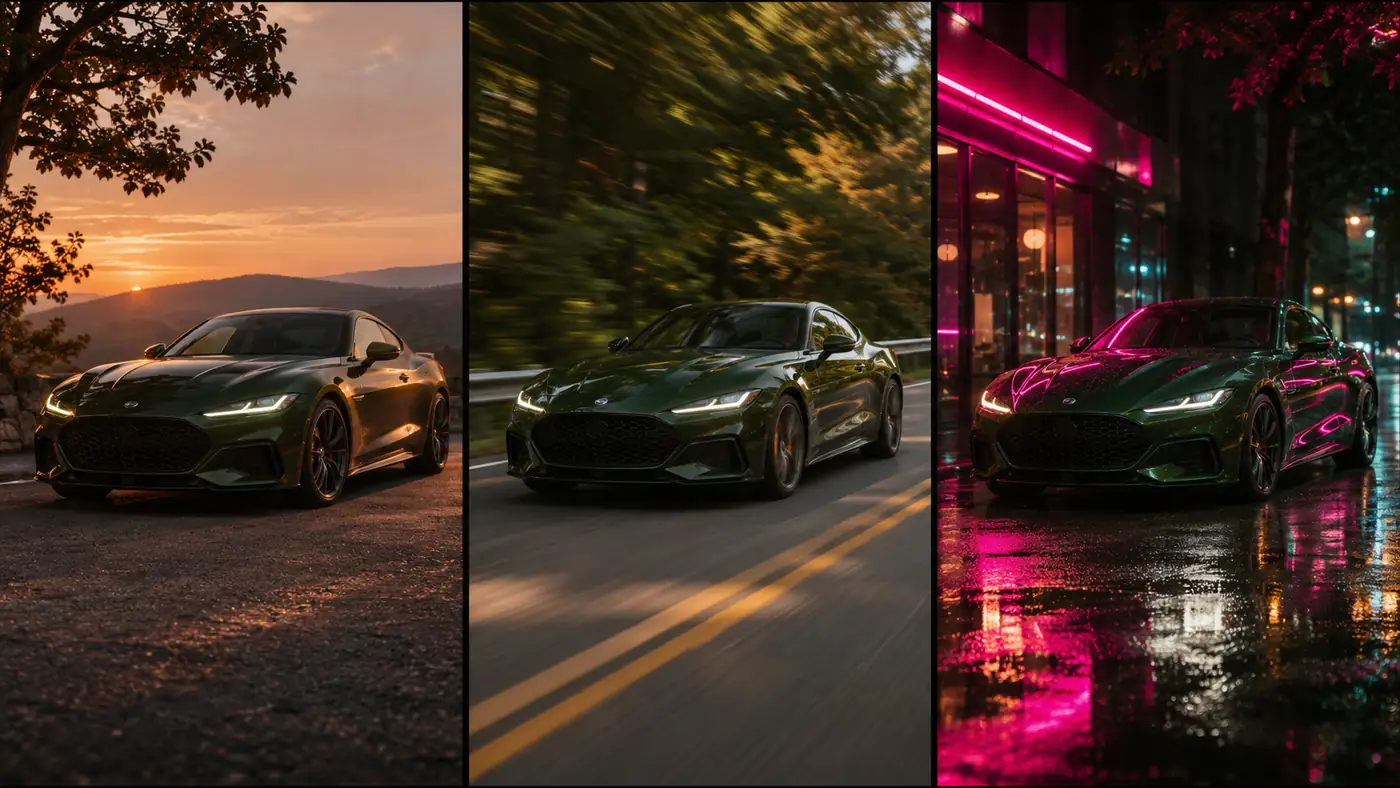
A static shot sells the shape; a rolling shot sells the motion. Static frames use a low angle, a clean background and a long shadow. Rolling frames use a sharp car and a blurred road, with the wheels and background streaking while the body stays crisp.
Describe motion with shutter language: “panning shot, sharp car body, motion-blurred road and trees”. For a static shot, describe stillness: “parked, engine off, long shadow, dust settling”. The two prompts should not share the same motion words.
| Mode | Car | Background | Prompt anchor |
|---|---|---|---|
| Static hero | Sharp, full body. | Clean horizon, long shadow. | Parked on an empty road, low sun, dust in the air. |
| Rolling pan | Sharp body, blurred wheels. | Streaked road and trees. | Panning shot, motion-blurred background, sharp car. |
| Rig shot | Sharp, low angle. | Heavy motion blur. | Low camera rig, speed lines, sharp paint. |
| Night static | Sharp, reflective. | Neon and wet asphalt. | Parked under neon, wet reflections across the paint. |
| Detail | Headlight or wheel. | Out-of-focus environment. | Macro detail, one highlight, shallow focus. |
| Interior | Dashboard and driver. | Street through the glass. | Dashboard glow, rain on glass, night street. |
How do you light a car at night?
Night car photography is a reflection problem again, but the sources are signs, streetlamps and headlights. One long neon reflection across the door can carry the whole image. Two competing colors on the same panel usually look like a video game.
Wet asphalt doubles the light and adds depth under the car. Keep the car itself readable: one bright edge, one dark side and a clear silhouette. If the background is brighter than the car, the shape disappears.
The rain guide covers wet streets and backlit water; the night portrait guide covers source hierarchy for people in the same scene.
How do you build a six-shot car sequence?
A car sequence is six frames: the hero, the front detail, the side profile, the rolling shot, the interior and the departure. The hero sells the shape, the details sell the craft, the rolling shot sells the performance and the departure gives the story an ending.
Keep the car, paint, wheels and environment fixed. Change the angle and the distance, not the world. If the car is on a desert road at dusk in the hero, it should still be the same road at the same hour in the side profile.
| Frame | Job | Angle | Light |
|---|---|---|---|
| Hero | Shape and stance. | Low front three-quarter. | Warm rim, long shadow. |
| Front detail | Grille, headlight, paint. | Close low front. | Defined highlight, dark background. |
| Side profile | Wheelbase and roofline. | Wheel-level side. | Long strip highlight. |
| Rolling | Speed and performance. | Panning side or rear. | Sharp body, blurred road. |
| Interior | Craft and driver. | Through the windshield. | Dashboard glow, ambient night. |
| Departure | Story and aftermath. | Rear three-quarter, wide. | Rim light, dust or rain. |
Which six car briefs should you try?
Six briefs cover the range: the desert hero, the city night, the mountain road, the garage detail, the coastal drive and the rain-soaked street. Each one pairs a body line with a place and a light.
| Brief | Place | Light | Prompt anchor |
|---|---|---|---|
| Desert hero | Empty highway at dusk. | Low sun rim, long shadow. | Green coupe, dust, warm rim, wide sky. |
| City night | Neon street after rain. | Neon reflections, wet asphalt. | Magenta and cyan across the paint, dark sky. |
| Mountain road | Switchback at golden hour. | Side light, long shadows. | Car on the inside line, valley behind. |
| Garage detail | Concrete garage, one lamp. | Hard top light, dark corners. | Wheel and fender detail, dust in the beam. |
| Coastal drive | Cliff road at blue hour. | Cool ambient, warm tail lights. | Car small in the landscape, sea below. |
| Rain street | City street in heavy rain. | Backlit rain, reflected signs. | Sharp car, rain streaks, mirrored asphalt. |
What are common car AI mistakes?
The first mistake is a broken reflection that makes the body look dented. The second is a badge or license plate rendered as text. The third is a generic car that changes shape between frames. The fourth is a background that reflects more than the car.
The fifth is a rolling shot where the car is also blurred. The sixth is a crop that cuts the wheels or the roof. Car photography is a geometry problem before it is a mood problem.
- Broken or chaotic reflections on paint.
- AI-rendered badges, plates or text.
- Car proportions changing between frames.
- A background that competes with the body line.
- A blurred car in a rolling shot.
- Crops that cut the wheels or the roof.
Frequently asked
How do I write a cinematic car AI prompt?
Name the car type and color, the angle, the place, the light and the reflection. For example: “dark green coupe, low front three-quarter, empty desert road at dusk, warm rim light, long highlight along the fender, dust in the air, 35mm.”
How do I get realistic reflections on car paint?
Describe one continuous highlight that follows the body line and a clean reflection source such as a horizon, sky or strip light. Avoid cluttered environments that break the reflection into noise.
What is the best angle for car photography?
Low front three-quarter for aggression, side profile for wheelbase and roofline, rear three-quarter for the shoulder, and wheel-level side for stance. Pick the angle by the line you want to show.
How do I prompt a rolling car shot?
Use motion language: “panning shot, sharp car body, motion-blurred road and trees, blurred wheels”. The car should stay sharp while the environment streaks.
How do I light a car at night?
Use one dominant neon or streetlamp reflection across the paint, wet asphalt for a second reflection, and a dark background so the car’s edge reads. Avoid two competing colors on the same panel.
Can Soul Cinema render a specific car brand?
Soul Cinema renders a generic car shape from your description; it does not guarantee a real make or model. Badges, plates and brand text should be avoided and added only if you have the rights.
Your first cinematic frame is one prompt away
Sign in with Google, pick a plan and keep every still at the resolution the model produced. Plans from $12/month, cancel at any time. No watermark, no re-encode.