
Soul Cinema prompts
Five lines decide the frame: subject, light, lens, palette and grain. How each line works, how to reuse a brief across a sequence, and what flattens a render.
What is the Soul Cinema prompt structure?
Five lines, in the order a cinematographer would ask for them: subject and blocking, light, lens and frame, palette, stock and grain. Everything you leave out is a decision the model makes on your behalf, and everything you add costs you a little control over the rest.
This page covers the structure itself. If you arrived looking for the model-family naming — what “Higgsfield Soul Cinema” refers to and how this site relates to it — that belongs to Higgsfield Soul Cinema explained and Higgsfield Soul Cinema prompts.
How do you write each of the five lines?
Line one is subject and blocking: who is in frame and what they are doing, in one clause. Line two is light: direction, quality and the source that motivates it. Line three is lens and frame: focal length, depth of field, aspect ratio. Line four is palette: name a colour or a hex value rather than a mood. Line five is stock and texture: grain size, contrast, and an explicit request for no digital sharpening.
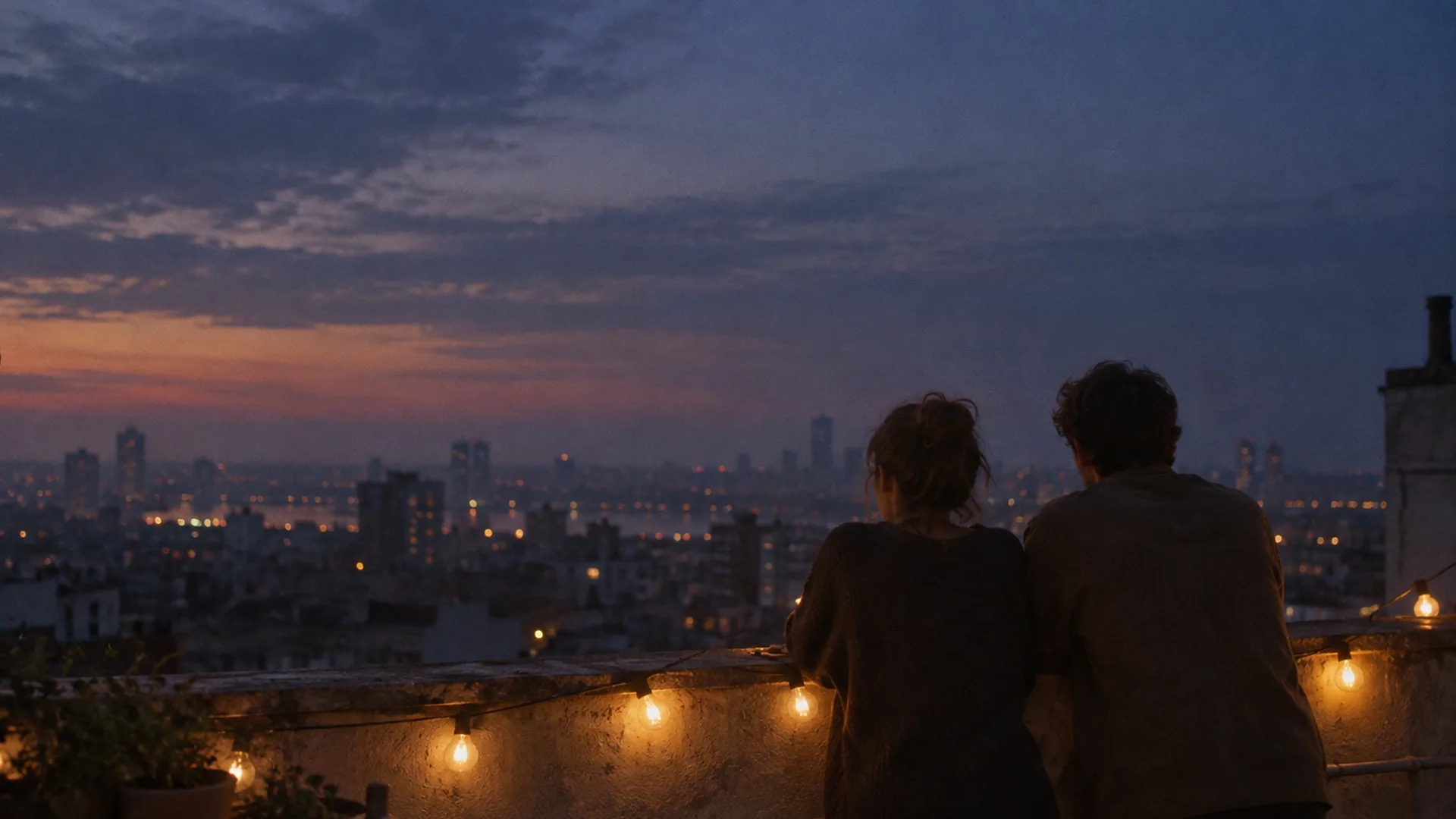
A complete brief fits in three sentences. “Two silhouettes under a red-lit tree at dusk, backlit by the tree, faces three stops down, 35mm anamorphic, shallow depth of field, 2.39:1, crimson key against a slate background, 35mm grain, no digital sharpening.” Every phrase removes a decision the model would otherwise invent.
- Subject and blocking — one clause, no adjectives.
- Light — direction, quality, source.
- Lens and frame — focal length, depth, ratio.
- Palette — a colour or hex, not a mood.
- Stock — grain, contrast, no sharpening.
How do you reuse a prompt across a sequence?
Write the identity sentence and the stock line once and paste them unchanged into every frame. Then change only what a director would change between setups: framing, angle, which side the key comes from, expression. Soul Cinema holds one cast for up to six frames through Soul ID, and palette lock keeps a pinned hex value intact across re-renders at a different size or angle.
Drift almost never comes from the camera; it comes from a prompt that re-describes the person a second way. The failure modes are catalogued in AI character consistency.
Which words change light, lens and grain?
Direction is the highest-leverage phrase you can write: backlit, side-lit from camera left, top-lit, under-lit by a practical. Quality comes second: a soft source wraps, a hard source draws an edge. Colour temperature is third — a tungsten practical sits near 3200K and daylight near 5600K, the balances Kodak publishes for its Vision3 500T and 250D stocks — so naming where the warmth comes from gives the model a motivated source instead of a cast.
For lenses, pick from the working set: 24mm for wide rooms, 35mm for reportage, 50mm for conversation, 85mm for compressed backgrounds and flattering faces, 135mm for isolation. Then name the texture: fine grain for a modern negative, coarse for something older, halation only when you want the highlights to bloom.
What flattens a frame?
Three habits, in order of frequency. First, conclusions instead of instructions: cinematic, moody, epic and 8K describe an outcome the model cannot act on, and they pull toward the bright, evenly lit default. Second, contradictory time of day — golden hour and blue-hour neon in the same line — which averages into neutral flatness. Third, over-describing: a brief that names eleven props and four sources gives the model more chances to invent, and the props it invents are rarely the ones you wanted.
The fix is almost always subtractive. Remove a light source, remove an adjective, keep the two or three things that must be true, and re-render. Test at 2K, where a frame costs one credit, and move to 4K or 8K once the look has stopped moving.
Frequently asked
How long should a Soul Cinema prompt be?
Long enough to answer five questions and no longer — in practice two to four sentences. Everything past that tends to dilute the brief rather than sharpen it.
Do I need the word cinematic in the prompt?
No. Cinematic is a conclusion, not an instruction. Name the direction of the key, the focal length, the palette and the stock, and the finish follows.
Can I save a prompt and reuse it?
Yes — that is what the 40+ locked looks on Pro and Max are: saved combinations of lens, key direction, contrast, grain and palette that apply to every frame in a sequence.
How do I test a look without burning credits?
Render at 2K, where a frame costs a single credit, and change one line per test. Four 2K tests cost the same as one 8K delivery.
Where do I find prompt examples for a specific model name?
The Higgsfield-named questions — what the name refers to, how Soul-style lighting behaves and how to prompt it — are covered in the Higgsfield Soul Cinema prompts guide and the Higgsfield Soul Cinema explainer.
Your first cinematic frame is one prompt away
Sign in with Google, pick a plan and keep every still at the resolution the model produced. Plans from $12/month, cancel at any time. No watermark, no re-encode.