
Soul Cinema prompt examples
Twelve finished shot briefs across noir, neon, daylight and portrait — each one written the five-line way, ready to paste, test and re-render.
How do you use these prompt examples?
Every example on this page is a complete five-line brief — subject and blocking, light, lens and frame, palette, stock and grain — in the order a cinematographer would ask for them. Paste one as-is to see the look it makes, then change a single line per test rather than rewriting the whole brief.
The structure itself is explained in Soul Cinema prompts, and the vocabulary around the model family is covered in Higgsfield Soul Cinema prompts. What this page adds is finished material: twelve briefs across four worlds, written to be rendered rather than read.
Test at 2K — one credit a frame — and move a winning look to 4K or 8K only once it is chosen. Every example is written for a still, not for a moving frame.
Noir and low-key crime
Three briefs that live in shadow: the key is small, the fill is absent, and the frame is allowed to go dark. If a render comes back flat, the cause is almost always an unranked second source — in these briefs there is only ever one winner.
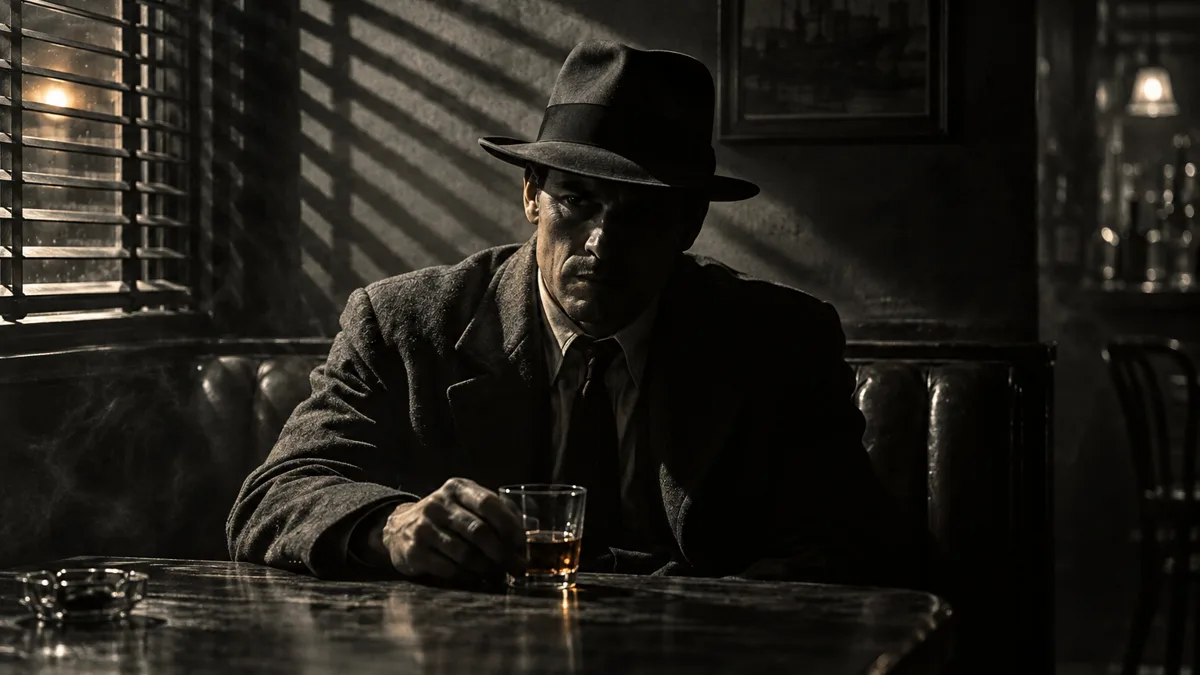
- A detective alone at a corner booth, shoulders square to the table, half the face in shadow. Single hard source from a venetian-blind window camera left, deep shadow on the right, 40mm at chest height, 2.39:1, cold grey-green with one pale amber window slash, monochrome-era stock pushed two stops, visible grain, no digital sharpening.
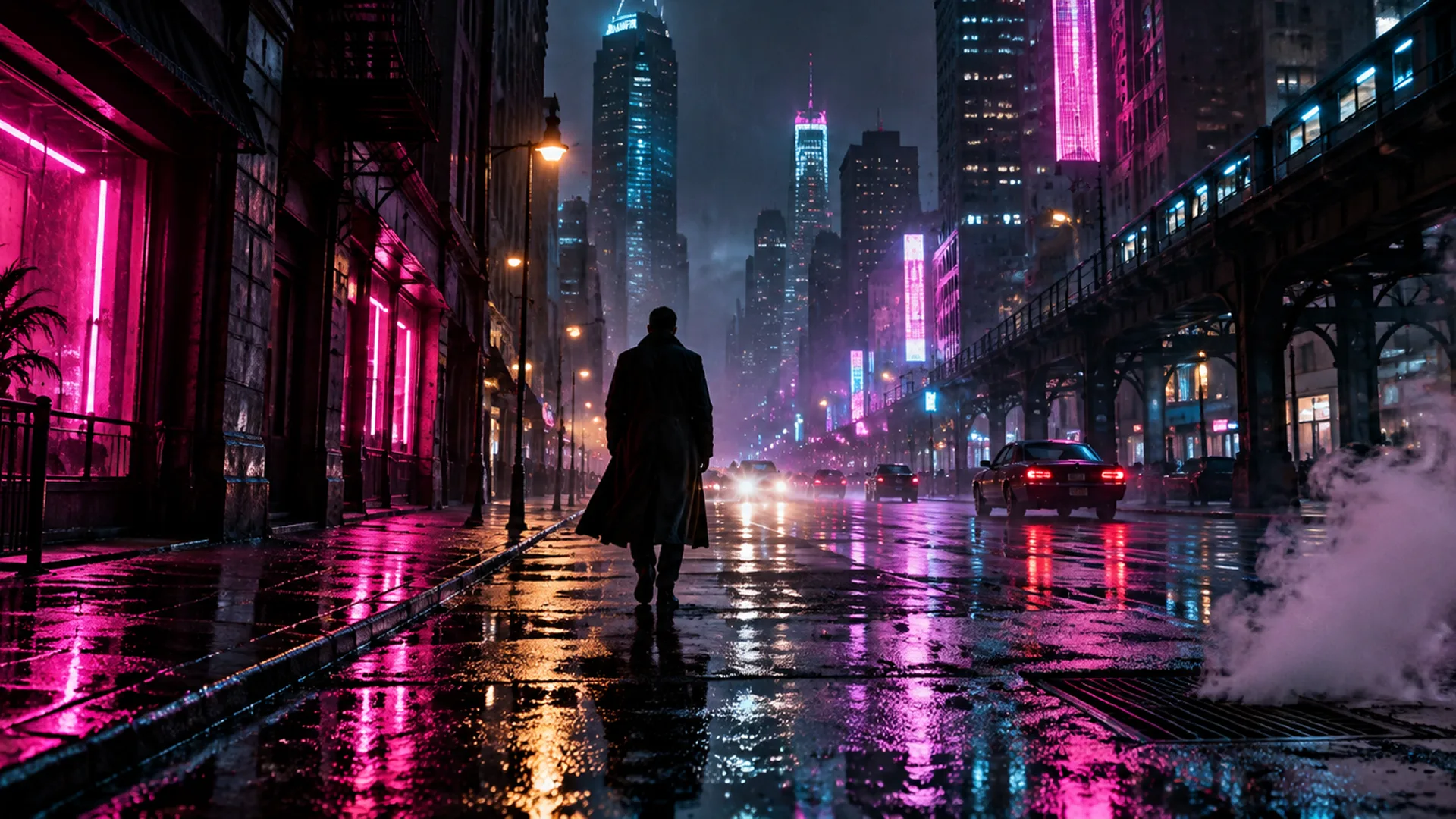
- Two silhouettes under a failing streetlamp in the rain, one walking, one waiting. The streetlamp overhead as the key, wet asphalt catching a rim from behind, 35mm at eye level, warm sodium pools against blue night, 500T stock, medium grain, no digital sharpening.
- A phone call in a parked car, the driver lit only by the screen. Single soft source from below — the phone itself — no fill, 50mm from the passenger side, teal-grey cabin, city signs softened into colour blobs, fine grain, no digital sharpening.
Neon and science fiction
The neon briefs rank their sources in pairs: one key, one rim, and a base colour the accents are allowed to interrupt. Keep the palette line to one base plus two accents; a frame with four competing colours reads as a mistake, not a mood.
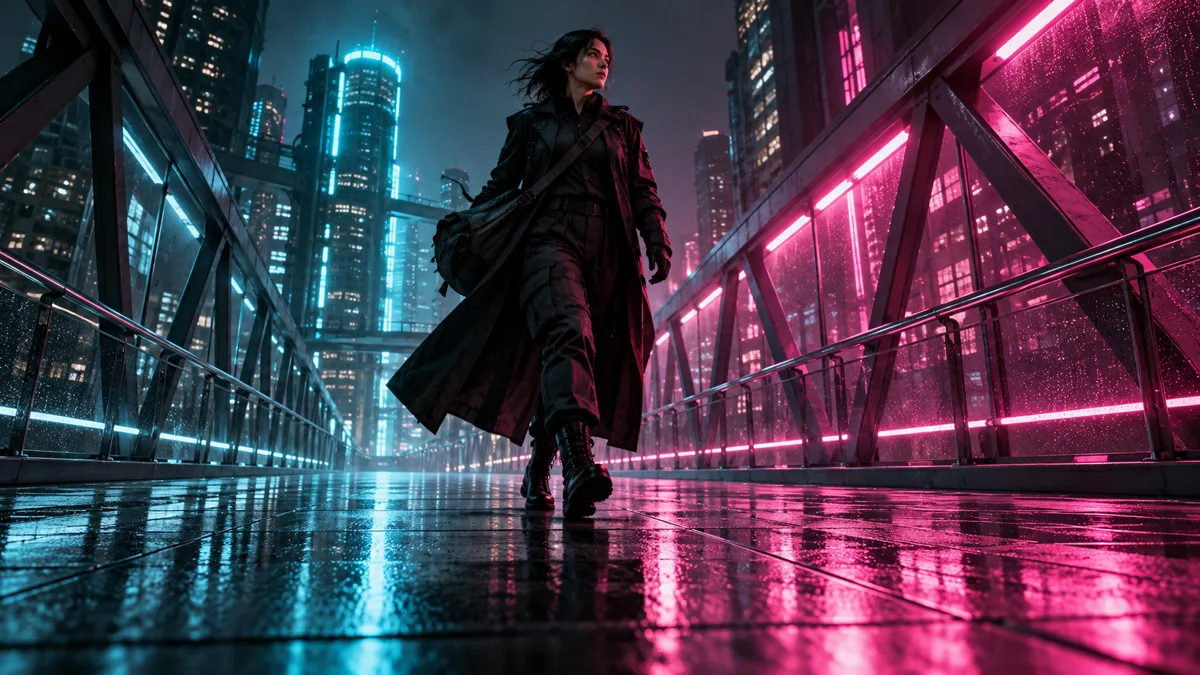
- A courier crossing an empty skybridge, coat moving in the wind. Two neon signs as key and rim — magenta camera right, cyan behind — 24mm from a low angle, wet reflections on brushed steel, deep magenta and cyan on a slate base, modern clean stock with fine grain, no digital sharpening.
- A close-up of a hand resting on a dark console, one fingertip making contact. The console is the only source, cool cyan from below the hand, falloff almost complete at the frame edge, 85mm, chrome and smoked glass, cyan on gunmetal with one amber indicator, fine grain, no digital sharpening.
- A night train platform, one figure waiting, city towers dissolving in drizzle. A vending machine as the warm accent, a mercury platform light as the overhead key, 35mm at eye level, saturated sodium against a desaturated blue-grey, 500T pushed one stop, coarse grain, no digital sharpening.
Period, western and daylight
Daylight is not the absence of lighting decisions — it is a softbox with a colour temperature. In these briefs the sun does the key work through dust or windows, and the fill is whatever wall the location provides.
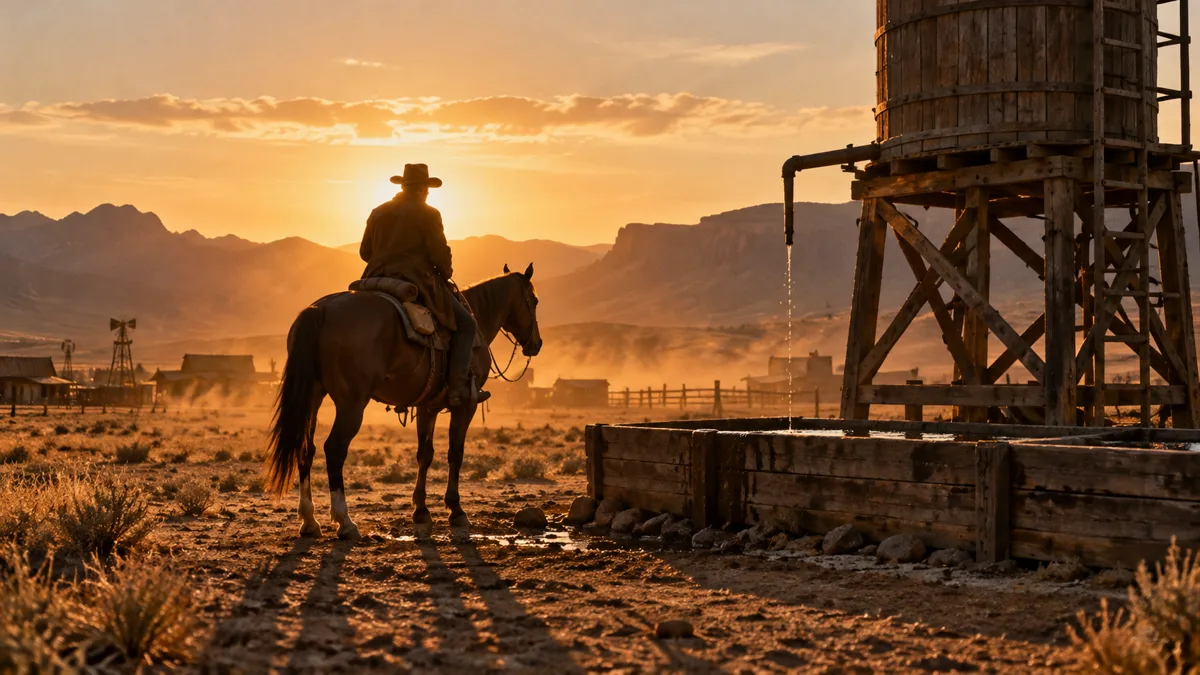
- A rider dismounted at a dry water tank, hat down, dust hanging in the light. Low sun behind-right through the dust, long shadows running forward, 75mm compressed against a flat horizon, burnt ochre and faded denim, 250D stock, medium grain, no digital sharpening.
- A kitchen in a seaside house, two people at a table, late afternoon. A large soft window camera left as the key, white wall as natural bounce, 50mm slightly above the table, bleached linen whites and pale blue, daylight stock, fine grain, no digital sharpening.
- A ballroom doorway at dusk, a woman pausing in the frame. A warm chandelier behind her as backlight, cool evening window as the only fill, 85mm from across the hall, brass and deep green, 500T, medium grain, gentle halation on the highlights, no digital sharpening.
Portraits and quiet frames
A portrait brief is a light brief with a face in it. One source, one direction, one falloff — and a lens close enough that the background becomes texture instead of information.
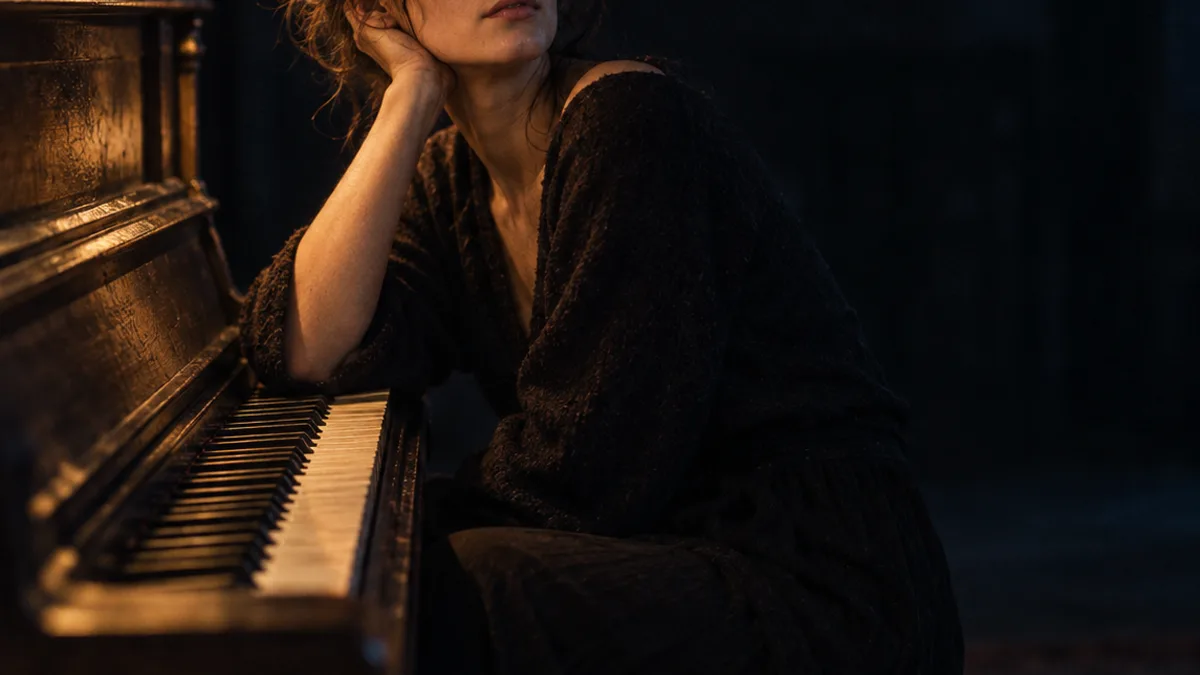
- A musician at the piano after the session, coat still on, looking past the keys. Single warm lamp above and behind camera left, falloff to near-black, 85mm wide open, oxblood coat against dark walnut, 500T, fine grain, no digital sharpening.
- An older fisherman mending a net on a harbour wall, gaze off frame. An overcast sky as a giant softbox — no visible source — 105mm, grey-green sea behind, desaturated palette with one red float, daylight stock, medium grain, no digital sharpening.
- A dancer resting between takes in an empty theatre, one work light on. Hard work light from the wings camera right, rows of seats dissolving behind, 135mm, dusty blue shadows and warm skin, 500T, medium grain, no digital sharpening.
How do you adapt an example without breaking it?
Treat the light line and the stock line as constants and change one camera variable per test: framing, angle, expression, which side the key comes from. If a frame is wrong you want to know whether it was the lens or the light, and you only learn that one variable at a time.
Two habits break these examples. The first is contradiction — pasting a second key or a second palette into a brief that was ranked. The second is dilution: adding mood words back in because the brief looked too plain. The plainness is the instruction.
- Keep the light and stock lines unchanged between tests.
- Change one variable at a time, in writing.
- Never add a second key to a low-key brief.
- Describe colour as values — a hex or a named colour — not moods.
What does a set of these examples cost to render?
Credits are charged per frame by output size: 2K costs 1 credit, 4K costs 2 and 8K costs 4, and failed frames are refunded automatically. Testing all twelve briefs at 2K is twelve credits; taking the four best to 4K costs eight more.
Plans start at $12/month for 120 credits, which is enough for a full afternoon of look tests and the deliverable set that follows. See Soul Cinema pricing for the credit tiers per plan.
Frequently asked
Can I paste these prompts into any Soul Cinema app?
The five lines are the interface: subject, light, lens, palette, stock. Any front end rendering the same Soul model family reads them the same way. On this site they render as-is, at 2K, 4K or 8K.
Do longer prompts render better than these?
No. Each example is about 70 to 90 words because every line removes a decision the model would otherwise make for you. Length without structure just adds contradictions.
How do I keep the same face across different examples?
Lock the cast before you start: Soul ID holds one face and wardrobe across a sequence of up to six frames, so the person in the noir brief is also the person in the portrait brief.
Why do my re-renders drift away from the example?
Usually two reasons: the brief is being re-described rather than reused, and the accent colour is unpinned. Reuse the identity and stock lines unchanged, and pin the accent with palette lock so it survives a re-render at a different size or angle.
Can I sell frames rendered from these examples?
You keep the rights to the frames you render, provided you hold the rights to the people and material you describe. Commercial use for client work is covered by the Max plan’s licence.
Your first cinematic frame is one prompt away
Sign in with Google, pick a plan and keep every still at the resolution the model produced. Plans from $12/month, cancel at any time. No watermark, no re-encode.